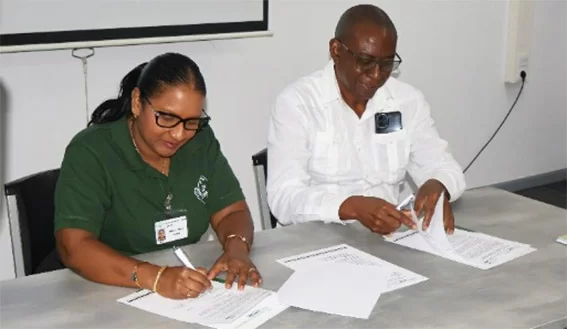
A groundbreaking public health partnership was signed on Friday in Suriname, designed to expand access to local healthcare training and address longstanding staffing gaps in rural regional care. The agreement was formalized by Angèle A. Wallerlei-Kumbangsila, director of EFS College COVAB, and Henk Aviankoi, director of Streekziekenhuis Marowijne (Regional Hospital Marowijne), with Suriname’s Minister of Public Health, Welfare and Labor André Misiekaba in attendance.
For years, Suriname’s healthcare education and clinical capacity have been heavily concentrated in the capital city of Paramaribo, creating a critical shortage of qualified medical personnel in outlying districts like Marowijne. This new collaboration forms a core part of the national government’s policy to decentralize healthcare training, with the explicit goal of improving the resiliency and quality of regional care across the country.
Under the terms of the partnership, students from Marowijne and neighboring districts will now be able to complete their full healthcare training close to home, eliminating the need to relocate to Paramaribo for their education. EFS College COVAB will lead the academic instruction component of the program, while the Marowijne Regional Hospital will serve as an on-site practical training and clinical learning hub for participating students.
Project organizers emphasize that training local students in their home regions significantly increases the likelihood that graduates will remain and work in the area after completing their program. This pattern is consistently supported by global healthcare workforce data, which repeatedly shows that learners trained in their native rural or regional communities are far more likely to build long-term careers in those same underserved areas.
The initiative is expected to deliver a wide range of tangible benefits beyond expanded access. It will boost enrollment of local Marowijne students by removing the financial barriers of long-distance travel and off-site housing costs that have historically prevented many qualified candidates from pursuing healthcare careers. Higher graduation rates are also projected, as students no longer face the added stress of relocation and unexpected living expenses. Over time, the partnership aims to grow the pool of qualified local care workers and create a more balanced distribution of healthcare professionals across the entire nation.
A key infrastructure component of the project is the development of fully equipped distance learning classrooms, which leverage modern educational technology to deliver high-quality instruction without mandatory travel to the capital. By combining local clinical training with connected remote learning tools, partnering institutions aim to make healthcare education more accessible while building long-term, sustainable strength for regional healthcare systems.
Suriname’s Ministry of Public Health has framed the partnership as a critical milestone in building a future-ready national healthcare system, one that integrates academic training, clinical practice, and regional development into a cohesive, community-centered model.