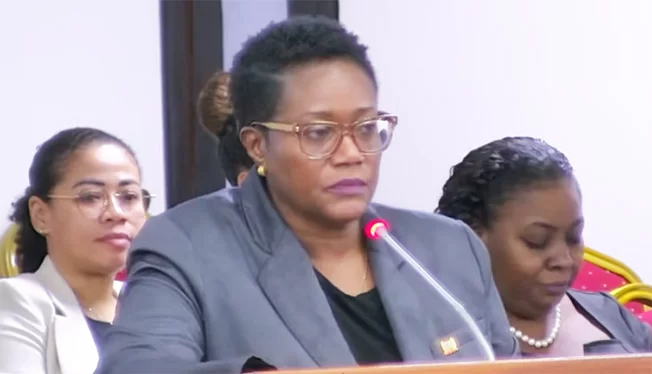
During parliamentary budget discussions held on June 19, Suriname’s Minister of Finance and Planning Adelien Wijnerman responded to pointed questions from members of the National Assembly about the monetary policy framework implemented by the Central Bank of Suriname (CBvS), centering on growing scrutiny over the costs of the bank’s flagship Open Market Operations (OMO) and associated interest expenditures. Lawmakers Jerrel Pawiroredjo from the National Party of Suriname (NPS) and Jennifer Vreedzaam from the National Democratic Party (NDP) raised concerns referencing a critical investigative report commissioned by former president Chan Santokhi, which has put the high costs of the policy under the political spotlight. Minister Wijnerman confirmed that the CBvS disputes the core assumptions underpinning the investigative report, and announced she will hold formal consultations with the CBvS leadership to resolve the disagreement over the findings.
Pawiroredjo argued that the investigation’s findings reveal the Surinamese state has already accumulated billions of Surinamese dollars in interest payments tied to the OMO program. He pressed the government to clarify the fiscal responsibility of these large outlays, asking who will ultimately bear the financial burden, as well as what long-term risks the spending poses to public finances and the broader national economy. For her part, Vreedzaam also raised reservations about the current monetary policy approach, calling on the administration to provide full transparency on the foundational parameters of the OMO cost investigation and how the researchers arrived at the cited spending figures.
Minister Wijnerman emphasized that while she has not publicly disputed the individual spending figures named in the report, the CBvS has confirmed that the analysis is built on incorrect foundational assumptions that skew the final calculations. She pushed back against criticism by outlining the core purpose of the current monetary policy: the ongoing consolidation of macroeconomic stability after years of volatility in Suriname. Wijnerman explained that OMOs have functioned as the CBvS’s primary policy tool to drain excess Surinamese dollar (SRD) liquidity from the domestic banking system. Through term deposit auctions and the issuance of central bank certificates, the central bank has actively pulled excess liquidity out of the market to curb rampant inflation and maintain exchange rate stability. She added that the CBvS has also maintained a 44% cash reserve requirement to reinforce these efforts, and has deployed foreign exchange auctions when necessary to limit extreme volatility in the country’s currency markets.
Data presented by the minister shows that 12-month inflation in Suriname has declined from 11.4% at the end of 2025 to 10.8% in March 2026, with a slight uptick to 10.9% recorded in April 2026. Wijnerman stressed that price trajectories are not shaped solely by monetary policy: government spending levels, private and public liquidity creation, and global developments—including rising energy prices and ongoing geopolitical tensions—all play major roles in shaping domestic inflation outcomes.
On exchange rate performance, the minister noted that the SRD has maintained relative stability in recent months, a result she attributes to a combination of prudent monetary and fiscal policy alongside higher export revenues, driven largely by elevated global gold prices, one of Suriname’s top export commodities. That said, Wijnerman issued a clear warning that the hard-won macroeconomic stability achieved so far remains fragile. She noted that factors including the trajectory of public finances, global commodity price swings, and geopolitical disruptions will continue to shape policy priorities in the coming months. As a result, OMOs will remain a core policy tool for the foreseeable future to manage liquidity growth and preserve hard-won price stability.