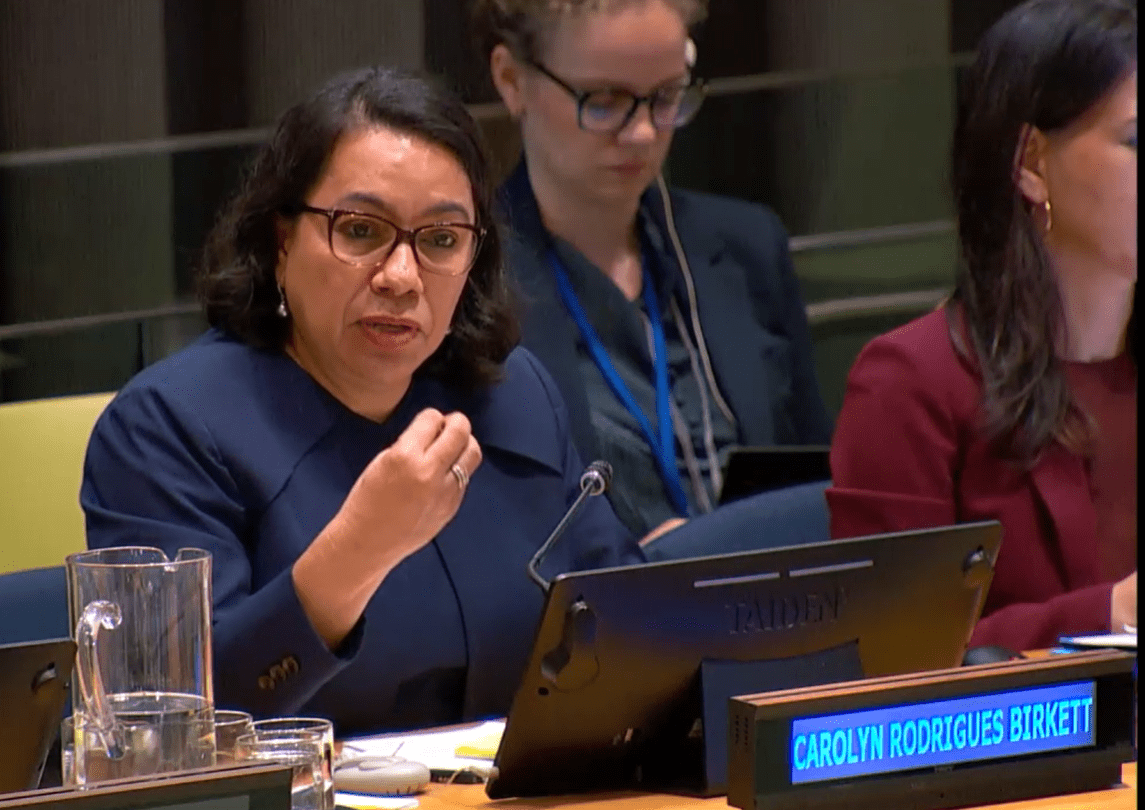
As the race for the next United Nations Secretary-General gains momentum, Guyana’s candidate Carolyn Rodrigues-Birkett has laid out her foundational policy vision during an interactive dialogue with UN member states, centering her argument on the critical link between peacekeeping operations and long-term political settlements. Currently serving as Guyana’s Permanent Representative to the UN and a former national foreign minister, Rodrigues-Birkett is in the running to succeed incumbent António Guterres when his term concludes in December 2026.
During Thursday’s question-and-answer session, Rodrigues-Birkett emphasized that no matter the format of a UN peace operation — from traditional peacekeeping to targeted enforcement missions — military and peacekeeping deployments must act as a stepping stone, not an end goal. “Whether we’re doing a traditional peacekeeping, a certain type of enforcement operation, it must be a means to an end, a means to a political solution, giving a space for a political solution to move forward,” she told attending member state representatives.
Her comments come amid a major ongoing security deployment in Haiti, where the UN Security Council has authorized a 5,500-strong multinational gang suppression force to address the country’s ongoing humanitarian and security collapse. The question that prompted Rodrigues-Birkett’s remarks came from the Dominican Republic, which shares a border with Haiti and has hosted multiple UN peacekeeping missions along its frontier over the past decades. On the topic of evolving peacekeeping models, she noted that member states will need to evaluate a range of proposed frameworks, with the non-negotiable priority of upholding the United Nations’ long-held high standards across any structural adjustment.
A seasoned diplomat with deep multilateral experience, Rodrigues-Birkett previously led Guyana’s delegation during its recent term on the UN Security Council and has also served as a senior director at the Food and Agriculture Organization (FAO). If selected as the next UN chief, she confirmed she would further explore evidence-based options to strengthen global peace operations to match evolving conflict dynamics.
Beyond peace and security, Rodrigues-Birkett outlined additional key planks of her leadership vision. She placed strong emphasis on advancing and protecting global human rights standards, and put forward a new proposal to develop structured payment plans for UN member states that have accumulated outstanding membership dues, a longstanding financial challenge for the organization. She also committed to advancing more balanced, equitable geographic and gender recruitment across UN staff, to better reflect the organization’s global membership.