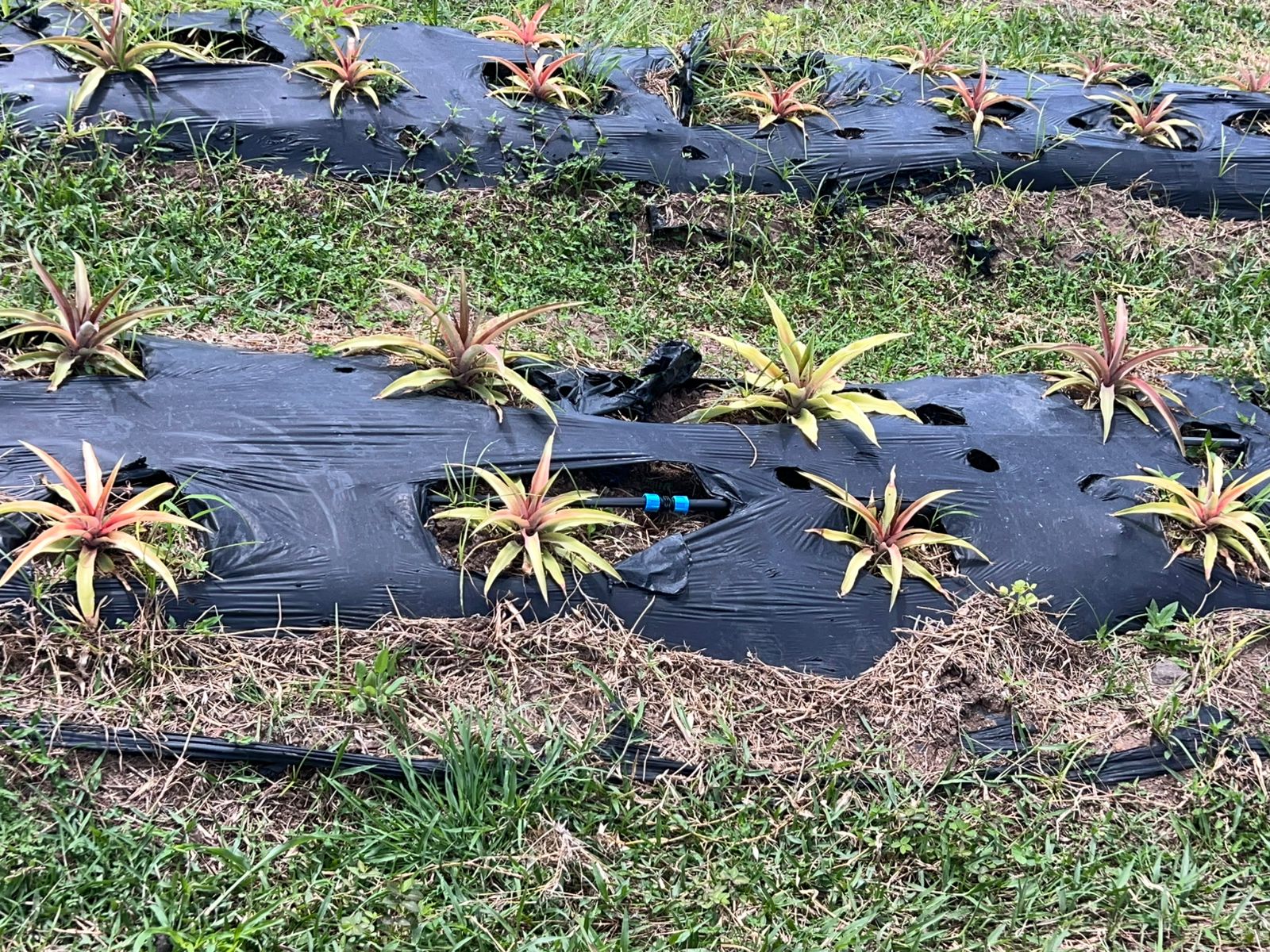
Antigua and Barbuda’s government is ramping up a strategic long-term agricultural initiative to breathe new life into the country’s legendary Black Pineapple industry, targeting propagation of at least 200,000 genetically improved plants to restore the iconic crop’s legacy.
Details of the industry revival plan were formally unveiled during this week’s post-Cabinet briefing on Thursday, where government officials confirmed that a new shipment of 15,000 tissue-cultured Antigua Black Pineapple seedlings is scheduled to arrive on the island in the coming days.
Maurice Merchant, Director General of Communications, explained that the incoming batch of cultivated plants will join an existing 15,000 plants already established at the Cades Bay Agricultural Station, the central hub for the entire propagation project. “Another 15,000 tissue cultures will arrive in the coming days and they will be propagated at the Cades Bay Station,” Merchant stated in his remarks to reporters. “The ultimate aim is to have at least 200,000 Antigua Black Pineapple plants propagated and ready for cultivation at this facility.”
This large-scale expansion is a core component of a broader national program designed to recover and boost production of the fruit, which has long been celebrated as one of Antigua and Barbuda’s most unique and recognizable agricultural exports. For years, local farmers raised growing concerns that decades of cultivation had eroded the crop’s quality, with the fruit failing to reach its signature large size and delivering lower crop yields than in previous generations.
To address these challenges, agricultural officials launched a scientific genetic improvement initiative more than 12 months ago, when roughly 50 original Antigua Black Pineapple samples were sent to research facilities in St. Vincent for tissue culturing and genetic refinement. The scientific process has successfully preserved all the distinct characteristics that make the Antigua Black Pineapple famous, while eliminating genetic degradation and producing high-quality starting material for large-scale propagation.
“The scientific process cleaned up the genetics so it remains the authentic Antigua Black Pineapple,” Merchant emphasized, confirming that the program has achieved its core goal of retaining the crop’s unique flavor and identity while boosting its productivity.
All propagation work is being conducted at the Cades Bay agricultural facility, where young seedlings are multiplied in controlled conditions before being distributed to local farmers for commercial cultivation across the island. Merchant cautioned that pineapples have a naturally long growing cycle, meaning consumers will not see expanded supply hit local and international markets overnight. Even with this timeline, however, government and agricultural leaders are confident the initiative will deliver significant growth in available Antigua Black Pineapple in the coming years, ultimately reviving an industry that is a key part of the country’s agricultural and cultural identity.
“It is anticipated that we should have regenerated growth of Antigua Black Pineapple very soon on the market,” Merchant added.