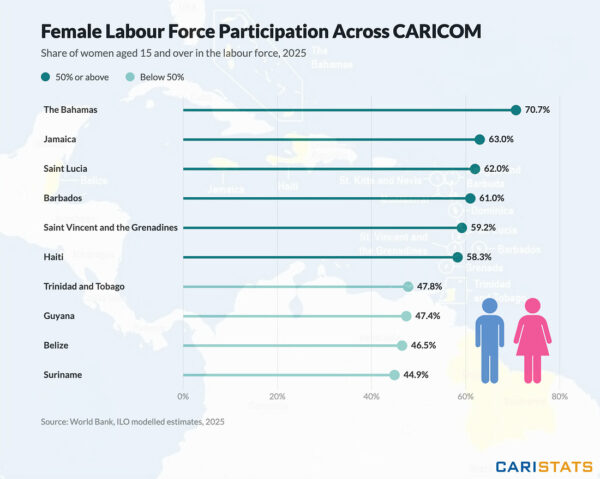
Female labor market engagement stands as one of the most fundamental catalysts for expanding national economic output and boosting household earnings across the globe. Within the Caribbean Community (CARICOM), however, this critical metric shows greater divergence between member states than almost any other key economic indicator, according to the latest 2025 data. When measuring the share of women aged 15 and above who are either actively employed or searching for work, figures span from a low of 44.9% in Suriname to a regional high of 70.7% in The Bahamas. To put this gap in perspective, less than one out of every two adult women participates in the formal labor market in Suriname, while nearly seven out of 10 do so in The Bahamas.
Across the 10 CARICOM member states tracked, six nations record female labor force participation rates above 58%, with The Bahamas claiming the top spot followed closely by Jamaica and Saint Lucia. The remaining four member states fall into a tight cluster between 45% and 49%, with Guyana emerging as a notable success story of gradual growth. Once sitting in the upper 30% range back in 1990, Guyana has lifted its female participation rate to 47% today, marking meaningful progress over three and a half decades.
Disparities are also stark when comparing labor force engagement between women and men within individual CARICOM countries. In two nations, The Bahamas and Barbados, women’s probability of participating in the labor market comes almost level with that of men. The World Bank has highlighted that the gender gap in both countries is actually smaller than the average gap recorded across the world’s group of highest-income economies. At the opposite end of the spectrum, Belize shows one of the widest gender gaps globally, with men far more likely to participate in the labor force than their female counterparts.
Uniquely among all CARICOM member states, The Bahamas achieves two standout milestones: it boasts not only one of the highest female labor force participation rates in the entire region, but also one of the smallest gender participation gaps among all its member nations.