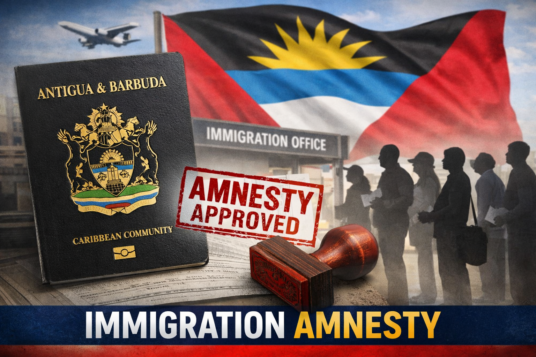
Lawmakers in Antigua and Barbuda have formally passed a landmark bill that opens the door for a targeted immigration amnesty programme, enabling qualifying undocumented migrants already residing in the twin-island nation to bring their immigration status into line with national law over a 60-day period kicking off on July 1.
The 2026 Immigration and Passport (Amendment) Bill secured approval in the country’s House of Representatives this Tuesday. Speaking after the vote, Immigration Minister E.P. Chet Greene framed the initiative as a long-awaited opportunity for eligible non-citizens to step forward voluntarily and resolve their uncertain legal status, rather than remaining in the shadows of the country’s immigration system.
Stretching from July 1 through to August 31, the amnesty window sets clear, specific requirements for all prospective applicants. To be considered, candidates must supply official police clearance records from every country they have lived in over the past four years, a mandate designed to carry out thorough background checks before any status adjustment is granted. Beyond documentation requirements, applicants are also required to pay two separate statutory fees: a $500 processing charge and an additional $150 endorsement fee for the change of legal status, bringing the total fixed cost of participation in the programme to $650.
Repeating the eligibility requirement for parliamentary record during the bill’s debate, Greene confirmed that the four-year, multi-territory police clearance mandate applies to all candidates seeking amnesty under the new framework. To prevent repeated exploitation of the government’s programmatic generosity, the legislation also includes strict eligibility restrictions that block repeat applicants from accessing the initiative. Under the new rules, any individual who has already benefited from three previous immigration amnesty programmes will be automatically barred from qualifying for the 2026 iteration.
“A person who has applied for amnesty on three previous occasions is ineligible and will not qualify for the amnesty extended here and now by the government,” Greene told assembled lawmakers, reinforcing the government’s commitment to balanced, accountable implementation of the programme.
Senior government officials have clarified that the core goals of the programme are twofold: first, to formalize the status of undocumented migrants who already live and work in Antigua and Barbuda, contributing to the nation’s economy and communities, and second, to uphold national security standards by ensuring every approved applicant undergoes mandatory screening before being granted legal status.
This new amnesty legislation forms a central plank of the Gaston Browne administration’s broader push to overhaul and strengthen national immigration administration, bringing a larger share of the country’s resident population into compliance with existing immigration rules and regulations. In the coming weeks leading up to the amnesty’s launch on July 1, authorities are scheduled to release full, detailed guidance on the step-by-step application process to help eligible candidates prepare their submissions.