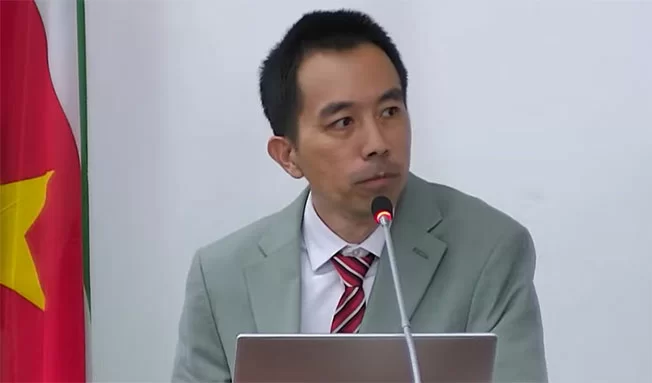
As Suriname’s parliament debates the national budget, a ruling party legislator has sounded the alarm over the country’s overreliance on projected offshore oil revenues to stabilize its public finances, warning that current fiscal planning leaves the nation exposed to significant market and operational risks.
Jeffrey Lau, a member of the National Assembly representing the National Party of Suriname (NPS), told lawmakers during budget deliberations that the government’s debt reduction strategy is built on a heavily optimistic foundation that depends entirely on favorable conditions in the global oil market. Under the government’s current plan, the country’s total public debt is projected to fall below the legal threshold of 60% of gross domestic product (GDP) starting in 2029. But Lau stressed that this projection is almost entirely tied to two core assumptions: that new offshore oil production will come online exactly on schedule, and that global crude prices will remain at profitable levels throughout the projection period.
“This projection only holds under the best-case oil scenario. Without those projected oil revenues, the legal debt target will not be met, which makes the entire debt strategy fundamentally vulnerable,” Lau explained to the assembly.
Beyond the overreliance on optimistic projections, Lau also pointed out that the current fiscal framework lacks any contingency planning for downside risks. These risks include sudden drops in global oil prices, a faster-than-expected global energy transition that reduces long-term demand for fossil fuels, or unexpected delays to the development of Suriname’s new offshore oil projects. To address this gap, Lau is calling on the government to develop and publish a formal stress test scenario alongside its baseline budget projections. This exercise would make clear exactly how slower growth, lower revenues, or higher debt would impact public finances, the annual budget, and long-term debt sustainability, he said.
Lau emphasized that Suriname should not count unearned future oil revenues towards its current wealth, and instead must continue pushing forward with structural economic reforms to diversify the national economy beyond the oil and gas sector. A sustainable, healthy budget does not depend on oil revenues alone, he noted: it requires sound, conservative fiscal policy and a broad, diversified economic base that can withstand shocks to any single industry.
While Lau acknowledged that the emergence of a new offshore oil and gas sector represents a major transformative opportunity for Suriname’s economy, he stressed that responsible governance requires preparing for less favorable outcomes. “We cannot only plan for the best-case scenario. We also need to understand how we will respond when setbacks occur. That is what responsible fiscal policy requires,” Lau told the assembly.