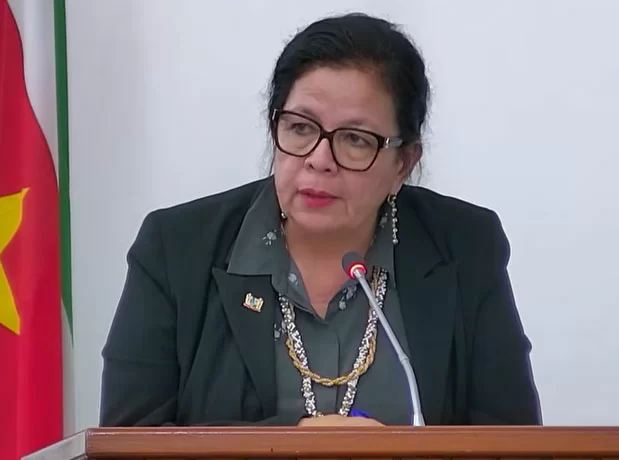
During ongoing budget deliberations in Suriname’s National Assembly, ruling NDP party legislator Jennifer Vreedzaam has sparked a debate over institutional governance, calling out the President’s Cabinet for overstepping its constitutional mandate in policy implementation.
Vreedzaam argues that the President’s Cabinet has strayed beyond its legally defined scope, which she says is limited to policy coordination, progress monitoring and government support. Instead, the body has taken on core responsibilities that the constitution explicitly assigns to individual line ministries, including policy development and on-the-ground execution, she claims.
A well-functioning public sector, Vreedzaam emphasized, depends entirely on three non-negotiable pillars: clear separation of responsibilities, long-term strategic planning, and reliable, accessible data for decision-making. By taking over ministry functions, the President’s Cabinet has disrupted the established governance structure, she contended, opening the door to counterproductive political interference that undermines effective policy delivery.
“Planning is the backbone of responsible policy direction and sound management of public funds,” Vreedzaam told the Assembly during her address. “When the President’s Cabinet steps in to set or delegate policy that rightfully belongs to ministries, it creates systemic barriers to coherent planning and smooth execution.” The lawmaker added that the current arrangement has already bred confusion across government agencies and fostered a reactive, ad-hoc approach to governance that is incompatible with modern public management standards.
To back her position, Vreedzaam cited Suriname’s constitution, which she says clearly delineates the separation of powers and responsibilities between the President’s Cabinet and the Council of Ministers. Nowhere in the founding document, she stressed, is the President’s Cabinet granted authority to formulate or delegate core policy.
“The President’s Cabinet must refocus on its core constitutional mandate: coordinating policy across agencies, tracking implementation progress, and supporting the work of the sitting government,” Vreedzaam said.
The debate comes at a critical juncture for Suriname, which is preparing for a major expansion of offshore oil and gas production that promises to reshape the country’s economy. Vreedzaam warned that current governance shortcomings put the country at risk of mismanaging the expected windfall of hydrocarbon revenues. To avoid this outcome, she said, the public sector must urgently modernize its organizational structure and management practices.
Effective stewardship of future oil revenues will require updated data infrastructure, improved strategic planning frameworks, robust accountability mechanisms, and unambiguous role definition across all branches of government, Vreedzaam argued. She added that the transition to an oil-dependent economy requires far more than financial adjustments: it demands deep, structural public administration reforms to realign governance with the country’s new economic reality.
“If we fail to build the bridge between our outdated governance systems and the demands of this new economic era, the billions in oil revenues will never reach the communities and priorities where they rightfully belong,” Vreedzaam told lawmakers.