Small island nations across the Caribbean are accelerating their transition to low-carbon, climate-resilient economies – and that shift demands a workforce equipped with the right practical skills to fill emerging green jobs. In Saint Lucia, that demand is being met with a landmark new donation of specialized technical equipment to the country’s technical and vocational education and training (TVET) sector, aimed at preparing young people for careers in sustainable development, renewable energy and green entrepreneurship.
The donation forms a core component of two linked international initiatives: the Green & Blue Skills project and the NDC-Tec (Nationally Determined Contributions Technology) Project. It is fully funded by the German Federal Ministry for the Environment through the country’s International Climate Initiative (IKI), with implementation led by GIZ, Germany’s state-owned international development cooperation agency. Beyond Saint Lucia, the NDC-Tec project will roll out similar equipment upgrades to TVET institutions across other CARICOM (Caribbean Community) member states in coming months, supporting a regional push for just transition to green economies.
To date, the programme has already begun delivering new tools to four of Saint Lucia’s leading TVET institutions: the School of Innovation and Technology, the Stanley Jon Odlum School of Arts, Media and Design, the School of Sustainable Agriculture and Culinary Arts, and the School of Construction and Heritage. Some equipment has already been installed at participating campuses, with the remaining shipment scheduled to arrive by the end of this week, according to GIZ’s programme head Ina De Visser.
The diverse equipment package is tailored to build skills across multiple high-growth green sectors of Saint Lucia’s economy. For renewable energy training, institutions received two photovoltaic system trainers that allow students to gain hands-on experience installing and maintaining solar power setups, alongside basic electrical installation training kits to build foundational technical skills. Two electric vehicle diagnostic tools – the centrepiece of the donation, aligned with global shifts toward electric mobility – give students the practical knowledge needed to enter the growing EV maintenance and repair sector.
For the island’s large agriculture and food processing sector, the donation includes two industrial smokers for developing value-added smoked food products such as smoked fish and cured meats, a pulveriser for processing raw cocoa, coffee and grain, and a commercial chocolate melanger to support artisanal chocolate production – a fast-growing niche tourism and export sector for Saint Lucia. The School of Innovation and Technology also received specialized green cooling systems to replace energy-intensive traditional air conditioning, cutting campus emissions while giving students first-hand experience with low-carbon climate control technology. As TVET Education Officer Delthia Naitram explained, the systems address a longstanding campus comfort issue while demonstrating sustainable solutions in action.
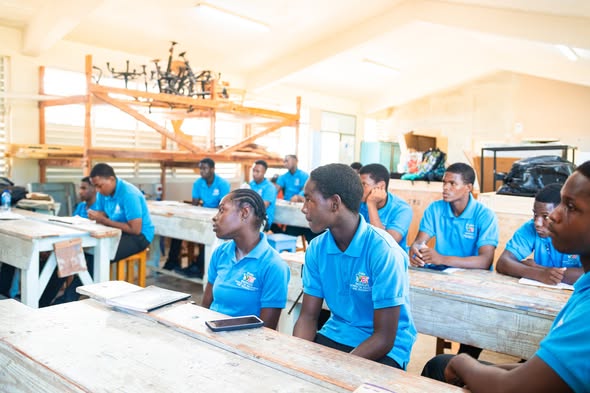
Speaking at an official handover ceremony held at the School of Innovation and Technology’s Anse Ger campus in Deruisseaux, De Visser emphasized the programme’s core goal: to ensure the new tools are fully integrated into training curricula and help close the skills gap for modern green economy jobs. “We hope these items will be used extensively and contribute to preparing the students for modern jobs,” she said.
GIZ Technical Advisor Sarah Stadler added that the initiative does more than deliver equipment: it supports the government of Saint Lucia’s long-term goal of expanding and modernizing the country’s entire TVET sector, aligning training outcomes with national climate and development priorities.
Augusta Emmanuel, principal of the School of Innovation and Technology, echoed that outlook in her address to the ceremony, noting that the new equipment will enable the institution to launch industry-recognized certification programmes tailored directly to current and emerging job opportunities in the island’s growing green and blue economies.
Saint Lucia’s Minister in the Ministry of Education Danny Butcher framed the investment as a critical response to global shifts in the world of work. Rapid technological innovation is reshaping every major industry worldwide, he pointed out, and the transition to electric mobility and clean energy is no longer a distant future – it is already unfolding across the Caribbean. “We must prepare our young people not for the jobs of yesterday, but for the opportunities of tomorrow,” Butcher said.