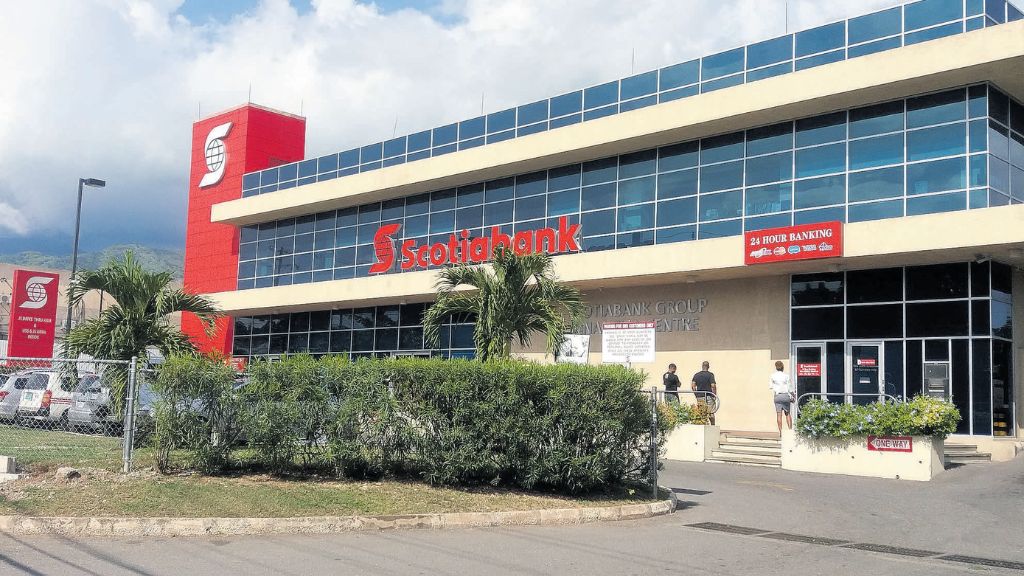
A proposed privatization of one of the Jamaica Stock Exchange’s (JSE) most prominent blue-chip companies is set to deliver a massive $54 billion cash windfall to Jamaican minority investors, but market analysts warn that filling the gap the banking giant would leave in portfolios and the broader exchange will be a far bigger challenge than deploying the new capital.
Scotiabank Caribbean Holdings Limited, which already controls a 71.78% majority stake in Scotia Group Jamaica Limited, has tabled a $61.50 per share offer to buy out all outstanding minority shares to take the dividend-paying banking group private. Based on the more than 878 million outstanding minority-held shares, the total payout to diverse stakeholders — from large institutional investors like pension funds and unit trusts to retail individual shareholders — would hit an estimated $54 billion.
Following the announcement, Scotia’s stock climbed 1.4% or 82 cents to close at $59.40 on Tuesday, still trading $2.10 below the proposed buyout price, putting the company’s total market valuation at roughly $184.8 billion. If the transaction wins approval from minority shareholders and Jamaica’s Supreme Court, Scotia will be delisted, removing one of the JSE’s largest and most liquid domestic financial stocks from an exchange that already has a limited pool of sizable, tradeable companies capable of absorbing large institutional investments.
Industry leaders say the flood of cash from the buyout is unlikely to be reinvested in a single replacement asset, with allocation varying based on individual investor mandates, risk tolerances and prevailing market returns. Richardo Williams, senior vice-president for asset management and head of Barita Fund Managers, explained that while the JSE may appear to have sufficient listed equities on paper, practical constraints narrow the options for large funds dramatically.
“The binding constraint is less likely to be the existence of listed equities and more likely to be investable capacity under investment mandate and risk limits,” Williams shared in emailed responses to *Jamaica Observer*, noting that regulatory and internal rules bar large funds from concentrating too much capital in a single company or industry. Funds also need enough publicly traded shares to absorb large investments without triggering sharp price spikes, meaning many existing listed Jamaican companies are too small, too thinly traded, or already overrepresented in institutional portfolios to replace Scotia’s capacity.
The core challenge, Williams emphasized, is replicating Scotia’s unique value proposition for most investors rather than just finding a single replacement stock. For decades, Scotia delivered a rare combination of consistent dividend income, solid exposure to Jamaica’s financial sector, a proven track record of profitability, and enough trading liquidity to accommodate large position entries and exits. Recreating that balance will require investors to spread their $54 billion in proceeds across multiple stocks, bonds and alternative assets.
The bank’s most recent financial performance underscores its strength: it reported $10.1 billion in net income for the six months ending April 30, up from $9.2 billion in the same period a year prior, and its board recently approved a second interim dividend of 45 cents per share.
Davie Martin, general manager for trading and treasury at JMMB Group, echoed the concern that Scotia’s departure will shrink viable options for investors prioritizing liquidity and regular dividend income. Last year, roughly 26.4 million Scotia shares traded hands, compared to 117 million for NCB Financial Group and 19.6 million for Sagicor Group Jamaica. Data shows that the top 10 shareholders of Scotia control more than 82% of the company, with most non-controlling stakes held by long-term holders like pension funds, leaving only a small portion of shares actively available for trading at any given time.
“If the deal goes through, then minority shareholders will have to seek appropriate alternative investment options, which could be difficult, especially in the sizes required by institutional investors,” Martin told *Business Observer*.
If a large share of the buyout proceeds stays within Jamaican equities, Williams warned, it could create upward price pressure on the small pool of remaining large-cap blue-chip stocks, increasing portfolio concentration in a handful of companies and pushing down dividend yields for new buyers unless those companies raise their payouts. Martin added that the current market environment of higher interest rates, global economic uncertainty, and muted domestic equity valuations has already pushed many investors toward fixed-income assets like government and corporate bonds, meaning a portion of the Scotia windfall is likely to flow into assets outside the domestic stock market rather than back into JSE listings.
The proposed delisting also raises a broader question about the JSE’s ability to replace major listed companies when they exit. Based on current market values, Scotia accounts for roughly 10% of the JSE Main Market’s total capitalization, meaning its exit would remove one-tenth of the market’s value if other prices hold steady. Over the past decade, 12 companies have been delisted from the JSE with a combined pre-delisting market valuation of roughly $123.67 billion — nearly 50% less than Scotia’s current $184.8 billion valuation. While the exchange added 16 new Main Market listings over that same period, none have approached Scotia’s size, liquidity and market role. Martin noted that based on the past two years of listing activity, a direct replacement of Scotia’s scale is unlikely to come to the JSE quickly.
In explaining the rationale for the deal, Scotiabank said taking the company private will boost capital and operational efficiency, allowing the group to respond faster to market opportunities, with no material changes to Scotia’s ongoing day-to-day operations in Jamaica. Martin noted that privatization deals typically follow similar logic: majority owners benefit from reduced public reporting requirements and greater flexibility to make long-term strategic decisions, and often move to buy out minority stakes when they believe the public market is undervaluing the business.
This rationale mirrors the 2018 privatization and delisting of Cable & Wireless Jamaica, where the controlling owner cited low trading volumes, reduced administrative and compliance burdens, and simplified group structure as core justifications for the buyout. While Scotia’s deal has a different structure, the underlying logic of full integration over retaining a public minority listing aligns with prior Jamaican privatization transactions.
Since the buyout announcement, Scotia shares have climbed steadily: jumping 7.78% or $4.22 to $58.43 the Friday after the announcement, adding 15 cents on Monday, and rising a further 82 cents to close at $59.40 on Tuesday. Williams advised shareholders to wait for full transaction documents and independent valuations to assess the fairness of the $61.50 offer against Scotia’s historical performance, balance sheet value, future growth prospects and dividend track record. Beyond valuation, he added, shareholders must weigh the certainty of an immediate cash payout against the potential long-term gains of retaining an ownership stake in the business.
With regulatory and shareholder approvals still pending, the immediate debate centers on whether the offer fairly values Scotia’s shares. For Jamaica’s national stock market, however, the bigger, longer-term question is what will fill the gap left by one of its most important listed companies, if any replacement can be found at all.