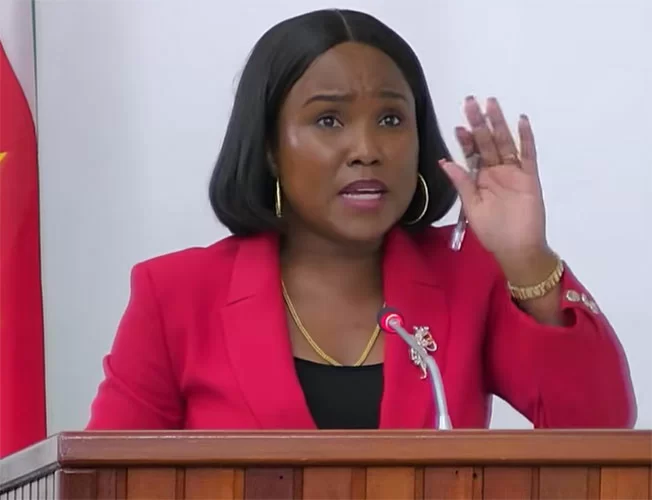
During ongoing parliamentary deliberations over the national government budget, Member of the National Assembly Silvana Afonsoewa of the NDP party has called for a rigorous, critical review of public spending, arguing that scrutiny must extend beyond total expenditure figures to verify that tax revenues actually reach their intended purposes.
Afonsoewa drew legislators’ attention to the key fiscal projections laid out in the 2026 budget plan, which forecasts total government expenditures of 77.5 billion Surinamese dollars against projected revenues of just 64.6 billion Surinamese dollars. Under the current framework, this substantial deficit would once again be covered through new borrowing, a move that will only add further pressure to the country’s already strained national debt load. To address this structural challenge, the parliamentarian stressed that three core priorities remain non-negotiable: improving tax collection capacity, strengthening overall public financial management, and keeping national debt growth at a manageable level.
She further noted that the vast majority of the 2026 budget is already allocated to fixed recurring costs, including public sector salaries, state subsidies, operational government expenses, and existing debt repayments. This leaves remarkably limited fiscal room for new infrastructure and social investments that would directly benefit the broader Surinamese public. In response, Afonsoewa has called on the sitting administration to publish clear, transparent targets outlining what outcomes it intends to deliver with the public funds at its disposal.
As part of her address during the budget debate, Afonsoewa raised multiple targeted questions about specific line items in the proposal, seeking greater clarity on several high-priority spending areas. She pressed for details on how additional allocated funds for social welfare programs will be distributed on the ground, exactly what initiatives fall under the vague budget line labeled “special projects,” and which road and infrastructure projects are actually scheduled for completion this year.
She also highlighted the long-running unresolved issue of traffic and infrastructure problems on Van ’t Hogerhuysstraat, pointing out that repeated explanations from relevant government agencies have done little to improve daily life for local residents, so long as the road itself remains unrepaired and congestion issues persist.
Beyond infrastructure and social spending, the assembly member demanded transparency around budget allocations for school renovation and new construction projects, as well as updates on the implementation of previously announced education initiatives that have yet to break ground.
Afonsoewa also voiced growing concerns over the management of public sports facilities across the country. She noted that the national government invests significant sums of public money into renovating and maintaining these venues, yet there is little public visibility into the revenue streams generated by facility operators. To resolve this gap in accountability, she called for strengthened oversight and mandatory public reporting for all funds related to sports venue management.
In closing, Afonsoewa emphasized that the government must enforce far stricter oversight over both the collection and spending of all public funds. She concluded her address by reiterating her call for greater fiscal transparency, stronger control mechanisms, and more efficient public financial management – changes she says are critical to ensuring that taxpayer money actually delivers tangible benefits to national development and the Surinamese people.