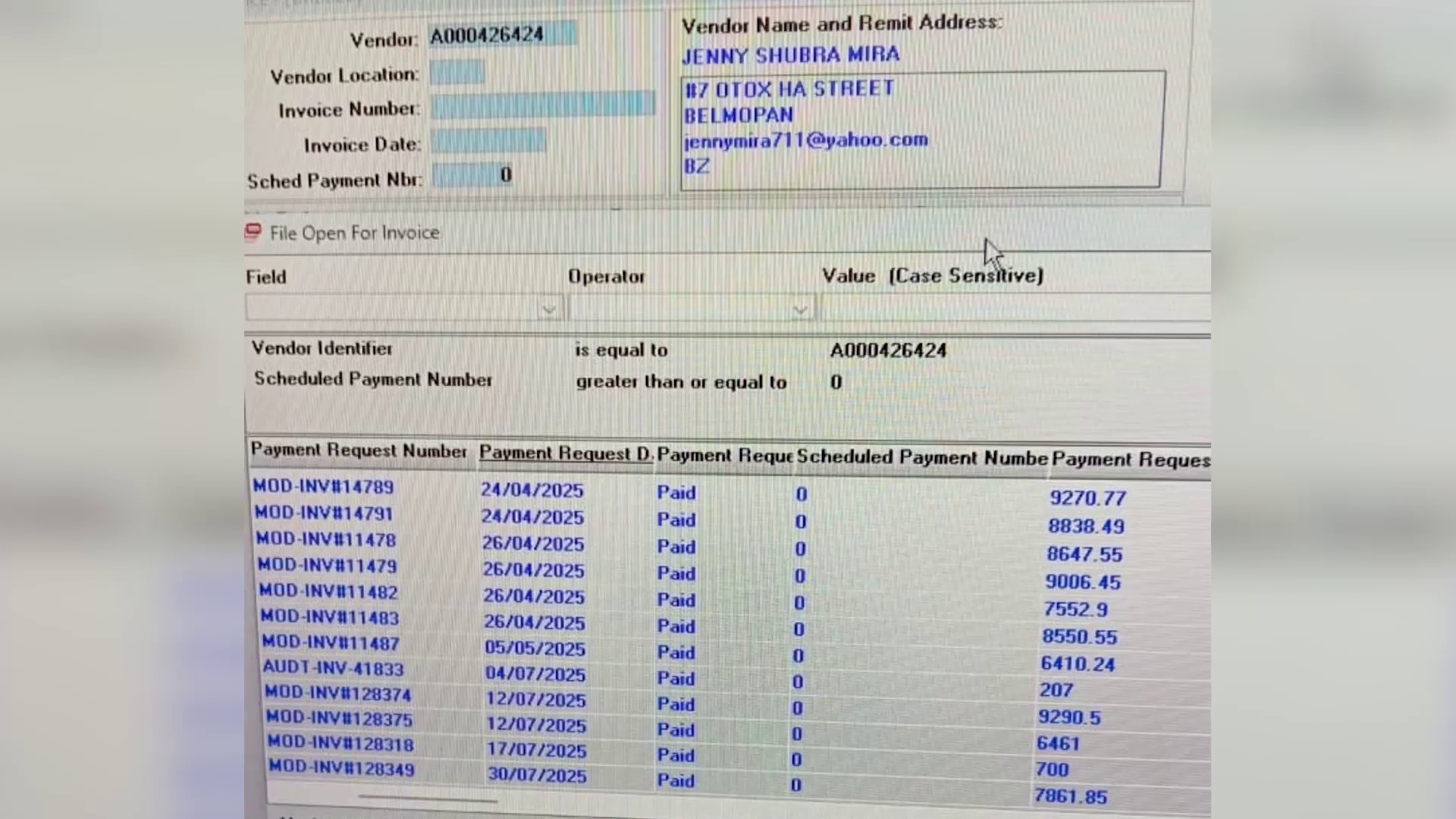
A brewing public spending controversy in Belize has escalated far beyond an initial single case of suspicious payments, with the country’s top public service union leader now calling for a full, cross-government investigation into what he calls deeply rooted, systemic corruption in state procurement processes.
The scandal first came to public attention when it was revealed that more than $1.7 million in public funds had been disbursed to Jenny Mira, sister of Minister of State Oscar Mira, in contracts awarded through the Ministry of National Defense. While ministry officials have defended the awards and insisted all contracted goods and services were delivered as agreed, public scrutiny has refused to die down, and has now expanded to question procurement practices across the entire government.
Speaking in an on-the-record interview with local outlet News Five, Public Service Union (PSU) President Dean Flowers argued that the Mira family contracts are just one visible thread of a much broader pattern of abuse. He pointed to a wide web of ongoing business interests tied to the minister and his extended relatives, with family members holding contracts across multiple sectors: from his sister’s vegetable supply contracts, to brothers’ holdings in air conditioning services and construction, to in-law-led firms winning roadwork projects. Flowers questioned how the minister’s family was able to finance the construction of a private gated community, raising implicit questions about the source of their wealth from public sector contracts.
Francis Usher, Chief Executive Officer of the Ministry of National Defense, pushed back against the allegations, defending the Mira family’s long history as government suppliers. He confirmed the family has provided produce to the Belize Defence Force and Coast Guard dating back to the early 2010s, years before the current administration took office, and emphasized they have been consistent, reliable partners over that time. Usher also rejected claims of payment fraud, stating, “There is nothing that is being paid for that is not being provided,” pushing back against long-running unconfirmed complaints from service members about substandard or insufficient rations.
On the widely noted practice of splitting large invoices into amounts just under the $10,000 threshold that triggers mandatory additional oversight from the Treasury Department and Ministry of Finance, Usher denied that government officials ever instruct suppliers to split contracts to avoid scrutiny. He suggested suppliers independently adopted the practice because it speeds up payment processing, as lower-value contracts do not require multi-layered approval from additional government bodies.
Flowers, however, remains unconvinced by the ministry’s denials. Drawing on his decades of experience working in Belize’s public service, he argued that official records frequently do not align with on-the-ground realities, a pattern well-known to the country’s Auditor General. He pointed to a previous confirmed scandal at the Ministry of Transport, where the government paid for high-end air conditioning units but received cheaper, lower-quality models instead, as an example of the kind of fraud that systemic weak oversight enables.
The PSU president also pushed back against Usher’s claim that all contracted goods have been delivered, questioning how the CEO could personally verify every delivery made across thousands of contracts. He called on Belize’s top independent oversight officials—including Maria Rodriguez, Teresita Miranda, and Maria Arthurs—to launch a full investigation and prove their commitment to protecting public funds and Belizean taxpayers.
Flowers also expanded the scope of accountability beyond elected ministers, arguing that long-tenured public finance officers are often the enablers of these corrupt practices. He claimed that new politicians and CEOs entering government are frequently introduced to end-runs around oversight rules by career public officers, who then allow the practice to be exploited to redirect public funds into private hands. To advance the investigation, the PSU has already filed formal Freedom of Information requests to obtain full procurement records from the Accountant General, Auditor General, and Contractor General. Flowers stressed that the probe must examine not just political leaders, but the public officials who processed the questionable transactions.
The unfolding scandal has sparked growing public demand for transparency and accountability around the management of public funds in Belize, with the outcome of the requested investigation expected to set a major precedent for government oversight reform going forward.