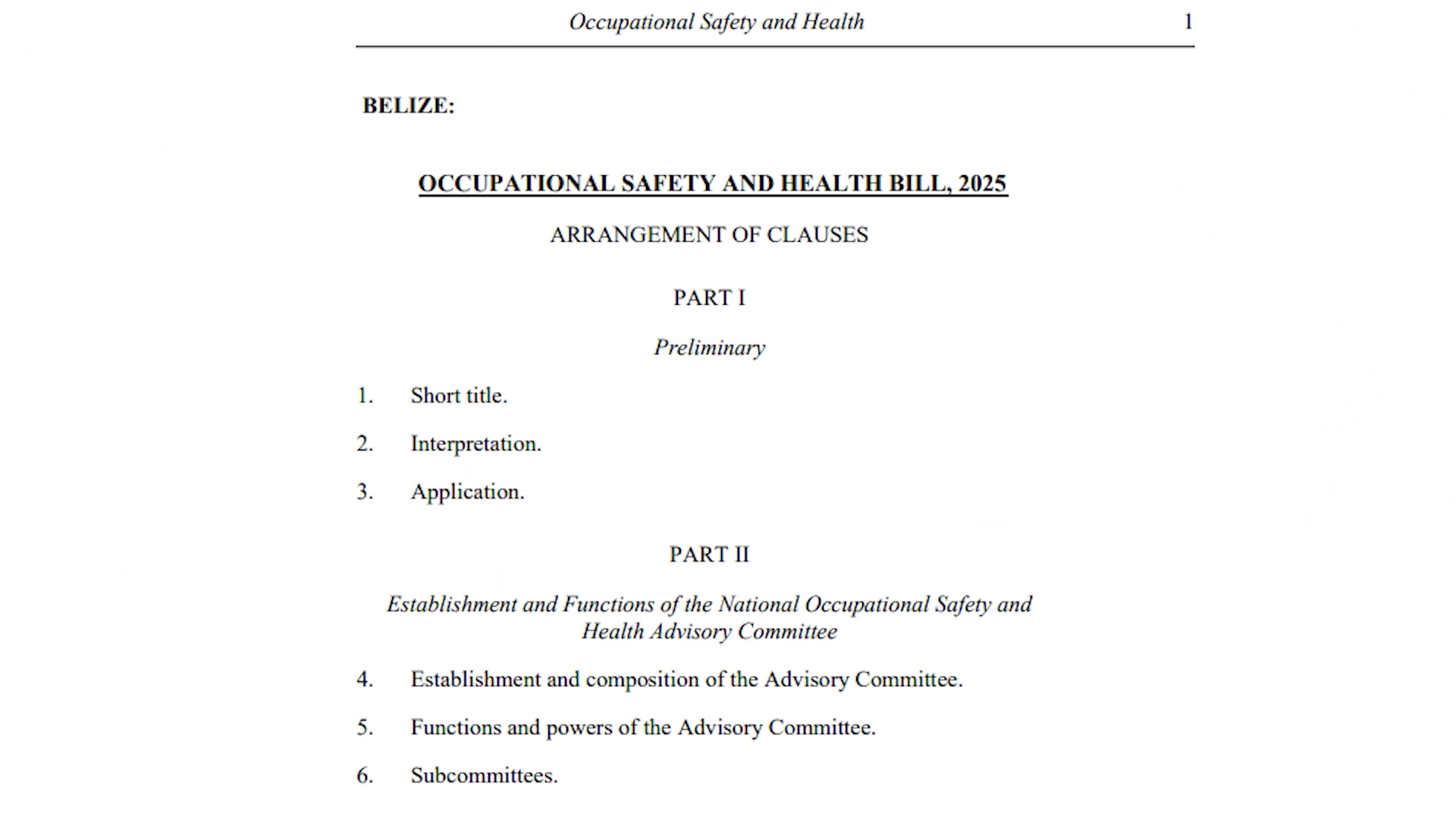
For more than 14 years, Belize has been working to update its workplace protection framework through a new Occupational Safety and Health (OSH) Bill, but the long-awaited legislation has hit a major deadlock in the country’s Senate, leaving the future of worker protections uncertain.
The bill successfully cleared the House of Representatives in February 2026, but just weeks after that milestone, it encountered unresolved disagreements over core policy provisions that have halted its progress. Senate lawmakers have pushed back against advancing the bill in its current form, arguing that it still contains critical flaws and internal contradictions that require revision before it can be enacted into law.
The prolonged delay has sparked growing concern among advocates for worker safety, who warn that every additional setback leaves thousands of Belizean workers vulnerable to unregulated on-the-job hazards without access to modern, comprehensive legal protections. Despite these concerns, social partners involved in the legislative process have maintained that taking the time to craft a well-designed, functional law is a better approach than rushing flawed legislation into effect.
To clarify the barriers moving the bill forward and the government’s position on the delay, local reporters pressed Attorney General Anthony Sylvestre for details on the impasse. Sylvestre, the government’s top legal advisor, explained that the hold-up centers on a controversial policy provision that would extend OSH regulations to domestic workers, placing private households that hire domestic staff under the same regulatory scrutiny and legal liability requirements as large, established business operations.
Sylvestre emphasized that the government does not oppose extending protections to domestic workers, but argues the current framework of the bill creates unworkable practical burdens for ordinary private employers. “The reality is that it may be difficult for a person who hires a domestic to be able to meet that same standard,” he told reporters, noting that the government’s current position is not an impulsive decision, but the result of more than a decade of careful deliberation among stakeholders. “That is a sensible approach,” he added of the push to revise the problematic provision before moving forward.