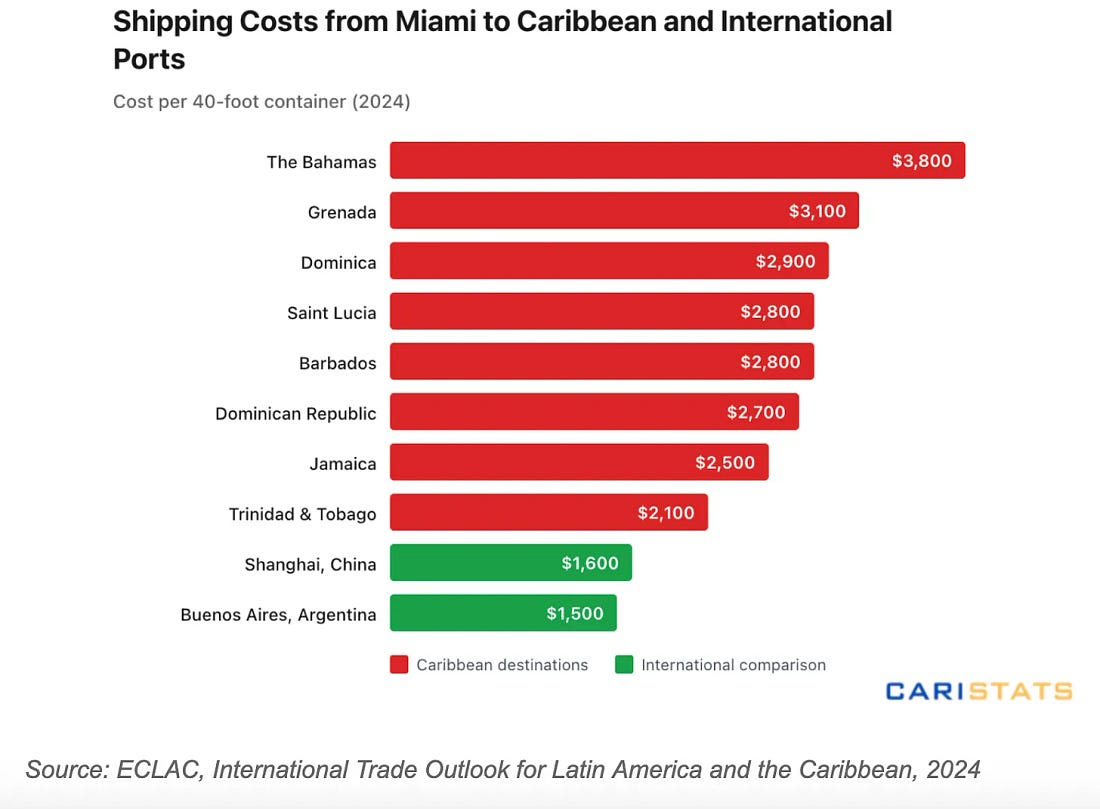
A counterintuitive pricing trend uncovered in the 2024 Economic Commission for Latin America and the Caribbean (ECLAC) International Trade Outlook has laid bare deep structural flaws in the Caribbean’s maritime logistics network: shipping costs to nearby island nations from major North American hubs are often far higher than freight charges for far-flung global ports thousands of kilometers away.
Consider this staggering example: moving a standard 40-foot container from Miami, Florida to The Bahamas – a journey of just 144 kilometers – comes with a price tag of $3,800. That is more than double the $1,600 it costs to ship the exact same container all the way to Shanghai, China, a port located nearly 15,000 kilometers across the Pacific Ocean. ECLAC analysis shows this lopsided pricing pattern is not an isolated anomaly; it plagues nearly all port facilities across the Caribbean region, with only a handful of exceptions.
Multiple interconnected structural challenges drive this so-called Caribbean maritime paradox. First, decades of underinvestment have left most regional port infrastructure ill-equipped to handle the larger, modern container vessels that dominate global trade today. Limited annual cargo volumes at smaller Caribbean ports push per-unit operational costs sharply higher, as carriers are forced to spread fixed expenses across far fewer shipments. Second, infrequent shipping routes – most small island nations only receive weekly service at best – make it impossible to efficiently consolidate cargo, a particular problem for regional exporters of perishable agricultural goods who cannot wait for larger loads to fill available container space.
This gap in global connectivity is confirmed by the United Nations Liner Shipping Connectivity Index, which shows nearly all Caribbean nations rank well below average for regional maritime infrastructure, with only Jamaica and the Dominican Republic bucking the trend. Compounding these issues is extreme market concentration: just a small handful of major shipping lines control most regional routes, allowing carriers to keep prices artificially high. Many of these routes also see ships returning north to North American hubs empty after dropping off cargo, meaning carriers must charge higher import fees to offset the lost revenue from the return leg of the journey.
In the most extreme cases, ECLAC estimates that freight costs from Miami to some small Caribbean destinations can reach four times the cost of shipping the same container to Argentina, Uruguay, or even mainland China. The ripple effects of these inflated shipping costs extend far beyond the logistics sector, hitting everyday consumers hardest. ECLAC links these elevated transport costs directly to the Caribbean’s status as the region with the world’s highest cost for a nutritionally adequate diet, where the average daily cost to access healthy food hits $5.16 per person.
To address this decades-long crisis, regional governments are moving forward with a landmark infrastructure intervention: a joint Barbados-Guyana regional food distribution hub, currently under construction and scheduled for completion in 2026. The project aims to consolidate cargo flows across the region, improve route efficiency, and create enough volume to drive down per-unit shipping costs for food imports and regional exports alike. As of 2024, this hub stands as the most ambitious coordinated effort to untangle the structural knots that have left the Caribbean facing its counterintuitive and economically damaging pricing paradox.
This analysis draws on data from CARISTATS, a free public data archive that draws on ECLAC’s 2024 trade outlook report. CARISTATS operates on a voluntary support model, inviting readers to pledge future subscriptions to sustain its work, with no charges levied until payment systems are formally activated.