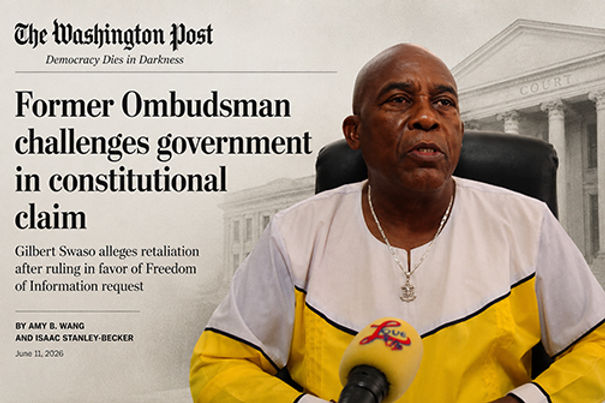
A high-stakes constitutional dispute has erupted in Belize after retired Major Gilbert Swaso, the nation’s former Ombudsman, launched a formal legal challenge against the government, accusing authorities of violating the constitutionally mandated independence of his former office by refusing to renew his appointment. Court documents submitted earlier this week detail Swaso’s allegation that the government’s decision to end his tenure was an act of retaliation tied directly to a landmark Freedom of Information (FOI) ruling he issued that ordered the disclosure of public records. That ruling centered on a request from activist and public-interest lawyer Jerry Enriquez, who sought transparency around millions in public funds paid by the government to private attorneys working on high-profile redistricting litigation. After Swaso ruled in favor of releasing the requested payment records, the Attorney General’s Ministry immediately contested the decision before the Court of Appeal, where the appeal remains unresolved as of 2026. According to the legal claim, tensions boiled over during a December 2025 meeting between Swaso and Minister of Public Service, Constitutional and Political Reform Henry Charles Usher. During that closed-door session, Swaso was reportedly confronted about the FOI ruling and a second separate report he had completed. Just 48 hours after that meeting, Swaso says he received formal notification that his appointment would not be extended when his term expired at the end of December 2025. The core of the constitutional challenge argues that the non-renewal of Swaso’s term is not just a personnel decision—it represents unlawful political interference in a constitutionally protected independent office, eroding the fundamental guardrail that allows the Ombudsman to operate free from partisan pressure. Swaso is asking the Supreme Court to issue formal declarations confirming the constitutional independence of the Ombudsman’s Office and ruling the government’s actions illegal. Beyond the tenure dispute, the lawsuit also raises serious questions about unpaid compensation, alleging Swaso never received the salary and benefits guaranteed to the office under existing Belizean law. The current Ombudsman Act, in Section 8(1), explicitly mandates that the Ombudsman’s emoluments must be no less than those paid to a Supreme Court Judge. In a parallel development that adds context to the dispute, the government tabled the Ombudsman (Amendment) Act 2026 in March 2026, which proposes repealing the existing Section 8(1) and removing the mandatory minimum salary provision tied to Supreme Court judicial pay. If passed, the amendment would leave the Ombudsman’s compensation entirely open to future adjustment by legislation or National Assembly resolution, a change that critics warn could further increase political leverage over the office. As the legal challenge moves forward, the Ombudsman’s Office remains unfilled more than 160 days after Swaso’s term expired at the end of 2025. This prolonged vacancy has already disrupted core functions of the office, including ongoing Freedom of Information proceedings that rely on the Ombudsman’s oversight. Under Belizean law, the Ombudsman serves as a critical independent watchdog tasked with investigating complaints against government departments and public authorities, covering everything from maladministration and abuse of power to corruption and disputes under the Freedom of Information Act.