Two parallel constitutional and legislative shifts are unfolding in Belize, where changes to pay rules for the nation’s top independent oversight offices have sparked debate over institutional independence and government accountability. The developments come as former Ombudsman Major Gilbert Swaso proceeds with a constitutional legal challenge against the Belizean government, centered on disputed compensation claims from his time in office. At the same time, Belize’s National Assembly is advancing paired amendment bills that would rewrite remuneration rules for two constitutionally mandated watchdog agencies: the Office of the Ombudsman and the Office of the Contractor-General.
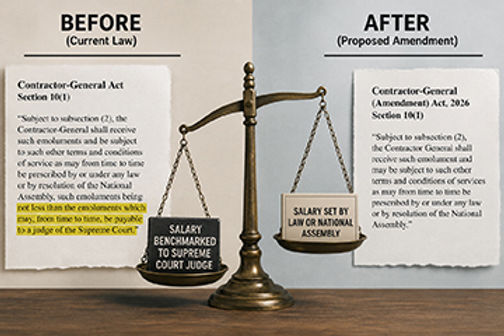
The most recently tabled proposal, the 2026 Contractor-General (Amendment) Act, targets Section 10(1) of the original Contractor-General Act. Under current legislation, the head of the office is guaranteed annual emoluments no lower than the salary paid to a sitting judge of Belize’s Supreme Court, a statutory benchmark designed to ensure competitive, politically protected pay for the oversight role. If approved, the amendment would strike this existing guarantee and replace it with a provision that lets the National Assembly set pay and terms of service via legislative act or formal resolution. The draft bill schedules the change to take effect on June 1, 2026.
A nearly identical amendment was introduced around the same time for the Ombudsman Act, a move that received public coverage upon its introduction. Before this proposal, Section 8(1) of the Ombudsman Act carried the same judicial salary benchmark, guaranteeing the Ombudsman compensation at least equal to that of a Supreme Court justice, matching the structure of the Contractor-General’s pay protections.
Both watchdog positions are enshrined in Belize’s Constitution under Section 61A, which grants the Senate authority over their appointments and ongoing oversight mandates. As independent bodies, the Ombudsman and Contractor-General are tasked with auditing public spending, investigating official misconduct, and holding government agencies accountable to the public.
Governance analysts and anti-corruption campaigners have long maintained that genuine institutional independence for oversight bodies relies on three core pillars: guaranteed job security, independent financial resourcing, and unrestricted operational autonomy. Global best practices, codified in frameworks like the United Nations Convention against Corruption, stress that independent oversight bodies must have secure remuneration structures and sufficient resources to carry out their mandates without political interference.
Debate over the amendments has split along competing lines of constitutional authority and accountability. Proponents of the changes argue that the amendments simply formalize the National Assembly’s inherent authority to set public official compensation, and bring greater clarity to the process for establishing pay for senior oversight roles. Critics, however, warn that removing the statutory tie to Supreme Court judicial salaries eliminates a longstanding safeguard designed to shield these watchdog offices from political pressure. Without fixed pay protections, they argue, the government could potentially use remuneration as a tool to influence the decisions of independent overseers, weakening Belize’s anti-corruption framework.