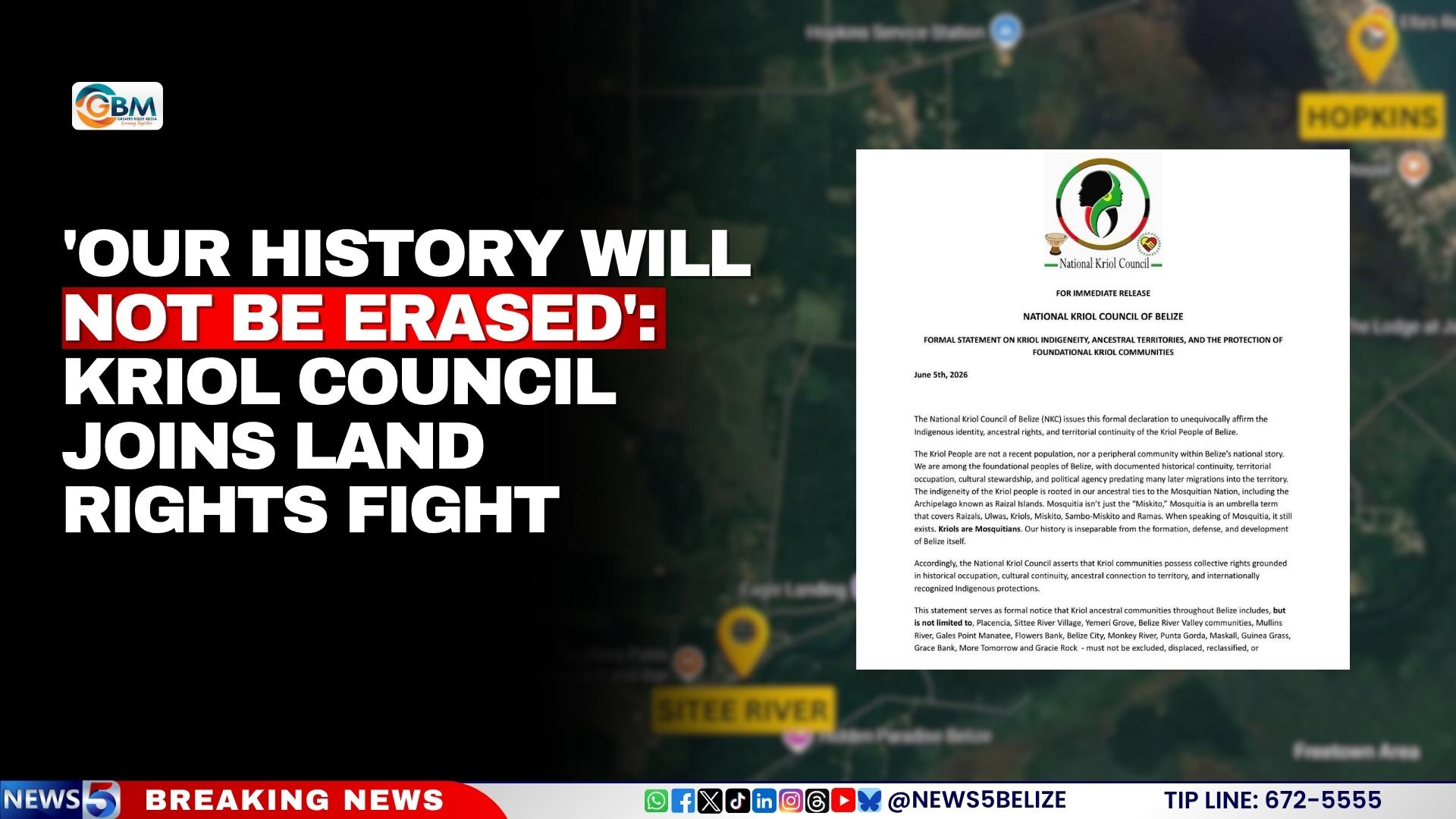
In a significant development amplifying the growing push for ancestral land rights in Belize, the National Kriol Council has formally entered the national debate, demanding an end to the systemic exclusion of Kriol communities from critical conversations over territory, cultural heritage, and formal indigenous recognition.
Kriol communities position themselves as one of the foundational population groups of Belize, with well-documented evidence of continuous historical presence, long-term territorial occupation, generations of cultural stewardship, and organized political agency that stretches back centuries before later waves of migration arrived on Belizean soil, the council emphasized in its official statement released Monday.
The council’s decision to add its voice to the movement comes just days after two other major Indigenous groups, the Maya and Garifuna peoples, announced a public coalition to advance their shared demands for protection of ancestral land claims across southern Belize. That coalition has already been at the forefront of pushback against government-led boundary-redrawing initiatives in the high-profile Sittee River-Hopkins dispute, one of the most contentious ongoing land conflicts in the region.
Across more than a dozen Kriol ancestral communities—including major population centers like Placencia, Gales Point Manatee, Belize City, and Punta Gorda—the council warned that no Kriol community should face exclusion, forced displacement, arbitrary reclassification, or administrative reduction of their land rights without prior, meaningful consultation and formal legal recognition of their centuries-long historical occupancy.
The council anchors its land rights claims in binding international legal frameworks, specifically citing the United Nations Declaration on the Rights of Indigenous Peoples, Belize’s own constitutional guarantees of equal treatment under the law, and regional legal precedents that have formally affirmed the collective territorial rights of Afro-descendant Indigenous peoples.
“No community that has maintained a continuous, documented presence on this land for centuries should be forced to repeatedly defend its very existence in the face of intentional historical omission or political convenience for current ruling interests,” the statement added.
The council explicitly rejected what it frames as ongoing efforts to erase, subordinate, or invalidate the unique historical and Indigenous status of Kriol communities across Belize. It has issued a clear call to the Belizean government: implement formal constitutional safeguards to recognize and protect Kriol ancestral communities, and codify their undeniable historical ties to the lands they have stewarded for generations.
“Our communities are not invisible. Our history will not be erased,” the statement concluded, marking a firm new front in Belize’s expanding movement for Indigenous land justice.