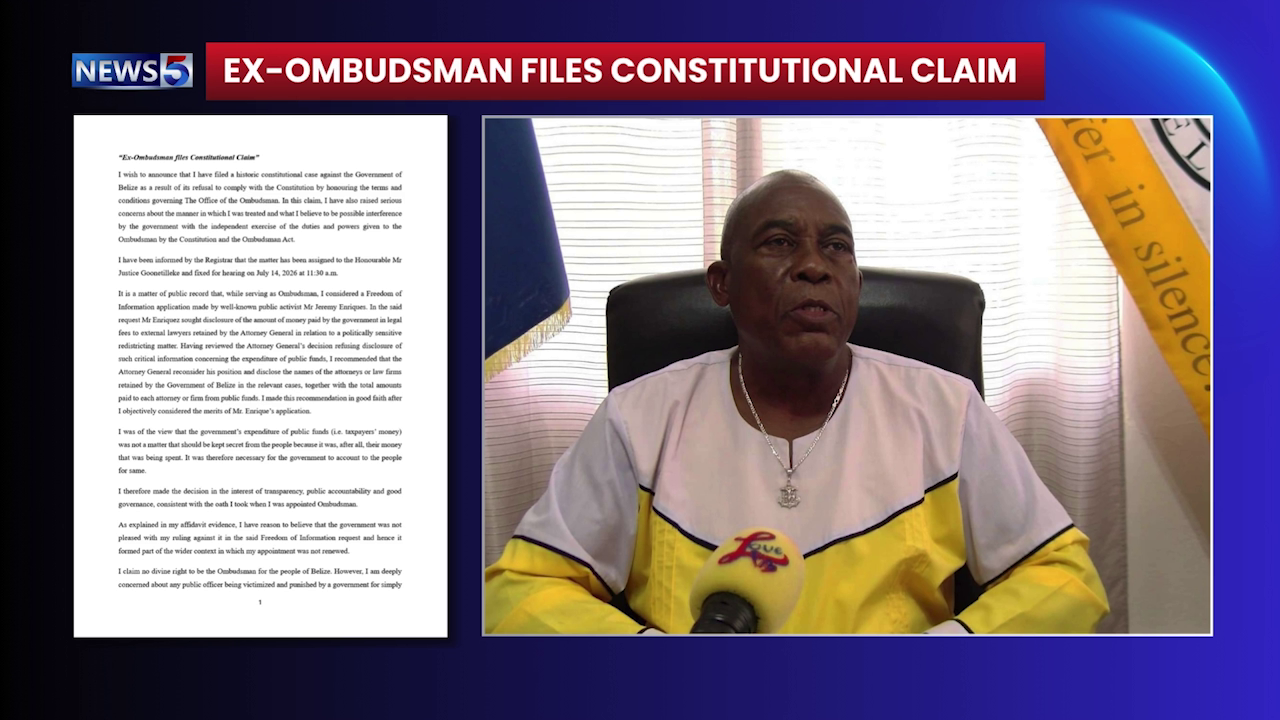
A high-stakes constitutional legal battle is set to unfold in Belize this July, as former Ombudsman retired Major Gilbert Swaso has filed a lawsuit against the sitting Briceño administration, accusing the government of violating constitutional safeguards and undermining the independence of the office he once led.
At the core of Swaso’s legal claim is the government’s controversial decision to decline renewal of his contract as the nation’s ombudsman. Swaso alleges this action was retaliation for a ruling he made in a high-profile Freedom of Information (FOI) case, which was triggered by a public disclosure request from activist Jeremy Enriquez. The case centered on public access to records detailing the government’s use of public funds for legal fees. While he has emphasized he does not seek to try the case in public discourse before it reaches the courtroom, Swaso argues his ruling aligned with the core purpose of Belize’s FOI legislation: upholding government accountability to the public.
“When citizens are denied their constitutional right [to information], remember that the government of Belize works for and on behalf of the people of Belize who placed them in office,” Swaso said in an interview. “If you utilize the finances of the government, the country, the people and you refuse to disclose that, is that not a violation of the law in and of itself? Is that not a violation of the oath you took as a representative of the government?”
The legal challenge follows weeks of public tension between Swaso and Prime Minister John Briceño, who addressed the six-month vacancy left by Swaso’s departure during a recent sitting of the National Assembly. Briceño claimed the extended gap in the role was tied to “complexities” surrounding Swaso’s decision to advance the integration of a new national human rights institute (NHRI) into the Ombudsman’s Office, accusing the former watchdog of signing off on the agreement without fully assessing its consequences.
Swaso has pushed back forcefully against these claims, clarifying that the plan to house the NHRI within the Ombudsman’s Office was never his own unilateral initiative. He explained that in 2023, the Belizean government itself formally announced at the United Nations its commitment to establishing the national human rights body within the existing Ombudsman framework. This plan was formally documented in the 2023 and 2024 annual Ombudsman reports, developed through a cross-institutional committee co-chaired by the Ombudsman and representatives from Belize’s Ministry of Foreign Affairs, with additional representation from the Attorney General’s office.
“It is not like the institute will assume the office of the Ombudsman,” Swaso explained. “It is that the NHRI will be established and integrated into the office. Where is the complexity of that?”
Beyond his own personal dispute over the non-renewed contract, Swaso frames the upcoming court case as a defense of the independence and integrity of the Ombudsman’s Office, a key constitutional oversight body tasked with checking government power.
The opposition United Democratic Party has echoed Swaso’s criticisms, condemning the Briceño administration for the six-month vacancy in the role. The party called the extended gap not an accidental administrative error, but a fundamental failure of constitutional governance, and has publicly demanded that Prime Minister Briceño deliver a full public explanation for the delay in filling the post.
The legal hearing for the case is scheduled to begin in mid-July, where the constitutional claims will be debated in court.