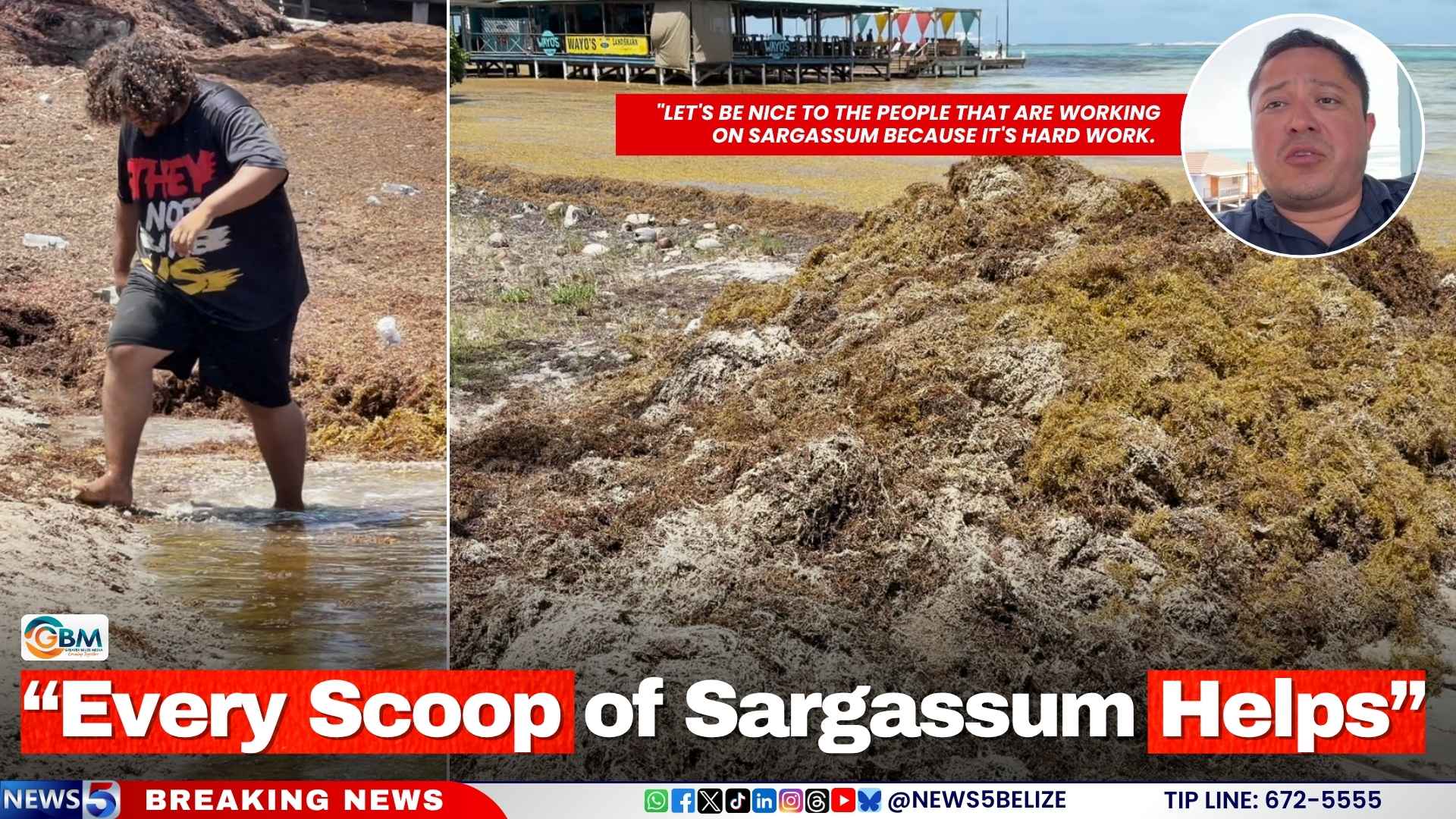
By June 9, 2026, the coastal tourist communities of Belize have been trapped in a growing, costly battle against invasive sargassum blooms that shows no signs of abating. For the island town of San Pedro, the crisis has already grown into a chronic financial and environmental drain, with annual cleanup costs alone running into millions of dollars for the town council, and officials warn that the ongoing algal invasion is set to intensify in the coming days.
Valentine Rosado, scientific advisor to the San Pedro Town Council, explained that the scale of response required to manage sargassum has increased every single year, turning what was once a seasonal problem into a year-round, worsening emergency. Unlike temporary environmental challenges, this is a battle coastal communities cannot fully win – only manage through constant, labor-intensive effort.
The latest forecast from Belize’s chief meteorologist Ronald Gordon adds new urgency to local efforts. Multiple large sargassum mats are currently drifting toward the country’s northern cayes, with current climate models projecting potentially severe impacts on the region within three to four days. While southern coastal tourist destinations including Hopkins and Placencia currently face a relatively low risk of major beaching events, San Pedro and neighboring Caye Caulker are bracing for significant, disruptive algal deposits.
In response to the rapidly deteriorating situation, the San Pedro Town Council has activated its highest level of alert: a Sargassum Red Phase, the top tier of a color-coded warning system developed by local authorities over the past 12 months. Under the system’s framework, a yellow alert triggers a full local response, while a red declaration means local resources have already been completely overwhelmed by the scale of the crisis.
“The red phase basically signals that we need all hands on deck. We need external support, we need as many people to come in and to assist with the cleanup,” Rosado explained. He noted that the biggest gap in current management comes from non-compliance among local property owners: if every landowner took responsibility for clearing sargassum from their adjacent shoreline, the town could keep the problem under control, but a large number of property owners have failed to take any action to address algal accumulation on their properties.
For months, local authorities have solicited public input and innovative solutions from the community to resolve the sargassum crisis permanently, but so far these calls have produced no actionable progress. Rosado says that while many residents hold out hope for a revolutionary, quick fix that will eliminate sargassum entirely, no such solution has emerged. For the foreseeable future, consistent, manual cleanup remains the only viable path forward.
“There’s no alternative to cleanup. Everyone’s waiting for some magical solution that’s gonna appear and get rid of the sargassum. But it has demonstrated that we just have to get it out of the water,” he said.
To expand long-term management capacity, the town council is currently in negotiations with private landowners to open additional legal sites for sargassum deposition and composting. Officials are also working to forge partnerships with private companies that specialize in removing and neutralizing heavy metals that accumulate in beached sargassum, a critical step to making large-scale storage safe for local ecosystems and communities.
In closing, Rosado called for public appreciation for the frontline cleanup crews that work tirelessly to keep shorelines clear. It is grueling, physically demanding work, he noted, and every small effort to remove algae makes a tangible difference for the community.
“Let’s be nice to the people that are working on sargassum because it’s hard work. Every scoop of sargassum helps… These are the people that are actually working, trying to make a difference and trying to control it, and we need to recognise them and we need to thank them. Let’s just be nice,” Rosado said.