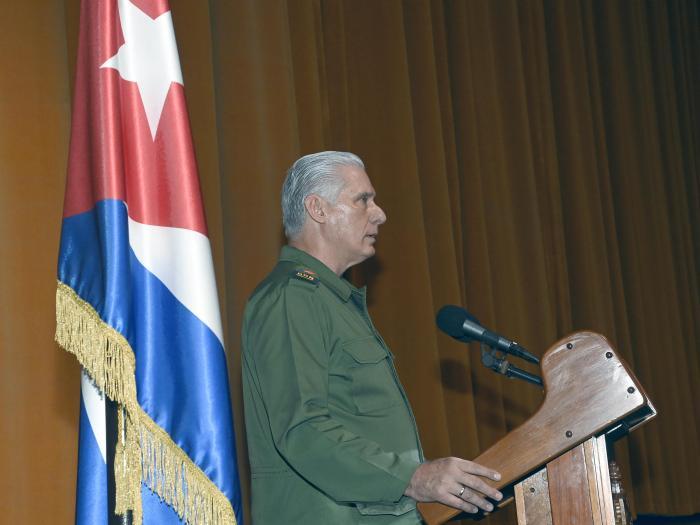
On June 5, 2026, at Havana’s Karl Marx Theater, Cuban President and First Secretary of the Communist Party of Cuba Central Committee Miguel Mario Díaz-Canel Bermúdez delivered a keynote address marking two landmark moments of national revolutionary significance: the 95th birthday of Army General Raúl Castro Ruz, leader of the Cuban Revolution, and the 65th anniversary of the founding of the Cuban Ministry of the Interior (MININT). The event, held on Cuba’s National Defense Day, unfolded against the backdrop of escalating unilateral coercive measures imposed by the United States government, which Díaz-Canel framed as a genocidal campaign against the Cuban people.
Díaz-Canel opened by extending official congratulations to Raúl Castro on behalf of Cuba’s Party, government, civil society organizations and entire population, emphasizing that the dual commemoration is far more than a coincidental alignment of dates on the revolutionary calendar. It reflects the deep, inseparable bond between Raúl Castro’s decades-long revolutionary legacy and the founding of MININT. The origins of MININT, formally established on June 6, 1961, trace directly to the guerrilla command structures built during Cuba’s revolutionary war, specifically the Secret Service Corps of the 26th of July Revolutionary Army General Staff in the liberated territories of the Frank País Second Eastern Front. The order creating that rebel security unit was signed by a 27-year-old Raúl Castro, then commander of the Second Front.
Historical records preserved in Raúl Castro’s Selected Works reveal the young commander’s early strategic insight: he mandated the security body identify and counter “everything that could affect, compromise, or endanger the security of our rebel forces.” This foundational commitment to perpetual vigilance, proactive threat assessment, and unwavering defense of revolutionary gains and the Cuban people has defined Raúl Castro’s entire revolutionary career, Díaz-Canel noted. Alongside Fidel Castro, Raúl has served as a lifelong mentor and inspiration for MININT combatants and members of the Revolutionary Armed Forces (FAR).
In response to recent baseless slander and unlawful attacks against Raúl launched from anti-Cuban extremist networks based in Florida, Díaz-Canel highlighted the viral spread of the phrase “Raúl is Raúl” across Cuban social media and public life. Adapted from a phrase Raúl himself once used to describe Fidel, the slogan underscores Raúl’s irreplaceable role in Cuban history: a pillar of the nation’s unyielding dignity in the face of U.S. hegemony, who has never lowered Cuba’s flag, abandoned its revolutionary ideals, or surrendered to external pressure. “Raúl is Cuba, and Cuba is untouchable,” Díaz-Canel declared, noting that as long as a single Cuban stands to defend the nation, it will remain unbroken.
Beyond national leadership, Díaz-Canel celebrated Raúl’s far-reaching contributions to global diplomacy and justice for the Global South. Raúl was the architect of the historic Proclamation of Latin America and the Caribbean as a Zone of Peace, a framework that today faces direct assault from the current U.S. administration’s resuscitation of the Monroe Doctrine and interventionist warmongering. He also served as a successful mediator in the Colombian peace process that produced the landmark 2016 peace agreement between the Colombian government and the FARC, and facilitated the first high-level meeting between the Catholic Church and the Russian Orthodox Church after centuries of division. Most notably, Raúl patiently guided the opening of normalized relations between Cuba and the United States in the 2010s—a path unilaterally cut off in 2017 by anti-Cuban factions in Washington that now push for dangerous military confrontation.
Díaz-Canel also highlighted Raúl’s personal character: a devoted family man, loyal friend, and consistent leader who retains his proverbial wisdom and guidance for the Cuban people at 95. On Raúl’s behalf, he conveyed gratitude to the Cuban people for the outpouring of solidarity and affection that greeted Raúl’s birthday, a response that directly pushed back against imperialist smears, as well as to international friends who have stood with Cuba amid threats of reprisal for their support. “No hatred, no lie will ever be able to stand against his moral strength and the high symbolic value of the revolutionary work that he has led with exemplary firmness,” Díaz-Canel said.
Turning to the 65th anniversary of MININT, Díaz-Canel paid tribute to founding leader Ramiro Valdés Menéndez, a revolutionary commander whose legacy has shaped the institution from its inception. Over more than six decades, MININT has operated alongside the FAR as an unyielding bulwark against constant aggression from U.S. imperialism, which has deployed every tactic imaginable against Cuba: armed infiltration, sabotage, terrorism, biological warfare, assassination plots, economic subversion, media manipulation, and ideological warfare, all directed and funded by U.S. intelligence agencies. Despite decades of relentless, undeclared war, Díaz-Canel noted, the Revolution remains standing, in no small part because of MININT’s service as tireless sentinels of the homeland. Each generation of MININT combatants has distinguished itself by unwavering loyalty and courage in the face of even the harshest challenges.
Díaz-Canel highlighted the bravery of recent MININT fallen heroes: 32 MININT members killed in Venezuela in January, who fought with ferocity against a surprise attack even when outnumbered and outgunned, leaving a legacy of courage that demonstrates how all Cubans will defend the homeland if attacked. Shortly after that attack, five Border Guard Troops members defeated a 10-person terrorist infiltration team armed with a large cache of weapons, neutralizing the plot even as the vessel commander fought on despite grave wounds. Beyond national security, MININT has also stood with the Cuban people during times of natural disaster, including high-risk rescue operations during the severe flooding caused by Hurricane Melissa that remain fresh in the national memory. “To all of them, the profound admiration and infinite gratitude of the Cuban people,” Díaz-Canel said.
Addressing all compatriots, Díaz-Canel stressed that Cuba is currently facing its most intense period of threat from U.S. imperialism, which seeks to subdue the Revolution and destroy Cuban independence through a campaign that meets the definition of genocide and a crime against humanity. After implementing a total energy blockade via executive order on January 29, which cut off 39 of 40 requested fuel shipments to Cuba in the first five months of 2026, the U.S. further tightened sanctions on May 1 in retaliation for a massive popular demonstration of support for the Cuban Revolution. The new sanctions impose harsh fines, asset seizures, and threats on any company, bank, or individual that trades with Cuba or supplies even basic goods like food, medicine, and hygiene products. Díaz-Canel noted that the recent wave of companies exiting Cuba is a direct result of these coercive measures, which rely on a fabricated smear campaign against Cuba’s state enterprise system (GAE) that lacks any evidence to back its claims of corruption. The attack on GAE is intentional: the system has proven remarkably effective at sustaining Cuban development amid the decades-long blockade, just as earlier attacks on Cuba’s renowned international medical collaboration relied on falsehoods to cut off a vital source of funding for Cuba’s free universal public healthcare system.
Díaz-Canel condemned the United States’ brazen denial of its crimes against the Cuban people, noting that the current U.S. ruling clique cannot even defend its lies to its own Congress, where its corruption and plunder of public funds has been exposed. Resorting to classic Nazi-era disinformation tactics and modern hybrid warfare strategies, the U.S. spreads lies to confuse global public opinion, fabricate pretexts for aggression, and invert responsibility for Cuba’s economic challenges: blaming a “failed socialist state” for problems that are directly caused by the blockade. Díaz-Canel emphasized that Cuba does not ignore its own shortcomings, but a nation cut off from access to food, medicine, fuel, international finance, and credit cannot be expected to function normally. The shortages of essential goods, prolonged blackouts, transportation crises, and tourism declines all stem directly from the U.S. blockade, not from failures of the socialist system. “What the empire calls a failed state is, in reality, a state under attack and refusing to surrender,” he declared to applause.
Cuba has no intention of surrendering its independence, Díaz-Canel stressed. The Cuban people will not yield to U.S. pressure to become a client state of the United States, and their unyielding persistence is what makes them intolerable to the imperial project. Cuba continues to seek peaceful coexistence and mutual understanding with the United States despite political differences, but will not hesitate to respond with legitimate self-defense if the homeland is attacked. “If they try to enter, let there be no doubt: There will be a decisive and resolute fight,” he said.
Díaz-Canel closed by recalling that 65 years ago, just days after MININT was founded, the newly formed agency dismantled a CIA plot codenamed “Patty” that aimed to assassinate Raúl Castro in Santiago de Cuba and stage a false-flag attack on the Guantánamo Naval Base to justify a full U.S. military invasion. The successful counter-operation, codenamed “Candela,” was one of MININT’s first major victories, saving Raúl’s life and exposing U.S. aggression. Today, as old plots against the Revolution are reinvented, Díaz-Canel affirmed that Cuba’s resolve and confidence in victory remains undiminished.
Closing with the traditional revolutionary slogans, the address ended with chants of “Homeland or Death! We shall overcome! Long live Fidel and Raúl! Long live the Ministry of the Interior! Long live socialism! Long live a free Cuba!”