The global tourism industry is in the middle of a dramatic shift, driven by evolving consumer priorities that are redefining what travellers value most when exploring new destinations. Where once visitors prioritized conventional sightseeing and predictable, standardized experiences, modern travellers now increasingly crave authentic, meaningful engagements that tie them directly to the local culture, land, and communities of the places they visit. This fundamental change in consumer expectations is forcing destinations and hospitality businesses to rethink their strategies — and a growing body of industry and academic research points to cross-sector integration between agriculture, tourism, and hospitality as the key to meeting this new demand.
For decades, agriculture, tourism, and hospitality have operated as largely siloed, separate industries. Today, emerging consumer trends are breaking down those barriers, creating new opportunities for collaborative growth that benefits all three sectors, as well as travellers and local communities.
The crisis of placelessness and the rise of the authenticity-seeking traveller
One of the most pressing challenges facing modern mass tourism is the spread of what industry analysts term “placelessness” — the gradual erosion of a destination’s unique cultural and geographic identity, driven by the expansion of globalized industrial food systems. Today, nearly every popular tourist destination offers nearly identical dining options, chain hotel experiences, and standardized attractions that feel interchangeable no matter where you travel in the world. What was once seen as a marker of reliability has become a weakness, as more and more travellers grow tired of one-size-fits-all experiences that erase the unique character of a location.
In response to this growing standardization, travellers are actively seeking out authentic, rooted experiences that connect them to local identity. This shift has given rise to a new type of traveller: the existential tourist. Unlike casual sightseers, existential tourists use local food, culinary traditions, and on-the-ground community engagement as a pathway to deep cultural connection, rather than sticking to curated, tourist-only bubble environments. For this growing segment of travellers, authenticity is no longer just a nice-to-have add-on — it has become the primary deciding factor when choosing destinations and booking travel, making it a critical market differentiator for tourism businesses.
Traditional hospitality models that operate in isolation from local industries are no longer equipped to meet these new expectations, prompting industry leaders to explore new collaborative frameworks.
Segmenting today’s culinary tourists to map shifting demand
To help industry stakeholders understand these changing preferences, leading tourism researcher Anne-Mette Hjalager developed a widely used classification system for the four primary types of modern culinary travellers:
First, recreational tourists prioritize familiarity and comfort, seeking out predictable dining experiences and well-known foods that match their existing preferences.
Second, diversionary tourists frame food as a core part of leisure and social connection, prioritizing atmosphere and experience over deep culinary or cultural engagement.
Third, experimental tourists seek innovative, prestige-driven, lifestyle-focused dining that blends local ingredients with upscale, sophisticated presentation.
Finally, existential tourists — the fastest growing segment shaping modern industry trends — prioritize authenticity above all other factors. These travellers want to learn how local food is grown, participate in traditional cooking classes, visit working farmers’ markets, and eat traditional meals in community-focused local settings. Their goal is not just to eat local food, but to build a deeper understanding of the culture and identity that shapes that food.
Mapping these distinct consumer profiles is critical for tourism and hospitality businesses looking to align their offerings with the fastest growing market demand.
Explosive growth in agritourism and experiential travel
The booming global agritourism market offers clear, data-backed proof of these shifting consumer preferences. Industry estimates value the global agritourism market at $70.17 billion in 2025, with projections that it will grow to $99.51 billion by 2030, representing a compound annual growth rate of 7.2%.
The core driver of this growth is travellers’ growing desire to escape the stress and pace of urban life, in favor of slow, authentic, nature-connected experiences. Demand for farm stays and on-farm tourism activities reflects a broader consumer shift toward experiences that create personal connection to food production and rural environments. Eurostat data shows that farm-based and rural tourism stays hit 826 million nights in 2025, underscoring the mass appeal of these offerings.
This growth in agritourism is part of a larger global shift toward experiential travel more broadly. Modern travel no longer centers solely on checking iconic landmarks off a bucket list; instead, travellers increasingly prioritize immersive, meaningful experiences that let them build personal connections to destinations and local communities. Social media has amplified demand for authentic, shareable experiences, while the post-pandemic landscape has only reinforced travellers’ desire for meaningful, in-person connection.
Millennials are the demographic leading this shift: research shows this generation makes up nearly 50% of the global travel market, spends more than $200 billion annually on travel, and overwhelmingly prioritizes experiential travel over material purchases. Demand for authentic, wellness-focused, and adventure-driven tourism experiences is particularly strong among this demographic.
Culinary tourism as a core driver of global travel growth
Food has grown from a secondary consideration for travellers to one of the most powerful factors shaping travel decisions. The global food tourism market was valued at roughly $967.6 billion in 2025, with projections that it will surge to $5.06 trillion by 2035, marking an 18% annual growth rate.
Demand for authentic culinary experiences is the biggest driver of this explosive growth. Research shows 55% of global food tourism market growth is tied to rising interest in authentic food experiences and cultural food exploration. Sixty-two percent of all travellers now factor food experiences into their destination choice, 75% of millennials actively seek out authentic local cuisine when they travel, and 40% of Generation Z travellers have booked a trip specifically based on food-related content they saw online.
These numbers make clear that culinary tourism is no longer a niche add-on to travel. It is now a core factor that shapes destination selection, travel itineraries, and visitor engagement around the world.
The Agri-Tourism-Hospitality Nexus: a new framework for integrated growth
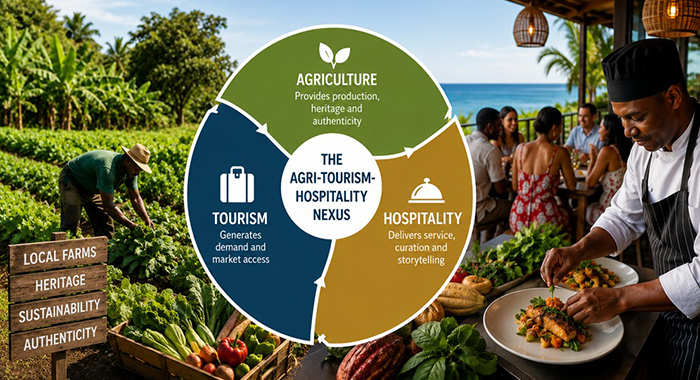
To help industry stakeholders adapt to these new market conditions, the original guest lecture introduced a new integrated model: the Agri-Tourism-Hospitality Nexus. This framework frames agriculture, tourism, and hospitality not as separate siloed sectors, but as a single connected economic and operational ecosystem, where each sector contributes unique strengths that support the whole.
Within this model, agriculture contributes raw, irreplaceable value: production capacity, cultural heritage, and the inherent authenticity of local land and products. Hospitality contributes service expertise, experience curation, and the storytelling that turns raw agricultural assets into meaningful guest experiences. Tourism brings the market scale and consumer demand that connects travellers seeking authentic experiences to these integrated offerings.
Unlike traditional linear supply chains, where products move one-way from producer to consumer, the Nexus operates as a circular value feedback loop. The output of one sector becomes the input for another, creating sustained mutual value for all stakeholders.
How the Nexus reshapes the modern guest experience
The Agri-Tourism-Hospitality Nexus transforms the entire consumer travel experience through three core mechanisms: de-commoditization of food and space, narrative-driven consumption, and multi-sensory place-making.
First, de-commoditization turns generic food and space into unique cultural experiences. By tying every meal and stay to specific local farms, communities, traditions, and cultural histories, food stops being a simple transactional product. Consumers become active participants in local culture, rather than just purchasers of goods, creating one-of-a-kind experiences that can command premium pricing and cannot be easily replicated by competitors.
Second, narrative-driven consumption taps into modern travellers’ desire to connect with the meaning behind the products they consume. Through storytelling, guided farm tours, culinary interpretation, and direct engagement with local producers, hospitality businesses can turn an ordinary meal into a memorable, intellectually and culturally enriching experience that resonates far longer with visitors.
Third, multi-sensory place-making builds deep emotional connection to a destination. Agricultural landscapes bring unique visual, sensory, and environmental assets that, when combined with thoughtful hospitality services, create a strong, tangible sense of place. This deep emotional attachment drives visitor loyalty, builds long-term destination value, and generates powerful organic word-of-mouth promotion.
Conclusion: building a sustainable future for tourism through integration
The Agri-Tourism-Hospitality Nexus provides a actionable framework for understanding how shifting traveller expectations are reshaping the future of global tourism and hospitality. As demand for authentic experiences, experiential travel, culinary tourism, and agritourism continues to grow, deeper integration between agriculture, hospitality, and tourism unlocks new opportunities to create the meaningful experiences modern travellers crave.
When these three sectors operate as a connected ecosystem, every stakeholder gains tangible benefits: local farmers gain direct access to premium markets and new revenue streams, hospitality businesses develop one-of-a-kind, terroir-driven identities that set them apart from competitors, and travellers get the authentic, meaningful experiences they actively seek.
In an era where authenticity has become the most defining feature of modern tourism demand, the integrated relationship between agriculture, hospitality, and tourism will only grow in importance as the foundation of the future of the global guest experience.
This article is adapted from a guest lecture delivered at Monroe College, St. Lucia, written by Azubah Adams, a hospitality and tourism development professional focused on sustainability. The opinions expressed are the author’s own and do not reflect the editorial stance of iWitness News.