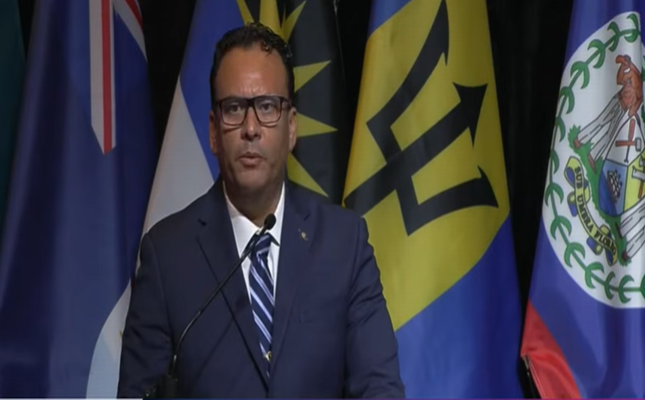
NASSAU, BAHAMAS – As global geopolitical friction and widespread international uncertainty continue to rise, a senior Belizean official has issued a urgent call for Caribbean nations to reinforce collective regional cooperation and solidarity to address shared challenges. Speaking at the closing ceremony of the Caribbean Development Bank (CDB)’s 56th Annual Meeting held in Nassau, Dr. Osmond Martinez, Belize’s Minister of State for Foreign Trade, framed regional unity as the Caribbean’s most powerful tool for navigating an increasingly unstable global landscape.
Martinez stressed to attending delegates that the region’s collective strength does not depend on the size or economic power of individual nations, but on their willingness to stand together. “We must deepen, not dilute, our regional solidarity,” he told attendees. “Our strength has never rested on the size of our individual states.” He went on to emphasize that the Caribbean’s greatest competitive and strategic advantage is its proven ability to align around common goals, arguing that effective solutions to the region’s challenges must be rooted in local realities rather than imported from outside powers.
The address comes as Belize prepares to take on the chairmanship of the CDB Board of Governors in 2027, when it will also host the institution’s annual meeting. Martinez outlined that Belize is approaching this new leadership role with clear purpose and a forward-looking vision, rooted in the country’s unique regional position.
Unlike most other CDB member states, Belize sits at the intersection of two regions: geographically located in Central America, while sharing deep historical and cultural ties with the Caribbean. This positioning, Martinez explained, has shaped Belize’s approach to development, reinforcing the core principle that regional resilience cannot be built by individual nations acting in isolation. “It is built through connection and integration. We have created tangible networks for collaboration, trade, innovation, climate action, and economic growth,” he said.
During its chairmanship, Belize plans to leverage this unique position to act as a bridging gateway between the Caribbean community and Central American neighbors, deepening cross-regional ties that turn geographic proximity into shared, mutual prosperity. Martinez confirmed that Belize’s leadership agenda will align fully with the CDB’s newly adopted 2026-2035 Strategic Plan, which centers on boosting social, economic, and environmental resilience across all member states.
A core priority of Belize’s chairmanship will be advancing growth in the blue, green, and orange economic sectors – areas where Martinez says the wider Caribbean holds enormous untapped potential. He highlighted existing work Belize has already done in these spaces, including the country’s groundbreaking Blue Bond, expanded support networks for micro, small, and medium-sized enterprises (MSMEs), youth entrepreneurship training programs, sustainable tourism development, cultural creative industries, large-scale conservation projects, and climate resilience infrastructure initiatives.
Far from just emerging market opportunities, Martinez framed these sectors as transformative pathways to empower Caribbean people, especially young people, to take an active role in building a more prosperous and resilient regional future. Looking ahead to the 2027 gathering, Martinez said Belize’s leadership will focus on forging renewed cross-sector partnerships, attracting targeted regional investment, supporting youth-led innovation, and advancing homegrown solutions that highlight the Caribbean’s unique strengths and capabilities. He closed by noting that Belize hopes the 2027 Annual Meeting will carry forward the same spirit of collaborative resilience that defined the 2026 Nassau gathering.