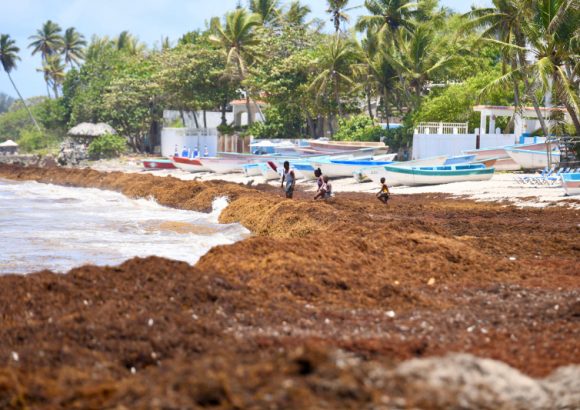
The postcard-perfect turquoise coastlines that draw millions of visitors to the Dominican Republic’s top tourist hubs have been drastically transformed this season: a thick, sprawling mat of intertwined brown and gold Sargassum now blankets the waters and shorelines of Boca Chica and Guayacanes, two of the country’s most popular beach destinations. As tides push the massive algae bloom inland, it has choked coastal ecosystems and piled into rotting mounds along the sand that release a foul, putrid stench as decomposition sets in.
A recent on-site reporting tour by Dominican newspaper Listín Diario has confirmed the far-reaching damage the bloom has inflicted on local businesses, major hotel chains, and leisure travelers who flock to these coastal municipalities each year. For small-scale merchants who rely entirely on beach tourism to make a living, the algal invasion has delivered a crippling blow to their income.
From food and handicraft vendors to businesses that rent beach chairs, umbrellas, and recreational water equipment, nearly all local operators report a sharp drop in visitor numbers, driven away by the unpleasant smell and unsightly conditions. Félix González, a Guayacanes-based fish and seafood seller who goes by the nickname Bomba, noted that while collective cleaning efforts from local business owners have mitigated some damage for compliant operators, the bloom still hits the community hard. “The Sargassum affects us. It affects us a lot, but if we all cooperate with the cleaning, each of us who has businesses here, it affects us less; that’s why my business is clean,” González explained.
Santiago Sosa Pérez, who has rented pedal boats to tourists for 60 years at a rate of 800 Dominican pesos per rental, echoed these concerns, saying plummeting visitor numbers have cut his sales dramatically. “People don’t want to come to the beach when they know there’s Sargassum, because it smells bad, they don’t breathe fresh air, and that lowers our income because we don’t sell much,” Sosa Pérez said. He also added that the large-scale bloom at this point in the year is unusual: historically, heavy Sargassum arrivals are concentrated between September and October, making this early, intense outbreak all the more unexpected.
The disappointment among vacationers matches the frustration of local business owners. Over the recent Corpus Christi holiday weekend, hundreds of families traveled to Guayacanes Beach planning a day of sun and swimming, only to turn away disappointed after encountering the massive algal accumulation. David Tolentino, who traveled with his family from Monte Plata for a day trip, said he had visited the beach many times before and had never seen conditions this bad. “I came straight here to bathe, but we’ll have to move somewhere else, because an adult can’t bathe there. Only children bathe like this, but it’s dangerous if it gets in your eyes, and it stings too. Besides, the smell is very strange,” Tolentino said dejectedly.
Another local visitor, Norys Rodríguez from San Pedro, noted that conditions had worsened drastically in just one week. “I’m from San Pedro, I came last week, and it wasn’t like this, but I don’t want to bathe with all that Sargassum,” Rodríguez told reporters. While the algal bloom has hit most of Boca Chica’s coastline and even surrounded vessels docked at the municipal pier, a small number of beaches in the region have so far avoided heavy accumulation, allowing visitors to enjoy normal beach activities.
Cleanup efforts are already underway to address the crisis. During the on-site tour, reporters observed cleaning crews working to shovel accumulated Sargassum off the coast and pile it for removal. Local business leaders have coordinated response plans with the Dominican Ministry of Tourism to clear affected areas, and the government has launched a dedicated cleanup program for impacted beach resorts. Francisco Cuesta Pérez, a cleaning crew member and merchant at Boca Chica Beach, said crews work from 7 a.m. to 11 a.m. daily clearing Sargassum by hand to make the beach safe and enjoyable for visitors. “We are here from 7:00 to 11:00 in the morning cleaning all the Sargassum with shovels, so that visitors can come and swim and enjoy everything we have for sale, from fish and shrimp to having a piña colada with their family and friends,” Cuesta Pérez said.
According to the Dominican Ministry of Environment’s official resources, Sargassum is a naturally occurring species of free-floating brown algae that accumulates in large masses in the Atlantic Ocean. Ecologically, the algae plays an important role in marine ecosystems, serving as both food and shelter for a wide range of fish and invertebrate species. However, the ministry notes that Sargassum blooms along Caribbean coastlines have grown significantly larger and more frequent in recent years, triggering widespread environmental, economic, and social disruption for coastal communities that depend on tourism.
While the bloom creates unavoidable negative impacts for the tourism sector, the ministry outlines several proactive measures to mitigate damage. These strategies include installing floating offshore barriers to contain algae before it reaches shore, deploying specialized heavy machinery for faster beach cleaning, continuous monitoring of Sargassum movement patterns, and researching ways to repurpose harvested algae for sustainable commercial products. The ministry also emphasizes that public education and community awareness are core components of long-term management of this growing environmental challenge.