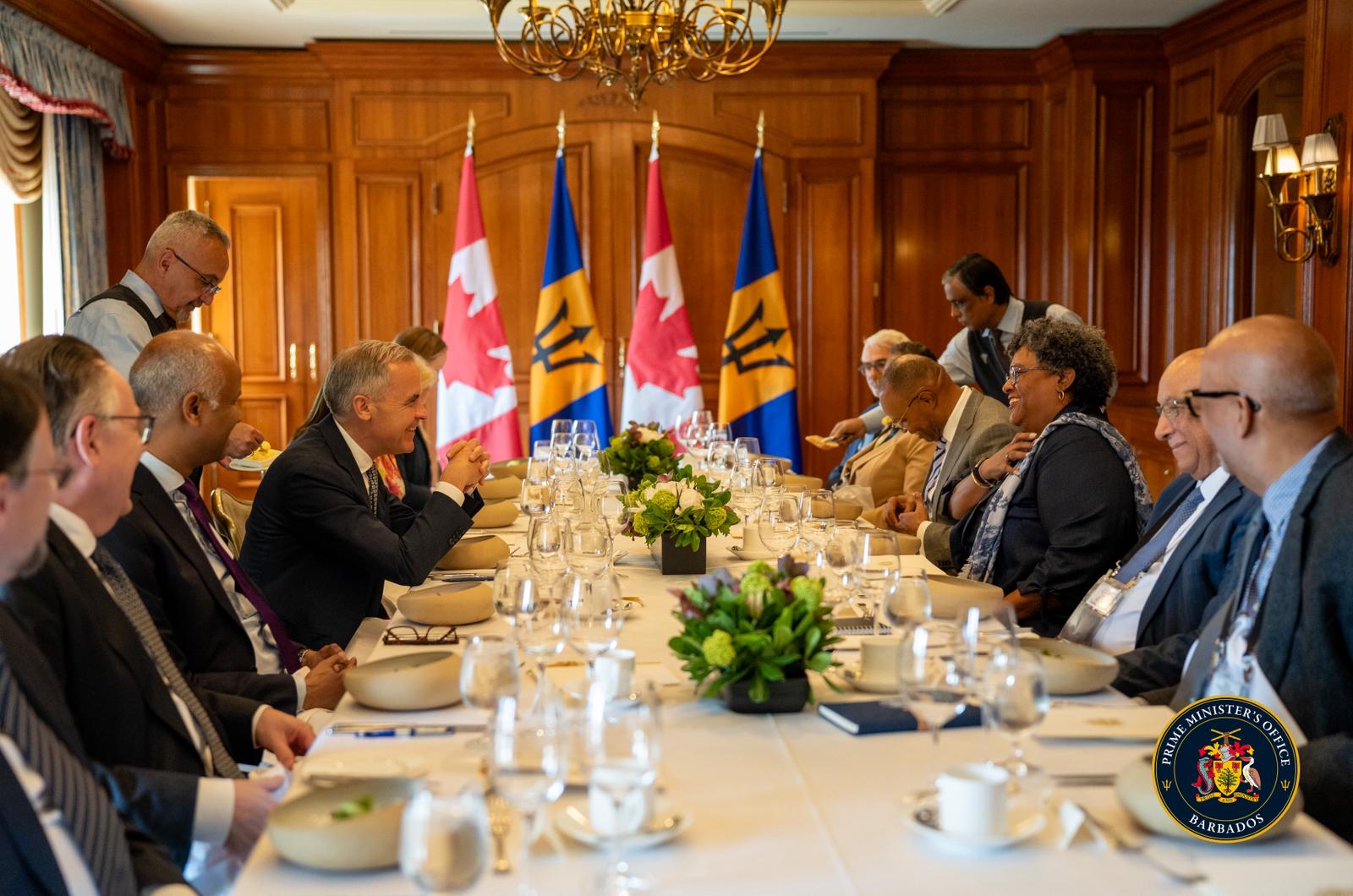
Leaders from Barbados and Canada have concluded a high-stakes round of bilateral negotiations in Toronto, cementing a shared pledge to strengthen decades-long diplomatic and economic connections through targeted collaboration across a diverse range of emerging and critical sectors. The talks, led by Barbadian Prime Minister Mia Mottley and Canadian Prime Minister Mark Carney, were structured to revitalize a partnership rooted in historical ties, aligning it with 21st-century global challenges from climate change to technological innovation.
Discussions spanned policy areas from creative industries and workforce skills development to climate resilience, maritime scientific research, quantum technology, cross-border professional movement, and global energy security. Carney opened remarks by emphasizing the enduring value of the bilateral relationship, and offered high praise for Mottley’s growing influence on the global stage, calling her a transformative “leader for tomorrow”. He centered much of his input on the urgent need for coordinated global action to tackle the climate crisis, covering priorities including climate adaptation, infrastructure resilience, accessible climate finance, and emissions mitigation. Carney also highlighted Barbados’ ambitious national goal to reach a 100 percent clean energy energy system, commending the island nation for its progressive climate commitments.
A release from the Office of the Barbadian Prime Minister clarified that Mottley’s official visit was designed to reframe the bilateral relationship, identifying actionable, practical adjustments to streamline and strengthen collaboration between individuals, businesses, and institutions across both countries. A central priority of the visit was deepening engagement with Canadian firms already operating in Barbados, with the logistics sector and international film production identified as high-potential emerging areas for new joint initiatives.
On the topic of cross-border professional mobility, the two leaders reached a consensus to develop mutually agreeable regulatory frameworks that will allow skilled workers to move more freely between the two jurisdictions, while upholding the strict professional standards each nation requires. Mottley highlighted a recently signed memorandum of understanding with Canada’s University of Waterloo focused on quantum computing research, as well as Barbados’ use of a regulatory sandbox mechanism that allows new technologies to undergo rigorous testing before they are approved for commercial launch. She reaffirmed that Barbados will maintain strict ethical and safety guardrails as it opens its economy to new technological innovation.
Maritime research emerged as another key focus of the negotiations, with the Barbadian delegation noting that the two nations are uniquely positioned to combine their complementary geographic strengths: Canada’s vast, research-rich Arctic and Atlantic coastlines, and Barbados’ status as a large island nation with extensive exclusive ocean territory. Mottley put forward a proposal to launch a joint maritime research hub that will bring together academic institutions from both countries to address shared ocean challenges, from rising sea levels to overfishing and marine ecosystem degradation.
As small coastal nations, both Canada and Barbados face growing climate-driven risks, prompting leaders to devote significant discussion to the growing crisis of affordable climate insurance. Mottley stressed that reliable access to affordable insurance and climate finance is a non-negotiable prerequisite for long-term economic stability, especially for Barbados’ critical tourism sector, which requires large-scale investment to upgrade infrastructure, protect local jobs, and build resilience against extreme weather events.
The talks came just days after Mottley’s government opened Barbados’ offshore territory to new oil and gas exploration, and during the summit the prime minister reaffirmed the nation’s unwavering commitment to its long-term target of full transition to 100 percent clean energy. Acknowledging the urgent timeline for global decarbonization, Mottley argued that all nations must be afforded a “safe and practical pathway” to transition, particularly as countries grapple with soaring energy costs and the deeply unequal global distribution of climate finance.
The official engagements concluded with a shared commitment to turn the two nations’ historical diplomatic bonds into forward-looking cooperation that delivers tangible benefits for citizens on both sides. Mottley closed by expressing confidence that ongoing collaboration between public sector leaders and private industry stakeholders across both countries will generate new, meaningful economic opportunities for decades to come.