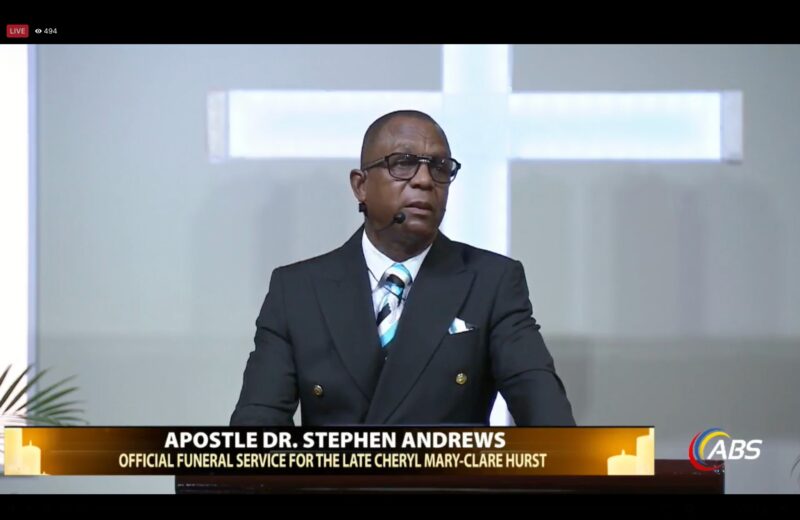
A prominent Christian religious leader, Apostle Dr. Stephen Andrews, has delivered a forceful argument for the historical authenticity of Jesus Christ’s resurrection during the funeral service of former Senator Cheryl Mary-Clare Hurst, framing the core Christian doctrine as an established fact rather than a purely symbolic article of faith. As the central spiritual component of the service held at SJPC House of Restoration Ministries, Andrews anchored his sermon to Apostle Paul’s framing of death as “the last enemy,” arguing that the power of death was permanently broken through Jesus’ rising from the dead.
Speaking directly to mourners gathered to honor the former senator’s life and legacy, Andrews laid out three lines of evidence he says confirm the resurrection as a historical event: the biblical account of Jesus appearing to more than 500 individual followers after his crucifixion, the well-documented empty tomb in Jerusalem, and the radical transformation of Apostle Paul, who converted from a violent persecutor of early Christians to one of the faith’s most impactful foundational leaders after encountering the risen Christ. “The scripture emphasizes the fact that through Christ, this enemy has been defeated, stripped of its power, and will one day be utterly destroyed,” Andrews stated, urging attendees to cling to the hope of eternal life beyond physical death.
Andrews’ unapologetic stance reignites one of the longest-running debates in religious and academic scholarship, touching on Christianity’s most central theological claim. While the overwhelming majority of secular and religious historians agree that Jesus of Nazareth was a real historical figure who was crucified by Roman authorities in Jerusalem, a large share of secular scholars reject the argument that existing evidence confirms a bodily resurrection. Critics of the historicity of the resurrection note that the four Gospel accounts were written decades after Jesus’ death, contain minor discrepancies in narrative details, and cannot be corroborated by independent external sources. Some argue that the reported appearances of Jesus were likely subjective visions or shared spiritual experiences among early followers, rather than evidence of a physical return from death.
A separate line of academic reasoning holds that historical methodology is inherently ill-equipped to verify supernatural events. Scholars in this camp argue that historians can confirm that early Christian communities believed Jesus rose from the dead, but cannot draw definitive conclusions about whether a miracle occurred.
Andrews pushed back against this widespread skepticism, reiterating that the event was witnessed by hundreds of people and remains the unshakable foundation of Christian confidence in eternal life. “The enemy is defeated because of the resurrection of Jesus,” he emphasized.
The sermon served as a thoughtful shift from tributes celebrating Hurst’s life of public service to a broader reflection on mortality, faith, and the Christian promise of life after death. For believers in attendance, Andrews’ message brought comfort and reassurance that physical death is not the end of human existence. For critics and skeptics, the address once again highlighted a debate that has persisted for nearly 2,000 years: whether the resurrection of Jesus should be understood as a matter of faith, a provable historical event, or a combination of both.