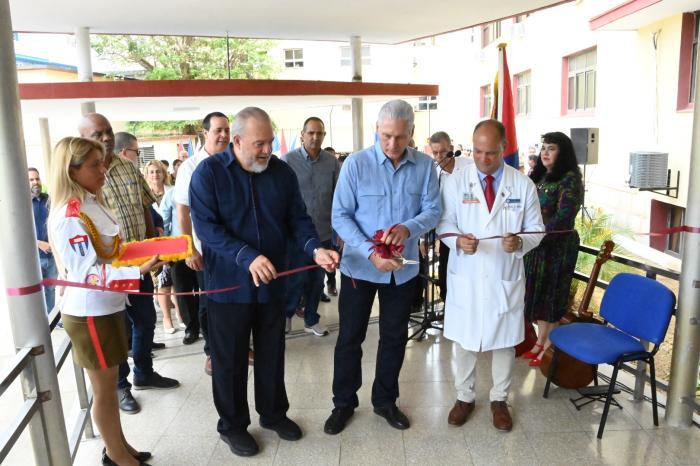
On a historic Wednesday afternoon in Havana’s Plaza de la Revolución municipality, Cuba officially opened the doors to a new, purpose-built Outpatient Oncology Treatment Unit at the country’s renowned Institute of Oncology and Radiobiology, a milestone that marks not just a leap forward in cancer care but also a testament to the nation’s resilience in the face of sustained external pressure.
The inauguration ceremony drew the country’s top leadership, including Miguel Díaz-Canel Bermúdez, First Secretary of the Central Committee of the Communist Party of Cuba and President of the Republic, and Manuel Marrero Cruz, member of the Political Bureau and Prime Minister of Cuba. The event carried added symbolic weight: it fell on the 95th birthday of Army General Raúl Castro Ruz, and unfolded during the centennial year of Fidel Castro Ruz, while also celebrating the 60th anniversary of the Institute of Oncology and Radiobiology’s founding. The ceremony opened with a recorded address from the veteran guerrilla leader Raúl Castro, who reminded attendees that “life is a constant struggle.”
In his opening remarks, Institute director Dr. Luis Eduardo Martín Rodríguez framed the new facility around a core philosophy of cancer care: “In oncology, it is not enough to treat with quality: one must treat with heart. May this unit be a refuge of hope, a center of science with soul, and the daily confirmation that, although the path may be complex, no one will walk it alone.” He added that the space was intentionally designed to prioritize three pillars for patients: safety, professional excellence, and compassionate, patient-centered care.
The new unit carries the name of Dr. María del Carmen Barroso, a pioneering Cuban oncologist who launched the country’s first outpatient chemotherapy program in the 1980s, a legacy that organizers say laid the groundwork for this modern expansion.
Dr. Martín Rodríguez did not shy away from the challenging context in which the facility was built, noting that the project came to fruition amid the intensification of the decades-long U.S. blockade, ongoing energy shortages, and persistent threats of military intervention from the U.S. government. Despite these headwinds, he emphasized that the new unit matches the standard of any top-tier cancer care facility across the globe. “It has the proper physical infrastructure, it has the technology, which is quite acceptable, but what it has most of all is the scientific quality of the leaders, the professors, the doctors who are here,” he explained. Many of the 20-plus specialized physicians and nurses working at the center are recognized as leading experts in their field across the Americas and beyond, he added.
The ceremony included an official recognition of the cross-sector collaboration that made the project possible, with President Díaz-Canel presenting honors to eight contributing entities: International Insurance of Cuba (ESICUBA), the Industrial Technologies for Construction Company (TICONS), the San Miguel Construction Materials MSME, the Inicio Group, the Center for Genetic Engineering and Biotechnology (CIGB), AICA Pharmaceutical Laboratories, and the Embassy of Qatar in Cuba.
After the presidential ribbon-cutting, Díaz-Canel, Marrero Cruz, Minister of Public Health José Angel Portal Miranda, other Havana municipal leaders, and health system representatives toured the new facility, where every space was marked by order, cleanliness, and a quiet, calming environment tailored to patient comfort.
Unlike traditional inpatient oncology settings, the new unit will deliver a full spectrum of outpatient care beyond routine chemotherapy: patients will have access to cutting-edge immunotherapy, targeted supportive care, and continuous monitoring to track recovery progress. Dr. Martín Rodríguez noted that the facility does not only improve patient experiences and care quality—it also transforms working conditions for clinical staff, boosting their comfort by 100% compared to older, outdated spaces.
Addressing the unique challenges that Cuban health workers face amid ongoing economic and energy pressures, including prolonged daily power outages, Dr. Martín Rodríguez highlighted the extraordinary commitment of the center’s staff. “We are all experiencing the same situation,” with various daily hardships, he said. “But these specialists have to know how to put on a suit in the hospital, one that has nothing to do with the one they left at home. So, it has to do with heart.” He emphasized that even with world-class training and equipment, successful care for 90 to 120 daily patients depends first on centering empathy for vulnerable patients and their affected families.
The inauguration marks the fulfillment of a long-held aspiration for Cuban healthcare, one that follows a presidential visit to the Institute of Oncology and Radiobiology back in late February 2026. During that tour of upgraded health facilities, Díaz-Canel highlighted the value of advancing digital transformation in care, and Dr. Martín Rodríguez reflected at the time that ambitious new ideas often seem impossible until they are brought to fruition. This Wednesday, that once-distant vision became a tangible reality for the Cuban people, joining the ranks of the nation’s long-cherished goals for accessible, high-quality public health.