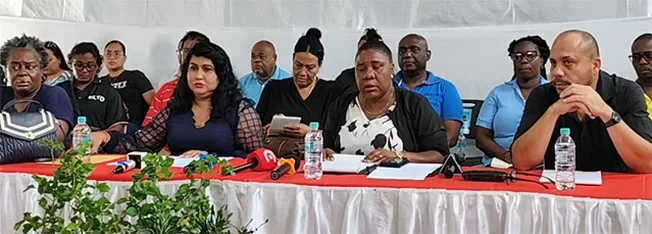
In a historic show of unified action across the Netherlands’ entire education sector, major education trade unions have formally launched a nationwide industrial dispute, confirming that talks alone with the government will not be enough to suspend the protest action.
Speaking at a joint press conference held earlier on 1 June, union leaders made clear they will only end the national consultation (industrial action) once concrete results and legally binding agreements are put on the negotiating table. Nearly every segment of the country’s education system—from primary and secondary education through to higher education institutions—has thrown its support behind the collective action. Union representatives describe the moment as unprecedented, marking the first time that diverse education organizations have aligned as a single front to draw urgent attention to the deep-seated challenges plaguing the sector.
While unions confirmed they are scheduled to hold talks on Monday with representatives from the government, the presidential commission and the Ministry of Education, they stressed that previous negotiation rounds have delivered little to no tangible progress. According to the unions, long-standing grievances including back pay, bonus payments, pay grading, permanent employment contracts and other workplace benefits have gone unresolved for years.
“We are willing to listen, but the industrial action will not be lifted without real results,” one senior union leader stated during the press conference. “We do not want to hear empty promises again—we want to see concrete agreements and immediate implementation.”
Beyond the unresolved employment benefits, unions highlight that the education sector has grappled with a severe teacher shortage for an extended period, with fewer and fewer young people choosing to pursue careers in education. They attribute this crisis in part to stagnant low salaries and the repeated delay of entitled compensation for education workers. Union leaders emphasize that the deteriorating situation does not only harm teaching staff—it also undermines the quality of education across the country, putting the long-term future of students at risk.
Despite launching the industrial action, unions stress they have not lost sight of the best interests of students. It is precisely because of their commitment to protecting students’ educational future that they are taking a stand now. “We are fighting for teachers, because without teachers, there is no education,” union representatives affirmed at the press conference.
Unions are set to hold further talks with government representatives later the same day, and the outcome of these discussions will shape the next steps of the industrial action. For the time being, the protest remains in full effect, and teachers are still being called to stay away from work until there is clear progress on tangible solutions. Unions have also been in contact with the president, who is currently visiting the Dominican Republic, and the president has agreed to meet with union leaders promptly upon his return on 2 June.