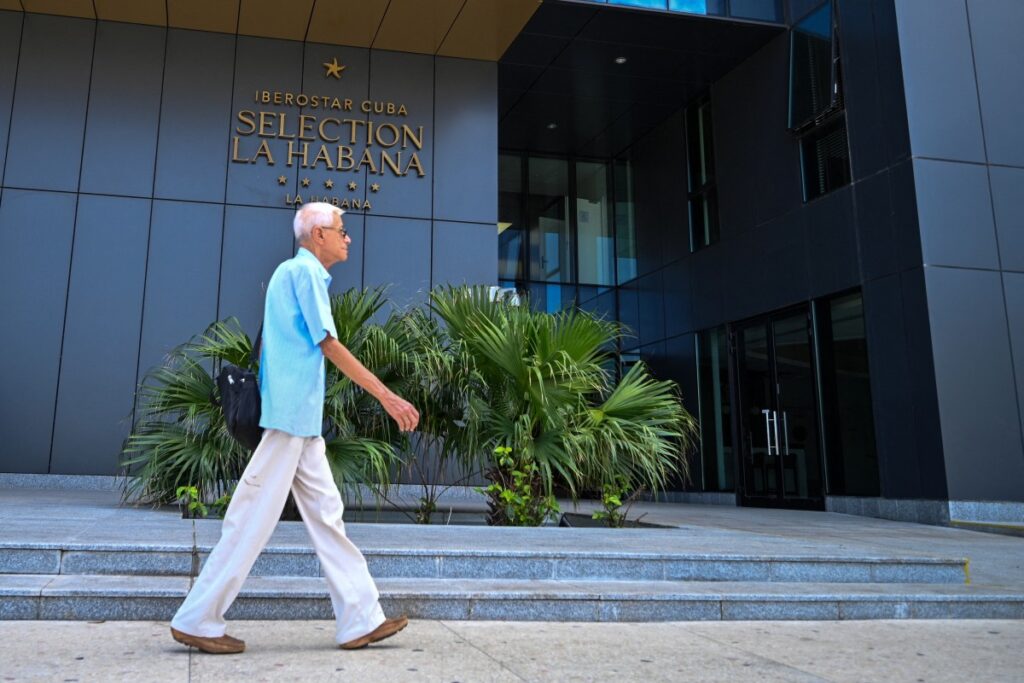
As a critical May 24 deadline from the United States forcing foreign firms to cut all business ties with Cuba’s powerful military-owned conglomerate GAESA approaches, international companies have dramatically drawn down their operations on the island by Tuesday, delivering another crippling blow to Cuba’s already collapsing economy. This latest round of sanctions is part of the Trump administration’s sweeping escalation of pressure on Havana, which has included a full energy blockade imposed earlier this year and growing rhetoric about potential US control over the island.
Back in early May, President Donald Trump issued an executive order freezing all of GAESA’s assets held within US jurisdiction and imposing harsh secondary sanctions on any foreign entity that continues doing business with the group. The US Office of Foreign Assets Control (OFAC) has given all affected international companies until this Friday to restructure their operations to comply with the new rules, or face harsh penalties including asset freezes and exclusion from the global financial system. By all indicators, the US pressure campaign has had its intended effect, with a wave of withdrawals and suspended operations unfolding across multiple key sectors of Cuba’s economy in recent weeks.
Cuban economist and independent consultant Daniel Torralbas told AFP that the immediate economic fallout from this exodus is catastrophic, noting that 2026 has already shaped up to be the worst year for Cuba’s economy in seven decades. The damage is being felt acutely across the island’s critical tourism sector, which has long been one of its largest sources of foreign currency. Canada’s Blue Diamond Resorts, one of the biggest international hospitality operators working in Cuba, announced Monday that it was ceasing all operations on the island. While the firm framed the decision as a response to broader challenging tourism conditions, it comes directly in line with the new US sanctions mandate.
Multiple industry sources confirmed to AFP on Tuesday that Spain’s Iberostar Group, another major hotel operator in Cuba, is withdrawing from 12 properties it managed in partnership with entities linked to GAESA. Specifically, the firm is exiting all co-management agreements with Gaviota Tourism Group, which is a core subsidiary of GAESA. The withdrawal went into effect on June 1, according to two separate sources familiar with the decision. The Mallorca-based company declined to publicly comment on the changes when contacted by AFP, but sources added that Iberostar will maintain its co-management agreements for hotels owned directly by Cuba’s Ministry of Tourism, which are not covered by the new sanctions. Two other major international hotel groups — Spain’s Melia and Indonesia’s Archipelago International — are currently evaluating full or partial withdrawals from their Cuban operations, according to industry insiders.
The impact extends far beyond tourism, hitting the island’s logistics and natural resource sectors as well. Two of Europe’s largest shipping companies, France’s CMA CGM and Germany’s Hapag-Lloyd, have already temporarily suspended all new freight bookings to Cuba, explicitly citing Trump’s executive order as the reason for the move. In early May, Canadian mining giant Sherritt International announced it was ending its decades-long presence in Cuba, where it had operated a joint nickel and cobalt mining venture with state-owned General Nickel Company S.A. since the 1990s.
The Trump administration has framed its crackdown on GAESA as a push against Cuban government corruption. US Secretary of State Marco Rubio, a Cuban-American politician and one of the most vocal critics of the Havana government, has repeatedly accused GAESA of operating as a shadow state that accumulates wealth for a small circle of ruling elites at the expense of ordinary Cuban citizens. “It is a ‘state within a state’ that is accountable to no one, hoarding the profits from its businesses for the benefit of a tiny elite,” Rubio said of the conglomerate.
Havana issued a sharp rebuke of these allegations on Tuesday, pushing back against the US claims and defending GAESA’s role in the Cuban economy. Cuban officials explained that the conglomerate was established specifically to counteract the impact of the decades-long US trade embargo that has been in place since 1962. The government called the new US sanctions “the most intense, disproportionate, and dangerous escalation in the recent history of relations between Cuba and the United States.” It also highlighted the public benefits GAESA has delivered to the Cuban people, noting that the group played a central role in keeping the Cuban economy stable during the Covid-19 pandemic and has led construction of more than 10,000 new affordable homes for Cuban citizens. “Its work speaks for itself, and it does so above the state slander concocted in Washington,” the Cuban government’s statement concluded.