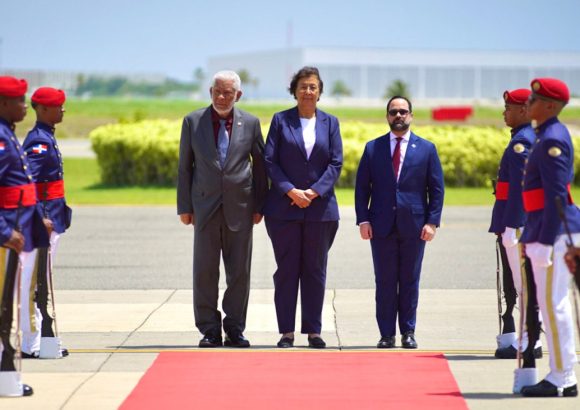
PUNTA CANA – Surinamese President Jennifer Geerlings-Simons touched down in the Dominican Republic Saturday, kicking off an official working visit that will extend through June 2. The visiting head of state was greeted with full military honors upon arrival, and received by high-ranking Dominican government representatives, including senior officials from the Dominican Ministry of Foreign Affairs and members of the Dominican diplomatic mission stationed in Suriname. Geerlings-Simons is not traveling alone; a delegation of senior Surinamese government officials, including Foreign Minister Melvin Bouva and Transport, Communications and Tourism Minister Raymond Landveld, is accompanying her throughout the visit.
On Monday, the diplomatic schedule will center on high-level talks at the Dominican National Palace, where Geerlings-Simons is set to hold a full slate of official meetings with Dominican President Luis Abinader. The packed agenda opens with a closed-door private bilateral discussion between the two leaders, followed by plenary talks between the full delegations from both nations. After the discussions, the two sides will hold a formal signing ceremony for multiple new cooperation agreements, before issuing a joint official declaration outlining shared priorities. Following the meetings, Geerlings-Simons will join Dominican Foreign Minister Roberto Álvarez to lay a wreath and pay respects at the Altar of the Fatherland, a prominent national memorial in the country.
Tuesday will bring the next phase of diplomatic engagement: the Surinamese president is scheduled to hold talks with top Dominican congressional leaders before delivering a landmark address to a joint session of the Dominican bicameral legislature.
This official visit marks a key milestone in the steadily growing bilateral relationship between the Dominican Republic and Suriname. Over recent years, the two Caribbean nations have actively expanded collaborative frameworks across a range of high-priority sectors, including energy, hydrocarbon development, agriculture, and commercial air services. Recent diplomatic efforts and existing agreements have centered on three core mutual goals: increasing bilateral trade volumes, advancing shared progress in sustainable energy development, and deepening cross-sector collaboration that benefits both nations’ populations and economies.