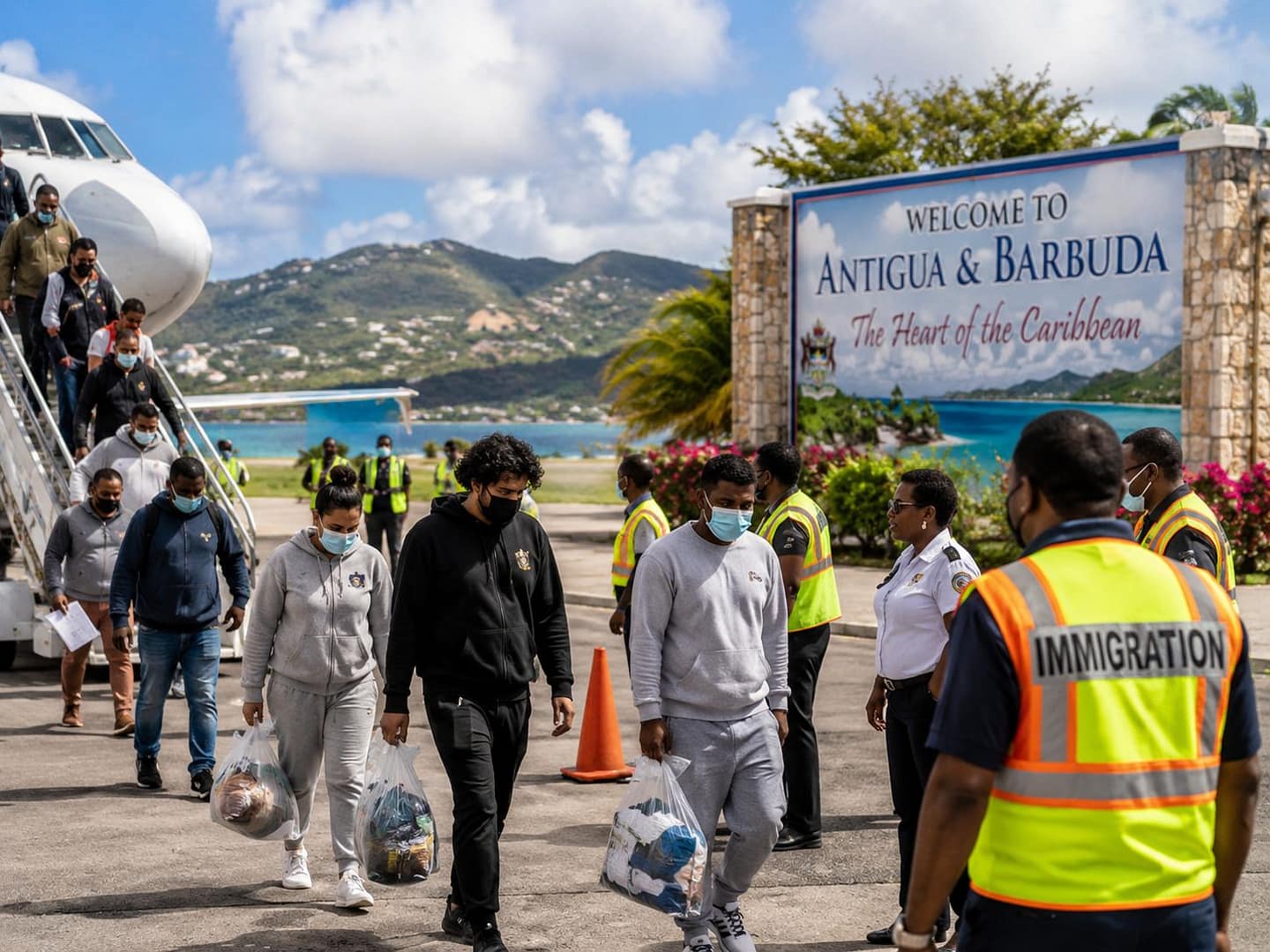
As bilateral negotiations over a proposed deportation arrangement continue between Antigua and Barbuda and the United States, Prime Minister Gaston Browne has publicly drawn a hard line against a U.S. request that would see the small Caribbean nation accept up to 120 third-country nationals annually, calling the proposal “totally unacceptable” and prioritizing the country’s limited capacity and national security over blind cooperation. Speaking during his weekly *Browne and Browne* radio broadcast on Saturday, Browne clarified that Antigua and Barbuda has only offered to accept a maximum of 10 deportees per year under any finalized deal, a cap that aligns with the nation’s size and inherent vulnerabilities.
Browne revealed that the initial 120-person proposal came with no binding commitments for U.S. assistance, nor any guarantee that comprehensive background checks would be completed on individuals before transfer. That lack of structure, he emphasized, is a non-starter for his administration. “At one point I was told that they had asked us to accept as many as 120 individuals and there was no guaranteed assistance, no guaranteed due diligence. And I said to them that that is totally unacceptable,” Browne told listeners.
The prime minister outlined three non-negotiable conditions that Antigua and Barbuda is requiring Washington to meet before any agreement can move forward. First, all individuals must undergo rigorous vetting by U.S. law enforcement and immigration authorities to screen out criminal elements. Browne stressed that even a single high-risk individual can have outsized negative consequences for a small nation like Antigua and Barbuda, saying “one criminal element coming into our country can make a difference.”
Second, Browne insisted that every deportee transferred to the country must hold valid, official travel documentation. He explained that undocumented migrants detained in the U.S. often destroy their identity papers to avoid deportation, and Antigua and Barbuda cannot absorb stateless individuals with no verifiable background. “What happens sometimes is some of these immigrants, who they detain as soon as they get to the United States, they tear up their travel documents and we can’t have them come here as stateless individuals,” he said.
While Browne reaffirmed Antigua and Barbuda’s commitment to maintaining a constructive, cooperative relationship with the United States, he made clear that cooperation will never come at the cost of the island nation’s core national interests. “We have said to them that, look, they have their issues, and we want to help. We want to be a cooperative state. But we cannot participate or agree to anything that is to our detriment,” he said.
The prime minister pushed back against any expectation that he would accept an unfavorable deal, asking rhetorically: “I mean, can anybody justify the prime minister of this country being part of any decision, or agreeing, or being compliant with anything that is not in the best interest of this country?” He noted that Antigua and Barbuda’s small geographic size and population leave it uniquely vulnerable to security risks, requiring extreme caution when entering any arrangements involving the transfer of foreign nationals. “We’re small, powerless and very vulnerable. Based on that vulnerability, we have to make sure that we keep our country safe and secure,” Browne said.
He added that the administration’s top concern is avoiding the accidental admission of individuals with criminal histories, a outcome that he says would never happen under his leadership. “Where there is any probability for us to even inadvertently and complicitly allow criminals to come into the country, as I said, that’s not in my leadership,” he stated.
As of Saturday, Browne confirmed that negotiations with U.S. officials remain ongoing, and Antigua and Barbuda has not yet received a formal response from the U.S. State Department after the country submitted its latest counter-proposal outlining its conditions and annual cap. Discussions on the arrangement were launched after the two sides signed a non-binding memorandum of understanding that outlined a framework for Antigua and Barbuda accepting a limited number of third-country nationals. From the start of negotiations, the Antigua and Barbuda government has maintained that while it stands ready to assist its international partners, any final agreement must align with the country’s national security needs and practical capacity to absorb new arrivals.
LISTEN: PM Browne Says A Proposal To Accept Up To 120 Deportees Is Not in Antigua’s Best Interest