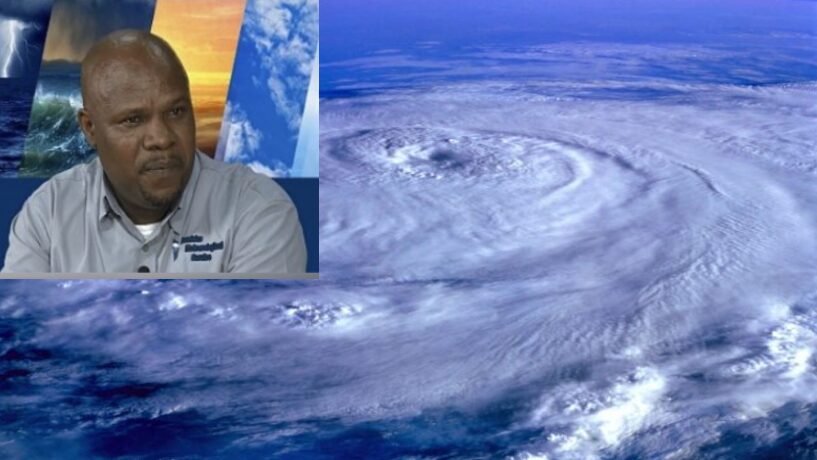
The 2026 Atlantic Hurricane Season officially got underway on June 1, marking the start of the six-month storm period that will extend through the end of November, according to top meteorological officials in Dominica.
Acting Director of Meteorology Marshall Alexander has highlighted that the U.S. National Oceanic and Atmospheric Administration (NOAA) is projecting a below-normal season for 2026. The agency’s probabilistic outlook puts the chance of below-average storm activity at 55%, with an expected range of 8 to 14 named storms, 3 to 6 full hurricanes, and 1 to 3 major hurricanes forming across the entire Atlantic Basin this year. This forecast is rooted in ongoing climate trends: a strengthening El Niño event is forecast to boost wind shear across the Atlantic, a atmospheric condition that typically suppresses tropical cyclone development. This suppressing effect is partially offset by warmer-than-average Atlantic sea surface temperatures, which can fuel storm growth when systems do form.
NOAA constructs its annual hurricane outlook using a robust combination of cutting-edge climate modeling, high-resolution satellite observations, and detailed analysis of large-scale atmospheric and oceanic circulation patterns. Integrating modern tools including artificial intelligence-powered prediction models and next-generation satellite systems, the agency’s cross-institutional team — drawing expertise from the Climate Prediction Center, National Hurricane Center, and Atlantic Oceanographic and Meteorological Laboratory — collaborates to produce the final seasonal outlook. Unlike fixed, precise predictions, NOAA frames its outlook as probabilistic ranges to reflect the inherent uncertainty of seasonal weather forecasting.
Even with the expectation of a quieter-than-average season, Alexander has stressed that communities, particularly those in vulnerable island nations like Dominica, must not let their guard down. “Our history has shown us that it only takes one storm to make for a very dangerous and devastating season,” Alexander explained, pointing to the catastrophic legacy of 2015’s Tropical Storm Erika and 2017’s Hurricane Maria, two events that left Dominica reeling from widespread flooding, catastrophic landslides, crippling infrastructure destruction, and irreversible losses of life and local livelihoods.
As a mountainous island nation located directly within the Atlantic hurricane belt, Dominica remains uniquely exposed to a range of hurricane-linked hazards, including flash flooding, overflowing river systems, landslides, rockfalls, destructive high winds, choppy coastal seas, and permanent coastal erosion. Even a single moderate storm can trigger cascading disasters across the island’s steep terrain.
To help residents stay ahead of developing threats, Alexander urged the public to rely exclusively on official information sources throughout the season, including updates from the Dominica Meteorological Service. Updates are distributed via local radio, the service’s official website at www.weather.gov.dm, and social media platforms including Facebook, Instagram, and WhatsApp.
“Preparedness, early action, communication and coordination remain our strongest defenses during the hurricane season,” Alexander said. He reaffirmed that the below-normal seasonal forecast should not change how Dominicans prepare for storm threats, repeating a critical message that underscores the stakes for at-risk coastal communities: “It only takes one.” NOAA echoed this sentiment, emphasizing that regardless of projected seasonal activity, pre-season preparedness remains the most effective strategy to reduce hurricane-related harm.