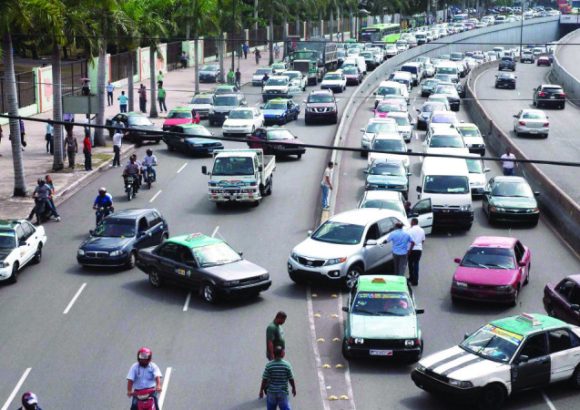
Over the past seven years, the Dominican Republic has secured more than $2 billion in international loans to fund traffic and mobility improvements across its major urban centers, according to an in-depth review of five nationally approved financing agreements. Each deal, vetted by the Dominican National Congress, signed off by the Ministry of Finance and authorized by the sitting president, is tied to targeted road infrastructure and public transport transformation projects, with varying requirements for policy reform tied to fund disbursement.
The first of these agreements dates back to December 2019, during the presidential administration of Danilo Medina. The government signed a $250 million financing deal with the Inter-American Development Bank (IDB), but the loan came with non-negotiable preconditions tied to the country’s 2017 Mobility, Land Transport, Transit, and Road Safety Law (Law 63-17). Before accessing any funds, the Dominican state was required to implement a series of substantial structural reforms rather than superficial changes. These requirements included launching a fully functional national Road Safety Observatory, establishing at least five active traffic accident investigation units within the General Directorate of Traffic Safety and Land Transportation (Digesett), adding new operational departments to the National Institute of Transit and Land Transportation (INTRANT), and rolling out a plan to formalize informal taxi operators into registered commercial businesses.
Per the contract terms, the funding was earmarked explicitly to support the rollout of Law 63-17, aligning with the pre-disbursement reform goals. Repayment of the IDB loan is structured in semi-annual installments that will continue through 2039.
A decade later, in October 2020, just ten months after the first loan was signed, the new administration of President Luis Abinader secured a second $250 million loan from the French Development Agency (AFD) to co-finance the same broader national transport reform program backed by the IDB. Negotiators secured a fixed annual interest rate of 2.80% for this agreement — a notably favorable term, as global interest rates surged sharply in subsequent years amid the COVID-19 pandemic and other global economic shocks. Repayment for the AFD loan is scheduled to begin in March 2025 and conclude in September 2039. A unique stipulation of the agreement notes that it falls under French legal jurisdiction, with any disputes required to be resolved via arbitration in Paris, conducted in the French language.
In October 2022, the Dominican government secured a third loan, an additional $200 million tranche from the IDB to expand the original transport reform program. This new tranche came with more ambitious pre-disbursement requirements: the government was required to show proof of at least ten fully implemented actions from the National Strategic Road Safety Plan, enact a school transportation regulation that integrates gender equity considerations and universal accessibility standards, and demonstrate concrete progress toward expanding electromobility across the country’s transport fleet.
It is important to note that both IDB and AFD loans are not generic lines of credit. Each agreement includes binding clauses that require the Dominican government to implement sweeping public policy changes in exchange for access to funding. The contracts explicitly allow lenders to suspend future disbursements or demand full early repayment if the government fails to meet its reform commitments.
The fourth loan analyzed diverges from the policy-focused reform financing, instead targeting a specific large-scale infrastructure construction project. The Central American Bank for Economic Integration (CABEI) provided $250 million to fund construction of Line 2C of the Santo Domingo Metro, a new section that will connect the western outskirts of the capital to the city’s existing metro network. This loan carries a 20-year repayment term from the first disbursement, with a five-year initial grace period. Unlike the fixed-rate AFD loan, this agreement uses a variable interest rate tied to the Secured Overnight Financing Rate (SOFR) plus 268 basis points, meaning Dominican public debt repayments will rise automatically if global interest rates increase.
The most recent and largest of the five agreements was signed in July 2024 by the Ministry of Finance, to fund the new Santiago de los Caballeros Monorail. BNP Paribas and Citibank, backed by the French government via its export credit agency Bpifrance, provided 464.9 million euros (equivalent to roughly $510 million) for the project. The monorail will span 13 kilometers of track, include 14 stations, and have capacity to carry 20,000 passengers per hour during peak travel times. French transportation firm Alstom Transport leads the construction consortium, holding a 73% stake in the project. This loan carries a fixed annual interest rate of 3.78%, with a full guarantee from the French government.