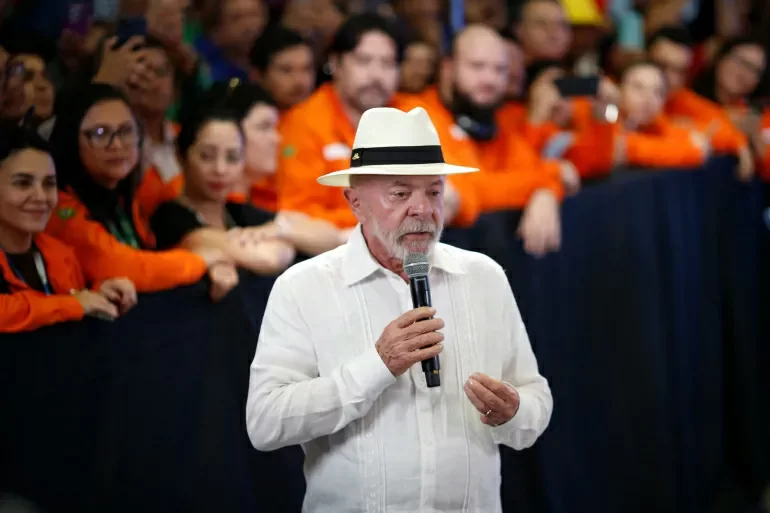
Brazilian President Luiz Inacio Lula da Silva has issued a sharp rebuke of the United States’ decision to classify two of Brazil’s largest transnational criminal networks — Primeiro Comando da Capital (PCC) and Comando Vermelho (CV) — as official terrorist organizations. In a lengthy statement posted to social media Thursday, Lula argued that the U.S. labeling undermines Brazil’s own domestic efforts to combat organized crime, drawing a clear distinction between profit-driven criminal activity and ideologically motivated international terrorism.\n\n“The terror these groups inflict on local communities is rooted in earning illicit profits from crime, but it cannot be equated to the political, ideological or religious motives that drive international terrorism,” Lula stated in the address. The U.S. announced Wednesday that the classification, which takes effect June 5, will add both groups to its official Foreign Terrorist Organizations list and label them as Specially Designated International Terrorists. Under the designation, any assets linked to PCC and CV held within U.S. jurisdictions will be frozen, and providing material support to the groups will become a federal criminal offense.\n\nSecurity analysts have already warned that the new restrictions could carry unintended negative consequences, potentially harming Brazilian financial institutions as well as civilian businesses and residents who have been extorted by the gangs. Beyond risks to innocent parties, Lula raised grave concerns that the terrorist labeling could open the door to unilateral U.S. military intervention on Brazilian soil. “We stand ready to collaborate on solutions that benefit all involved nations, but we will not accept arbitrary unilateral measures from outside powers that undermine our national sovereignty and our economy,” he warned.\n\nThe controversy unfolds against the backdrop of a highly contested 2026 Brazilian presidential election year, where public security is set to be a defining campaign issue. Lula, a veteran leftist leader, is currently seeking a fourth term as Brazil’s president. He defeated far-right incumbent Jair Bolsonaro in the 2022 election; Bolsonaro was later convicted of orchestrating a failed coup attempt following his loss, and is currently serving a 27-year prison sentence.\n\nPolitical observers widely point to Flavio Bolsonaro, Jair Bolsonaro’s eldest son and a sitting senator who is running for president in 2026 as a right-wing candidate, as the key driving force behind the U.S. decision. Flavio has openly confirmed he pushed for the terrorist classification during a recent visit to the White House, and has made cracking down on organized crime a centerpiece of his campaign against Lula. Lula has accused the Bolsonaro family of actively lobbying for foreign interference in Brazil’s domestic affairs through their long-standing political and personal ties to former U.S. President Donald Trump, calling the move “a sad day” for Brazilian democracy.\n\nThe Bolsonaro family’s close alignment with Trump dates back to Jair Bolsonaro’s presidency, and Trump has spent years backing far-right candidates in elections across the globe. In August 2025, Trump imposed sweeping new tariffs on Brazilian goods in retaliation for the corruption and coup conviction of Jair Bolsonaro. Since returning to the U.S. presidency, Trump has overseen a dramatic expansion of U.S. influence in the Western Hemisphere, reviving the Monroe Doctrine that asserts U.S. primacy over the region. Trump has repeatedly justified unilateral U.S. military action across Latin America and the Caribbean as a necessary measure to combat drug trafficking and organized crime. Since September 2025, his administration has launched 59 strikes on suspected smuggling vessels in the Caribbean and Pacific, resulting in at least 196 civilian and combatant deaths. In a much more high-profile move, the U.S. launched a military incursion into Venezuela in January 2026 that led to the arrest of then-President Nicolás Maduro on drug trafficking charges. Lula has repeatedly decried these unilateral military actions as illegal violations of national sovereignty.\n\nFor Lula, the terrorist classification puts him in a politically delicate position: he must condemn the U.S. designation as overreach without appearing to downplay the severe harm PCC and CV inflict on Brazilian communities. To counter criticism that his administration has not done enough to combat gang violence, Lula has highlighted the significant resources his government has already committed to anti-crime efforts: his administration has invested $11 billion in the national “Brazil Against Organized Crime” initiative, and earmarked an additional $2 billion in March to upgrade prison infrastructure, improve homicide investigations, and dismantle weapons smuggling networks and illicit criminal financial flows.\n\nAs the October general election approaches, the race remains extraordinarily tight. A Datafolha poll conducted May 16 found that in a head-to-head matchup between Lula and Flavio Bolsonaro, each candidate would capture 45% of the vote, with 9% of voters planning to cast blank ballots and just 1% remaining undecided, leaving the outcome of the election highly uncertain.