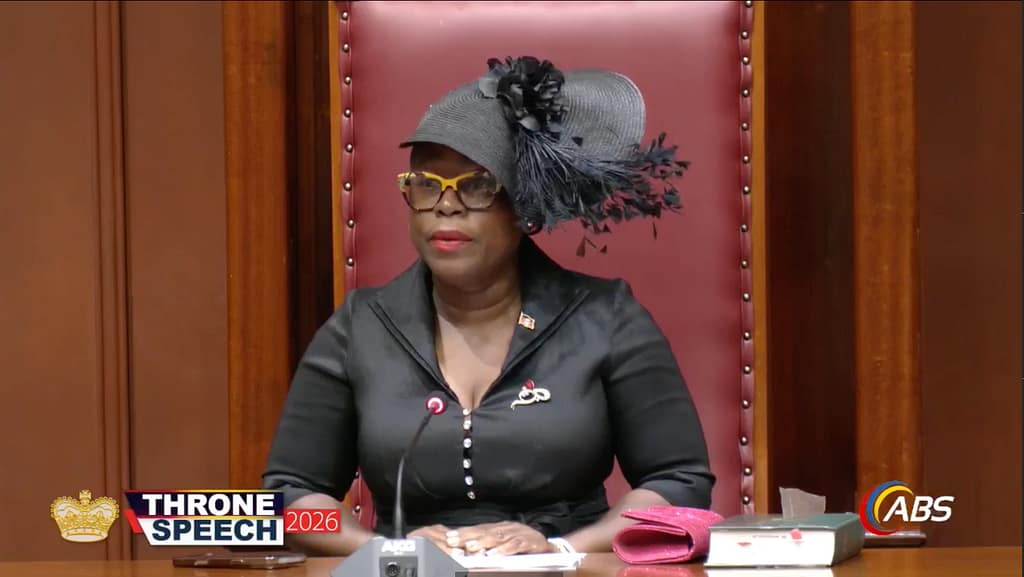
A recent high-stakes incident in the Parliament of Antigua and Barbuda has pulled a long-simmering question of Westminster constitutional convention into the national spotlight, sparking fierce debate over whether an unsworn Member of Parliament may attend a ceremonial sitting like the Governor General’s Throne Speech.
The controversy was triggered after the Senate President ordered the Opposition Leader to exit the parliamentary chamber, on the grounds that he had not completed the required oath of allegiance ahead of the ceremonial Throne Speech sitting. What began as a seemingly minor procedural incident quickly ballooned into a national conversation touching on constitutional norms, parliamentary procedure, and the limits of presiding officers’ authority during formal ceremonial sessions.
At the heart of the dispute lies a nuanced distinction that often goes unrecognized in Westminster-style democracies: the line between simply attending the ceremonial opening of Parliament and holding the constitutional right to sit and vote as an active, fully empowered parliamentarian. Under the Westminster system inherited from the United Kingdom, elected representatives are uniformly barred from engaging in substantive parliamentary business until they complete the mandatory oath of allegiance. This restriction covers core parliamentary functions, from speaking in plenary debate and voting on motions to tabling new legislation and exercising the formal powers of elected office.
Yet long-standing Westminster precedent also holds that ceremonial attendance at the State Opening of Parliament regularly takes place before new members complete the swearing-in process. In the UK itself, newly elected Members of Parliament conventionally attend the State Opening and hear the King’s Speech before the formal oath-taking process concludes. Swearing-in is typically staggered over the several days following the opening ceremony, after which regular legislative work gets underway.
This long-held practice embodies a core constitutional distinction deeply embedded in parliamentary convention. A person may be formally confirmed as elected or appointed to Parliament, but they do not gain full authority to exercise the functional powers of office until the oath is administered. The Antigua and Barbuda Constitution, like other Commonwealth constitutions modeled on the Westminster system, explicitly requires parliamentarians to take the oath before taking their seat and participating in full parliamentary proceedings. But constitutional scholars across the Commonwealth have long interpreted this requirement as applying exclusively to the exercise of formal parliamentary powers, not simple symbolic attendance at ceremonial events.
The core legal and conventional question at hand, therefore, is whether attending a Throne Speech counts as substantive participation in parliamentary business, or whether it remains a primarily ceremonial and symbolic act. Critics of the Senate President’s decision to remove the Opposition Leader argue the order represented an unnecessarily rigid reading of constitutional procedure that breaks from long-held broader Westminster custom. They emphasize that the Throne Speech is fundamentally a ceremonial state occasion that marks the formal opening of a new parliamentary term, rather than an ordinary legislative sitting that includes debate, voting or substantive lawmaking.
On the opposite side of the debate, supporters of the action insist that once Parliament is formally convened, only properly sworn members should be allowed to be present in the chamber in an official capacity. They argue that constitutional formalities and institutional order must be upheld from the very start of a new parliamentary term to maintain the integrity of the legislature.
Beyond the question of oaths and ceremonial attendance, the incident has also renewed long-running discussion about the scope of authority held by presiding officers in Westminster parliamentary chambers. In this system, Speakers and Senate Presidents hold broad procedural power to maintain order and interpret standing rules, but that authority is not unlimited. It is constrained by constitutional convention, historical precedent, and public political scrutiny.
A defining feature of Westminster governance that this controversy has underscored is the central role of unwritten constitutional convention. Unlike systems where all governing rules are strictly codified in a written constitution, many core parliamentary practices in Westminster democracies rely not just on written law, but on inherited tradition, widely accepted convention, and historical precedent.
It is this feature that has allowed the controversy to gain such traction across Antigua and Barbuda and the wider Caribbean. This is not simply a disagreement over seating arrangements or procedural niceties; it raises fundamental broader questions about constitutional interpretation, democratic legitimacy, and the balance between explicit written rules and long-established unwritten practice.
Across the Commonwealth Caribbean, nations including Jamaica, Barbados, and Trinidad and Tobago operate under near-identical constitutional frameworks. In most of these jurisdictions, parliamentary ceremonial openings have historically allowed unsworn members to attend ahead of formal swearing-in, so long as they do not participate in any substantive legislative business.
It remains unclear whether this incident in Antigua and Barbuda will set a precedent for stricter interpretations of parliamentary procedure going forward. What is unambiguous, however, is that the episode has opened a vital national conversation about the constitutional norms that underpin Antigua and Barbuda’s democratic system.
In Westminster democracies, major constitutional disputes rarely emerge purely from disagreements over what is written in law. Far more often, they arise from conflicting interpretations of convention, precedent, and unwritten practice. Antigua and Barbuda’s latest parliamentary controversy fits squarely within this tradition, offering a defining test of how the nation’s constitutional order balances written rules and long-held custom.