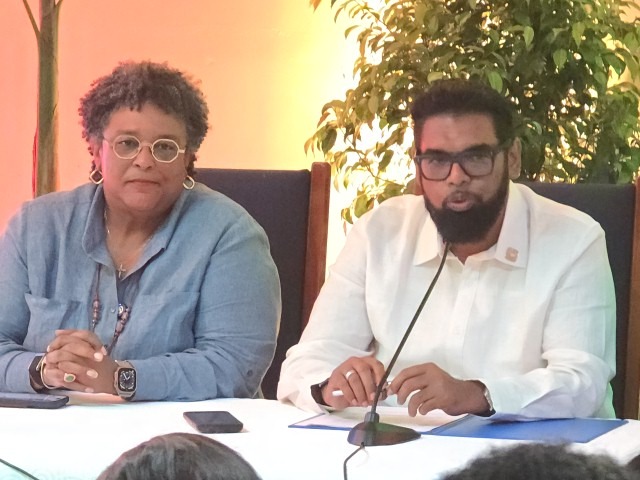
On Tuesday, May 26 2026, as Guyana marked its 60th anniversary of independence, President Irfaan Ali made a landmark economic announcement that opens new pathways for global Guyanese to contribute to their home nation’s rapid development. Speaking at a joint press conference alongside Barbados Prime Minister Mia Mottley, Ali confirmed that the South American Caribbean country will launch a diaspora bond as early as next week, designed specifically to attract investment from Guyanese residing overseas.
The financial instrument is structured to pool capital from the global Guyanese community to fund a broad pipeline of public infrastructure projects across the country, which is currently experiencing an economic boom driven by new offshore oil discoveries. “Members of the diaspora, here is your opportunity to make your contribution and to be part of the massive transformation taking place in our country,” Ali stated, framing the bond as an inclusive invitation for overseas Guyanese to participate directly in national growth.
Following President Ali’s announcement, Prime Minister Mottley revealed a parallel collaborative initiative between the two Caribbean nations: the establishment of the Trident Arrow Investment Fund, a collective investment vehicle built to give ordinary retail investors access to stakes in critical infrastructure projects, as well as medium and long-term opportunities across the utility, digital technology, and agricultural processing sectors.
Mottley emphasized that the fund addresses a long-running financial inequality facing Caribbean citizens, noting that traditional savings accounts currently deliver returns as low as 0.1% – a rate that fails to keep pace with inflation, effectively eroding the purchasing power and wealth of working people over time. “In an inflationary environment you effectively pauperise your citizens,” she explained, arguing that the fund provides a far more viable alternative for ordinary people to build long-term wealth.
A core stated mission of the Trident Arrow fund is to reframe ownership of strategic national assets: instead of ceding majority control of critical economic sectors to exclusively foreign investors, the collective vehicle allows local and diaspora Guyanese and Barbadians to hold stakes in the development of their home countries. Mottley framed this as a shift from lifetime tenancy to collective ownership, saying “Instead of allowing only other foreign investment to come into hold critical parts of aspects of our economy, it allows ordinary people who could not do it on their own, but who, as part and parcel of a collective group, can make it happen in those countries.”
Moving to address potential concerns over governance, Mottley gave explicit assurances that the fund would operate entirely outside of political influence, with strict adherence to global prudential financial regulations, formal oversight mechanisms, and robust legal frameworks to protect investor interests.
The dual announcements mark a new approach to inclusive development in the Caribbean, tapping into diaspora wealth and expanding local citizen participation in large-scale national projects that have historically relied heavily on external financing.