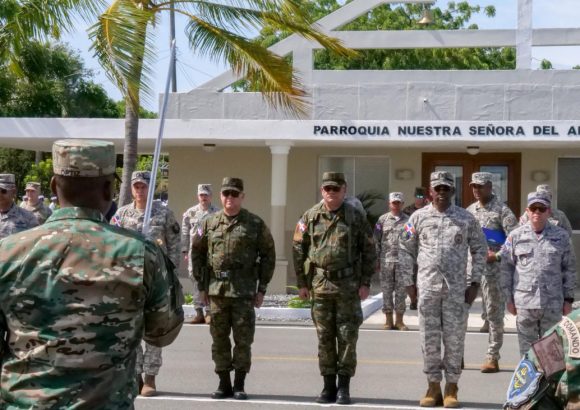
LAS CALDERAS NAVAL BASE, PERAVIA – The Dominican Republic Navy has officially wrapped up three interconnected military training initiatives, including the annual Joint Combined Exchange Training (JCET), Basic Diving Courses 011-012, and the Naval Special Forces Qualification Course (CCUFEN), during a formal closing ceremony hosted at its primary southern coastal installation.
The high-profile ceremony was presided over by Dominican Republic Defense Minister Lieutenant General Carlos Antonio Fernández Onofre, with senior leadership in attendance that included Vice Admiral Juan Bienvenido Crisóstomo Martínez, General Commander of the Dominican Navy, and Leah Francis Campos, the United States Ambassador to the Dominican Republic. Senior military stakeholders from across the Dominican Armed Forces General Staff and top-ranking Navy command staff also took part in the event, which centered on the tangible progress made in upgrading the Dominican Navy’s tactical and operational capacity.
In his keynote address to participating service members and assembled officials, Vice Admiral Crisóstomo Martínez underscored the outsized role that these structured multinational training programs play in boosting three critical pillars of naval readiness: cross-force interoperability, global defense cooperation, and the operational preparedness of Dominican naval special operations units to counter evolving maritime security and defense threats. He specifically highlighted the value of the longstanding defense partnership with the United States, noting that collaborative training frameworks create structured pathways to exchange frontline operational insights, updated military doctrine, and decades of tactical expertise between the two nations’ forces.
Following official remarks, the ceremony featured a live operational demonstration that put on display the specialized skills all participants mastered over the course of the training cycle. Trainees from the Dominican Navy joined operators from Alpha ODA 735, a team from the U.S. Army Green Berets, to execute tactical drills, showcasing the high level of coordinated readiness the joint program was designed to build.
Per Dominican Navy leadership, collaborative joint exercises like JCET are an indispensable component of the country’s efforts to reinforce national response capacity against a broad spectrum of transnational security challenges, ranging from maritime organized crime to large-scale search and rescue operations, as well as critical infrastructure protection. Each of the three training initiatives was tailored to target distinct, high-priority capability gaps: the Basic Diving Course focused on building foundational proficiencies in underwater operations, technical rescue procedures, maritime hazard mitigation, and specialized underwater naval missions, while the CCUFEN qualification program was structured to develop advanced special operations skill sets, including large-scale amphibious operations and direct-action special combat tactics.
Navy officials confirmed that these ongoing training programs are a core element of the service’s long-term institutional modernization and force strengthening strategy. The overarching goal of the initiative is to maintain a consistently high-readiness, fully trained maritime defense force capable of upholding Dominican national sovereignty and safeguarding the country’s extensive territorial maritime boundaries.