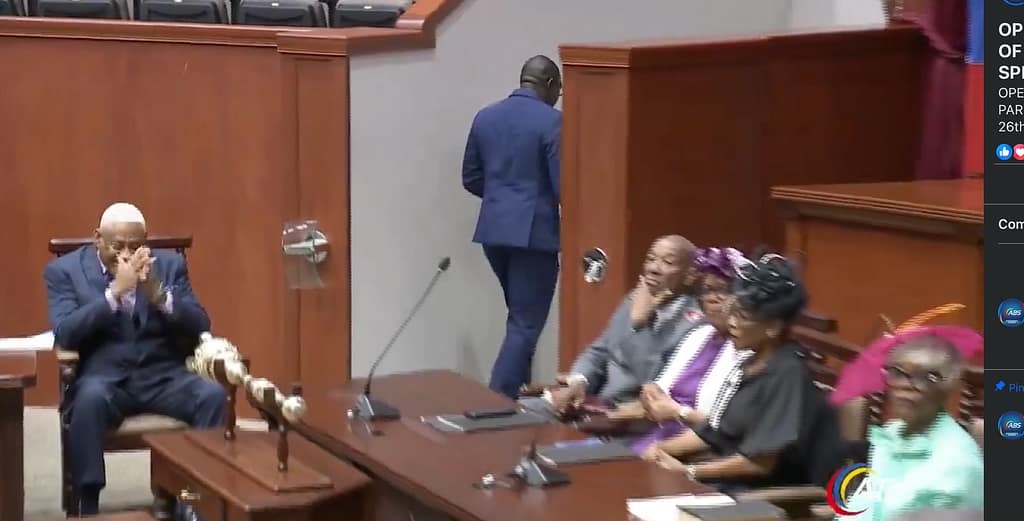
A major political confrontation has erupted in Antigua and Barbuda’s legislature after the Senate President barred Opposition Leader Jamale Pringle from taking his seat for the annual Throne Speech on the morning of May 26, 2026, triggering a walkout by all opposition lawmakers and sharp accusations of partisan manipulation of parliamentary procedure.
The United Progressive Party (UPP), the country’s main opposition bloc, has issued a fierce condemnation of Senate President Alincia Williams-Grant’s controversial decision, which it says violates long-standing parliamentary norms and undermines democratic representation. Pringle, a newly elected Member of Parliament, had been formally invited to the sitting in an official May 14 correspondence from the Clerk to Parliament, which addressed him as “Honourable Member.” The invitation explicitly called him to attend for necessary parliamentary business, which includes completing the oath of office administered by the Clerk, and he arrived at the chamber well ahead of the scheduled event.
Williams-Grant’s official justification for barring Pringle from the chamber was that he had not yet completed his oath of office. But the UPP and its senators reject this reasoning as baseless and politically motivated. Following the expulsion, when Senate Minority Leader Chester Hughes attempted to raise an objection to the ruling on the floor, Williams-Grant also refused to allow him to speak. In response, all four sitting opposition senators staged a coordinated walkout of the upper chamber in protest.
Hughes has laid out detailed arguments challenging the Senate President’s decision, framing it as clear partisan favoritism toward the ruling government. He emphasized that if a governing party MP had faced the same situation, they would have been permitted to complete the oath immediately before the Throne Speech and take their seat. Hughes also called out a double standard in procedural treatment: the Attorney-General, who holds no formal voting or priority position in the Senate, was allowed to address the chamber, while the minority leader, as an elected Senate representative, was denied his basic right to speak on a critical procedural matter.
Beyond accusations of favoritism, Hughes dismissed the secondary justification cited for the ruling — that the decision aligned with procedural norms in nearby Trinidad and Tobago — as entirely irrelevant. He stressed that Antigua and Barbuda’s parliament holds the independent authority to set its own procedural rules, meaning appeals to another country’s practices hold no weight in this context.
The UPP has gone further, alleging that the entire incident was the result of prearranged collusion between the Senate President and government members of the lower house of parliament. The party says the deliberate snub was designed specifically to embarrass Pringle personally and humiliate the opposition as a whole. In closing its condemnation, the opposition bench warned that the arbitrary use of parliamentary procedure to sideline elected opposition representatives poses a direct threat to the foundations of democratic governance in the country.