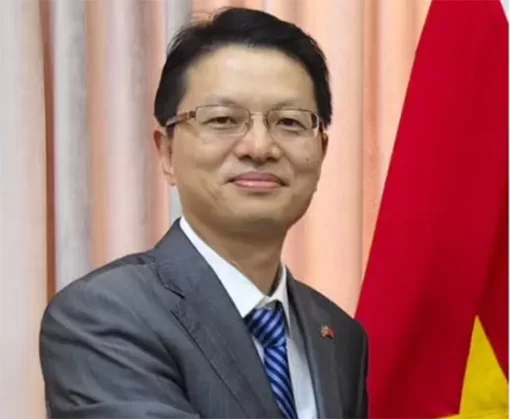
Fifty years after China and Suriname formally established official diplomatic relations, Chinese Ambassador to Suriname Lin Ji has emphasized the enduring value of the deep-rooted friendship and growing collaborative partnership between the two nations, outlining decades of progress that have turned bilateral ties into a model for South-South cooperation.
On May 28, 1976, the two countries officially launched diplomatic relations, marking the start of a steady, mutually respectful relationship built on the core principles of mutual respect, strategic trust, and reciprocal collaboration. Over the intervening 50 years, that relationship has expanded far beyond its early foundations to grow into a full strategic partnership spanning political, economic, cultural and social spheres, Lin noted in his remarks marking the golden jubilee.
A major milestone in the deepening of bilateral ties came in 2019, when the two countries elevated their relationship to a formal strategic cooperation partnership, with Suriname also becoming one of the first Caribbean nations to sign onto cooperative agreements under China’s Belt and Road Initiative (BRI). This opening has paved the way for an unprecedented expansion of bilateral infrastructure and development projects that have directly supported Suriname’s national growth agenda, the ambassador added.
Lin highlighted a range of completed Chinese-backed projects that have delivered tangible public benefits to the Surinamese people, including the Wanica Hospital, large-scale affordable housing developments, an agricultural technical cooperation center, national traffic monitoring systems, and a countrywide broadband infrastructure network. Beyond traditional development projects, he noted that Chinese companies are increasingly expanding their investment footprint in Suriname’s emerging high-growth sectors, including digital technology and renewable green energy, opening new pathways for job creation and economic diversification.
On the political front, bilateral cooperation has been defined by strong, consistent mutual support between the two governments, Lin emphasized. He pointed to Suriname’s longstanding, unwavering commitment to the One-China policy as a key foundation of political trust, while noting that China has consistently respected Suriname’s independent choices for its national development path and strictly adheres to the principle of non-interference in other countries’ internal affairs.
The ambassador also reflected on the deep people-to-people historical ties that predate formal diplomatic relations, noting that Chinese migrants first settled in Suriname more than 170 years ago, laying a groundwork for cultural exchange that endures today. A particularly notable marker of that cultural acceptance, he added, is that Suriname became the first country in the Western Hemisphere to designate Chinese New Year as an official national public holiday.
Looking ahead to the next 50 years of the bilateral relationship, Lin reaffirmed China’s ongoing commitment to expanding collaboration with Suriname across a wide range of priority areas, including economic development, infrastructure investment, education, cultural exchange, and regional integration. He closed by noting that both sides are committed to deepening their bilateral ties while also strengthening broader cooperation between China and the Latin America and Caribbean region as a whole.