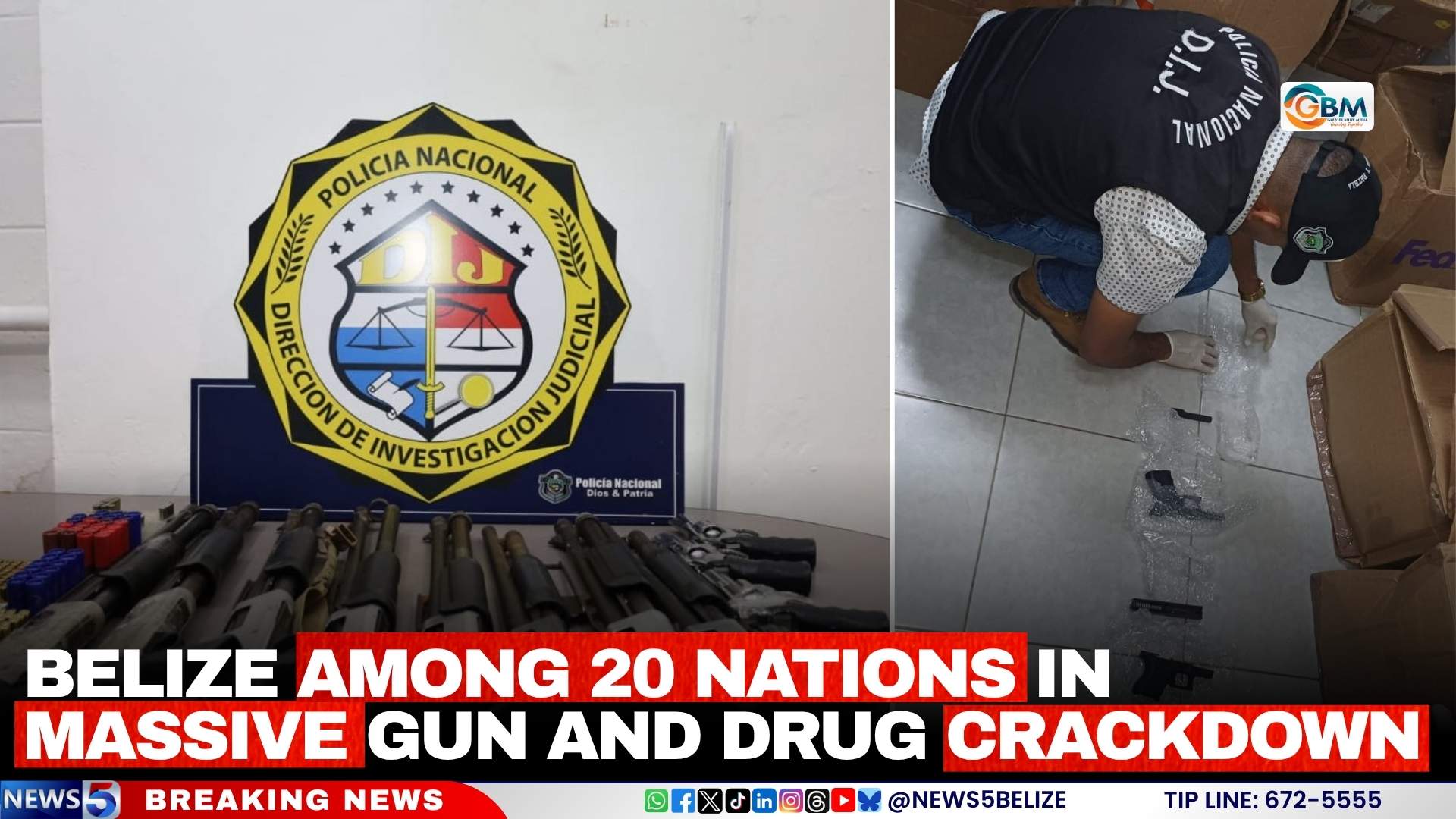
In a landmark six-week multinational law enforcement operation spanning 20 countries across the Americas and the Caribbean — including Belize — authorities have taken down thousands of criminal suspects and seized a massive stockpile of illegal weapons, narcotics and contraband, in one of the largest coordinated anti-trafficking operations in recent regional history.
Coordinated by international police body INTERPOL, with strategic backing from the Organization of American States (OAS) and financial support from the European Union, Operation Orca XI ran between October and November 2025, with official results of the crackdown announced publicly on May 26, 2026. By the end of the operation, law enforcement teams had recorded 8,701 arrests linked to organized crime and illicit trafficking. Beyond arrests, officers confiscated more than 3,300 unregistered firearms, nearly 200,000 rounds of ammunition, 210 suspected criminal vehicles, and $256,025 in undeclared cash linked to trafficking activity. The largest seizure by weight was 56 metric tonnes of illegal narcotics, destined for distribution across regional and global black markets.
Unlike disjointed unilateral enforcement actions, Operation Orca XI was deliberately designed to target the shared trafficking corridors that transnational gangs and organized criminal networks rely on to move weapons, drugs, and even trafficked people across open regional borders, the OAS confirmed in its official press release announcing the results.
Belize was one of 20 contributing nations from across Central America, South America and the Caribbean. The full list of participating partner countries also includes Bolivia, Brazil, Chile, Colombia, Costa Rica, the Dominican Republic, Ecuador, El Salvador, Guyana, Guatemala, Honduras, Mexico, Nicaragua, Panama, Paraguay, Peru, Suriname, and Uruguay.
OAS Secretary General Albert R. Ramdin framed the operation as a clear demonstration of the power of coordinated hemispheric security action. “This is what success looks like when hemispheric coordination and world-class technical and operational capacity join forces: thousands of firearms off the streets, drugs seized, and safer communities,” Ramdin said in his statement. “Operation Orca XI proves that international cooperation and information sharing get results, and our security frameworks must continue delivering. The OAS stands ready to continue supporting member states with partners like INTERPOL.”
INTERPOL Secretary General Valdecy Urquiza echoed that commitment, emphasizing that the evolving nature of transnational crime requires constant adaptive cooperation. “INTERPOL’s commitment remains to support law enforcement agencies with the intelligence, tools and coordination they need to stay ahead of these evolving threats,” Urquiza added.
Operation leaders also noted that the scale of seizures and arrests exposes just how interconnected transnational criminal networks have become across the region, highlighting the ongoing need for sustained cross-border collaboration to disrupt illicit trafficking activity.