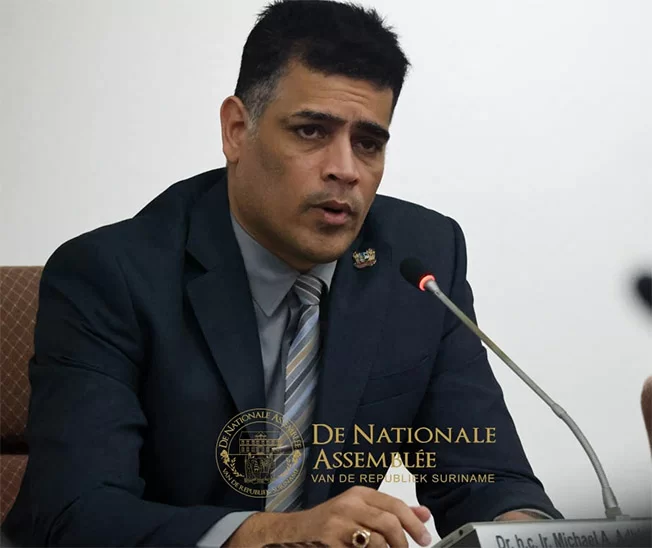
A new push for greater parliamentary transparency is underway in Suriname, where National Assembly Speaker Ashwin Adhin has reaffirmed that all commission meetings of the legislature will be open to the public by default, with secrecy only imposed when explicitly mandated.
Adhin outlined the new framework in an interview with local outlet Starnieuws, emphasizing that public access to parliamentary work is a constitutional starting point for Suriname’s democratic process, and that greater transparency toward the general public remains a key priority to strengthen. To advance this goal, Adhin confirmed that party leaders and internal parliamentary administrative bodies are currently holding discussions to remove barriers holding back broader public access to commission meetings. He added that commission chairmen are being prepared for the new operating model, and he will personally oversee high-stakes sessions when necessary to ensure compliance with the new open access rules.
The renewed discussion on parliamentary openness comes on the heels of recent high-profile hearings over the legislation on the indictment and prosecution of elected political officials. Former minister Bronto Somohardjo publicly requested an open public hearing for his case, a request that was granted, while closed-door hearings were held earlier for two other former government officials, Riad Nurmohamed and Gillmore Hoefdraad. The discrepancy in access for these high-stakes proceedings sparked renewed public debate about the rules governing parliamentary meeting openness.
To clarify the legal foundation for the new default of open access, Adhin cited Article 82 of Suriname’s Constitution, which explicitly states that all meetings of the National Assembly are public, with closed-door sessions only allowed in exceptional cases formally approved by the body. He also referenced the National Assembly’s Rules of Procedure to back the new framework: Article 26 of the rules states that preliminary investigations conducted by parliamentary commissions are not automatically confidential, and secrecy is only required when explicitly ordered by the full National Assembly, the national government, or a special general committee. Article 28 of the rules further explicitly allows commissions to hold open public meetings when coordinated with the Speaker’s office.
Adhin stressed that clarifying the legal foundation of open access is critical for future cases, particularly to set clear expectations for future requests for secrecy, as well as for legal representatives and all parties involved in parliamentary proceedings. He reaffirmed that the core principle guiding Suriname’s legislature should be that as much parliamentary work as possible is conducted in public view.
Practical implementation of the expanded open meeting policy will begin this week, with working groups drafting detailed procedural guidelines starting Tuesday. This is not the first time Suriname’s National Assembly has experimented with public commission meetings: the first pilot of open sessions launched in October 2016 during the speakership of Jennifer Simons, giving the public direct insight into how legislation is drafted and how the parliament operates. During the tenure of former Speaker Marinus Bee, the legislature launched an evaluation of the open meeting program to identify areas for improvement ahead of a broader rollout.