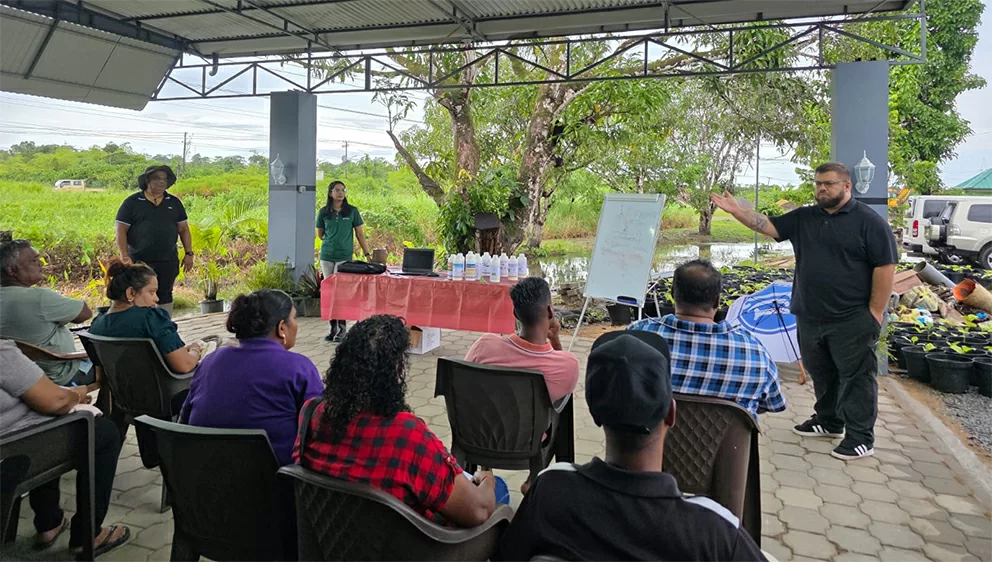
On May 23, a hands-on training program focused on modern crop protection strategies and innovative agricultural technology wrapped up in Para District, bringing new practical skills and sustainable production insights to 31 farmers from Uitkijkpolder and surrounding areas. Designed to boost both productivity and environmental sustainability in local agricultural production, the program was jointly organized by four stakeholders: Frits Fresh Impex, RamBhai Impex, HJ-Agro N.V., and the WUSC Sustainable Agriculture in the Caribbean Project. The entire training session was hosted on the personal plot of experienced agricultural expert Frits Bechoe, located along Ds. Martin Luther Kingweg.
Unlike traditional classroom-only agricultural training, the program integrated theoretical instruction with on-site field practice, giving farmers the chance to translate new knowledge directly into actionable skills. Agronomist Shaniza Pirbux led the first segment of the training, delivering a detailed walkthrough of the safe and responsible application of crop protection products. She emphasized several core practices that are often overlooked by small-scale local producers: accurately reading chemical labels to understand usage requirements, measuring precise dosages to avoid over-application that harms both soil and produce, using required personal protective equipment to safeguard farmers’ health, and implementing rotation strategies to prevent pests and pathogens from developing resistance to common control measures.
Even steady rainy weather did not dampen participants’ enthusiasm for hands-on learning. After completing the indoor theoretical session, the entire group moved out into the field to observe and practice the pest and disease control methods Pirbux outlined, working through real on-farm scenarios together to deepen their understanding.
In the second half of the training, Veldhuizen from GeoDrone Solutions introduced participants to the cutting-edge application of drone technology for precision agriculture. He explained how modern drones paired with specialized agricultural mapping software can quickly identify hidden drainage issues across large plots, map variations in soil moisture content, and pinpoint uneven crop growth that would be difficult to spot from the ground. This data-driven approach allows farmers to target water, fertilizer, and pest control interventions exactly where they are needed, cutting input costs while boosting overall crop yields. For participating smallholder farmers, exposure to this innovative technology opens up new pathways to transition to more efficient, sustainable production models that align with global and regional goals for low-impact agriculture.