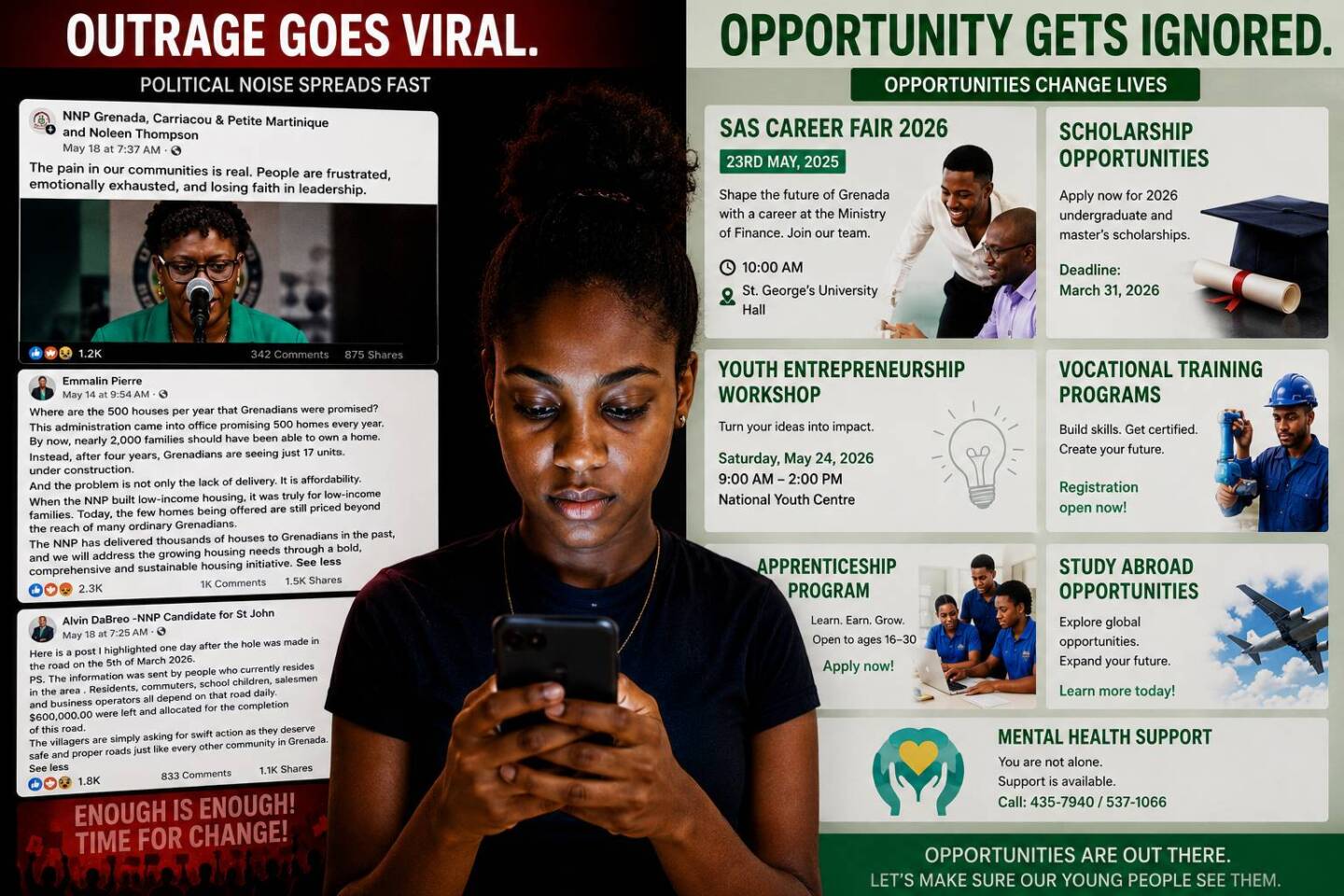
Across Grenada, contemporary political dialogue has coalesced around two pressing, growing challenges: rising hopelessness among young people and the ongoing fight for survival of the nation’s core productive sectors. In recent public remarks, opposition leaders – including St. David’s candidate Noleen Thompson and Opposition Leader Hon. Emmalin Pierre – have highlighted the deepening emotional and social unraveling impacting the country’s youth, as well as the grueling day-to-day survival struggle facing local farmers and working families.
Their concerns are not rooted in baseless criticism. From one end of the Caribbean to the other, households and producers are grappling with sustained economic pressure and pervasive feelings of long-term instability. But if this crisis is as severe as political rhetoric frames it, an uncomfortable but critical question demands asking: What responsibility do established political organizations and influential national leaders hold for actively connecting ordinary citizens to the existing opportunities that can improve their circumstances?
As a researcher who regularly tracks national legislative updates and administrative public notices, one consistent observation is impossible to ignore: the opportunities political discourse claims are out of reach are not imaginary. While political messaging centers heavily on accusations of disconnected policy planning and a collapsing economy, a recent review of national and regional agency programs reveals a consistent pipeline of legitimate, accessible pathways for skills training, higher education, and economic advancement already available in 2026.
A number of active, public resources posted to official government and regional agency boards rarely find their way into mainstream political discourse or public newsfeeds, for both youth and established producers:
For unemployed and underemployed young people, the Grenada National Training Agency (GNTA) is currently delivering vocational training placements to more than 160 youth out of work, while the Ministry of Education maintains open applications for fully funded international scholarships in China and other countries across the globe.
For local farmers, just this week the Ministry of Agriculture opened candidate applications for Agriculture and Fisheries extension assistant roles – positions created explicitly to bring on-the-ground technical guidance and climate resilience support directly to rural farming communities. The ministry has also allocated $500,000 for the second phase of the National Spice Replanting Programme, providing financial grants and tailored technical support to farmers operating holdings between 10 and 20 acres.
For small and micro business owners, the OECS Commission is preparing to launch the next round of its Regional MSME Matching Grants Programme, offering collaborative grants ranging from $100,000 to $150,000 USD for local fisheries operators and marine tourism small businesses. In tandem, the Grenada Development Bank’s Small Business Development Fund offers microloans up to EC$40,000 to help young entrepreneurs cover the cost of new equipment and inventory.
For producers focused on climate adaptation, the G-CREWS project and SAEP continue to offer specialized skills training and targeted grants for climate-smart agricultural practices and community rainwater harvesting infrastructure.
These opportunities do, in fact, exist. Yet far too many struggling young people and farmers never receive notification of these programs, or learn of application deadlines long after they have closed. This gap is not an accident – it is a product of how modern political communication operates in Grenada.
In recent years, national political discourse has become overwhelmingly centered on outrage. Political channels flood social media and news cycles with rapid-fire criticisms of government budgets and viral coverage of farmers facing financial ruin. While these stories highlight very real, serious challenges facing the country, practical information sharing about existing support programs has increasingly been pushed to the margins of political content.
Today’s political parties are far more than election campaign organizations – they function as the largest, most widely followed information hubs in the country, with tens of thousands of engaged followers across social and community networks. If political leaders truly believe that farmers are on the brink of collapse and that youth have lost all hope for the future, then systematic opportunity sharing should be a core part of political culture, not an afterthought added after a critical speech.
Widespread hopelessness is not only an emotional crisis. Often, it is an information crisis. A farmer who only hears political speeches about how unbearable the cost of living has become, but never receives a link or announcement for available agricultural grants or technical support programs, will inevitably begin to believe there is no path forward. When leaders frame public despair as a political talking point without sharing information about existing resources that can ease that hardship, we have to ask: Are we documenting the struggle to solve it, or are we just amplifying despair for political gain?
This critique does not target any single political party. Across the entire political spectrum, far more effort is invested in amplifying public despair than in systematically connecting citizens to existing pathways for advancement. While sharing a single link to a training workshop will not solve Grenada’s unemployment crisis overnight, it is a practical, immediate action that political leaders can take right now to advance national development. True leadership is not only about identifying critical problems – it is about helping ordinary people navigate the existing pathways to improve their own lives.
In a nation where so many young people feel uncertain about their futures, the information that leaders choose to amplify carries profound consequences. If political networks can mobilize public dissatisfaction with the current state of affairs, they certainly have the capacity to mobilize greater access to existing opportunity. Because a sharp political critique may win one news cycle, but sharing a life-changing opportunity can help build a stronger future for the entire country.