Nearly two weeks after unauthorized offshore dredging work along Belize’s Placencia Peninsula ignited widespread public outcry, local regulators and community leaders are still pressing for full accountability, with new details emerging about the scope of permit violations and ongoing uncertainty over what penalties the development firm will face.
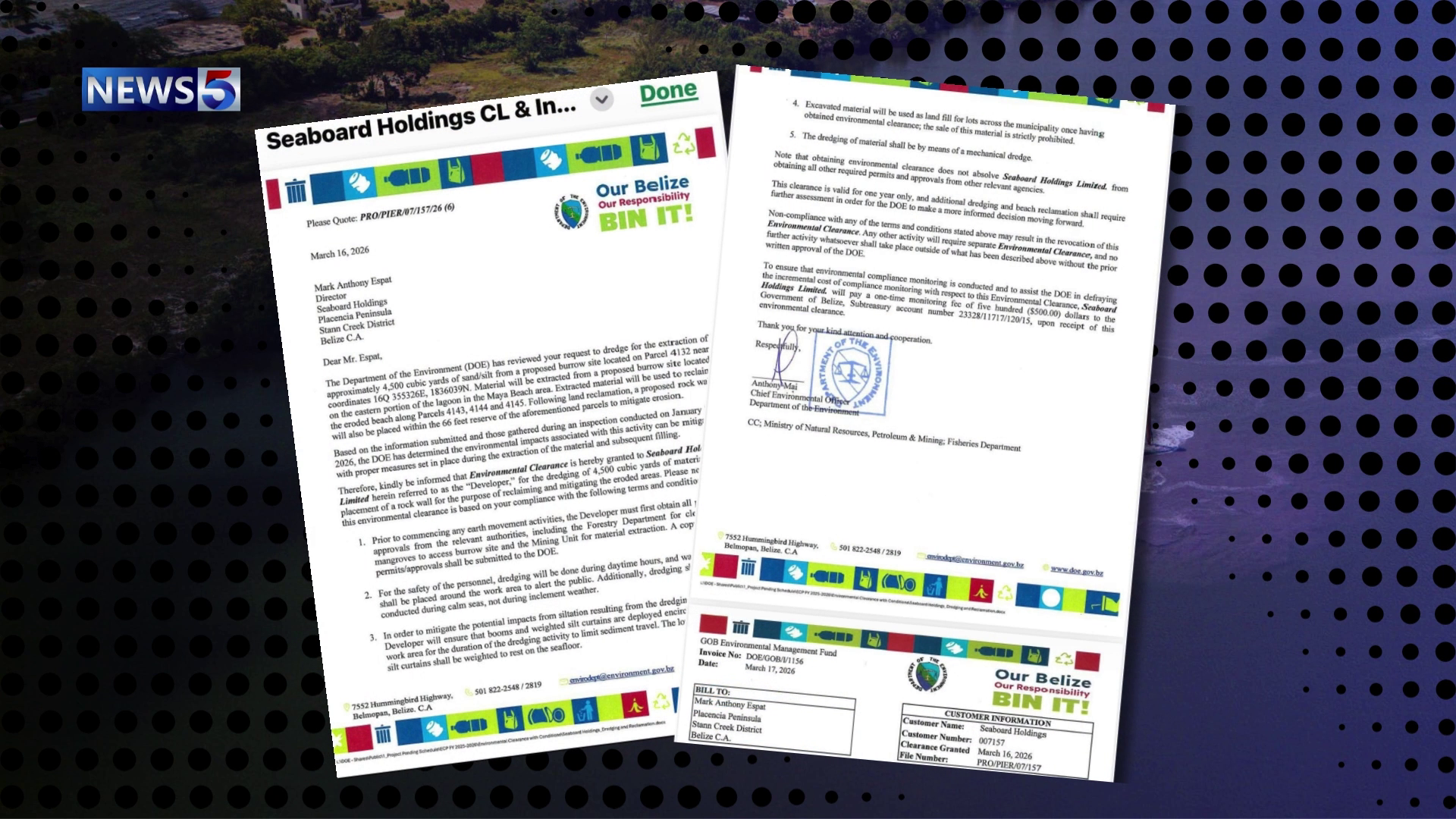
The controversy traces back to early 2026, when two separate government approvals were granted for the project. On March 16, Belize’s Department of Environment issued formal environmental clearance to Mark Espat, director of Seaboard Holdings and the country’s sitting Economic Ambassador. The clearance allowed the firm to extract 4,500 cubic yards of sand from the Placencia lagoon, with the material earmarked for restoring eroded shoreline along three privately owned parcels and constructing a retaining rock wall. More than a month later, on April 22, Belize’s Mining Unit issued a $650 quarry permit to Albert Loewen acting on behalf of Seaboard Holdings, with the permit set to remain valid through the end of 2026.
Despite the step-by-step approval process, Mining Inspector Michelle Alvarez confirmed in an official briefing this week that the developer blatantly violated core terms of the granted permit. One of the most significant breaches was the construction of an unapproved access road extending directly into the lagoon — work that was never authorized by the Mining Unit, and that has since been fully dismantled and removed per regulatory orders. Alvarez also confirmed that the firm extracted far more sand than the 4,500 cubic yard limit set in the permit. As a remedy for the over-extraction, the excess material, plus an additional 5% of the total permitted volume, will be donated to the Placencia local community.
Right now, the biggest outstanding question centers on what penalty Seaboard Holdings will face for the violations. Alvarez confirmed that a fine will be issued, but regulatory officials have not yet finalized the penalty amount. She also acknowledged a longstanding systemic issue: fines for permit violations of this nature are typically minimal under current Belizean law, leading to criticism that the current regulatory framework does little to deter non-compliance from developers.
Public criticism has also centered on the extremely low $650 cost of the dredging permit. Alvarez addressed that concern this week, noting that while she personally agrees the fee is far too low to reflect the environmental impact of the work, the fee schedule is set by national legislation, not by the Mining Unit itself. She added that the developer did complete all required formal steps to obtain both the environmental clearance and the mining permit before starting work, even though it later violated the terms of those approvals.
The Placencia Village Council has scheduled a public briefing this evening to revisit the controversy, answering community questions and reiterating ongoing concerns about unregulated offshore development and the enforcement of environmental protections along the peninsula’s sensitive coastline.