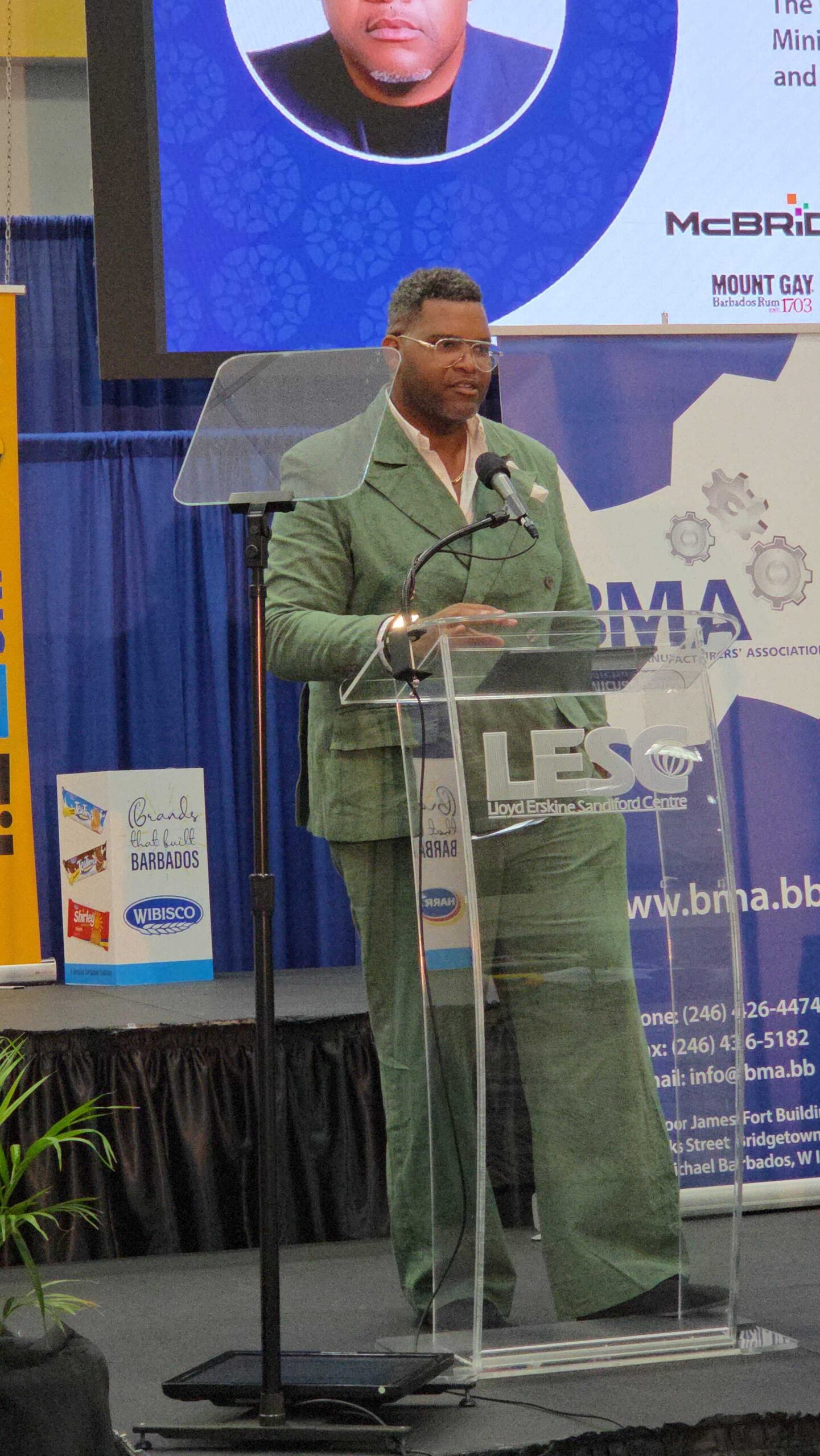
At the BMA’s annual State of the Industry conference, Barbados’ Minister of Industry Senator Jonathan Reid has issued a stark call to action, urging the small island nation to capitalize on a rapidly closing window of opportunity to reorient its economy away from dependence on imported technologies and toward building homegrown, globally competitive digital and AI-powered solutions.
Opening his address, Reid drew a clear line between his appearance at the conference and typical political events, noting he was eager to engage directly with the business community of practitioners who turn abstract ideas into tangible, on-the-ground results. Too often, he observed, policy discussions remain disconnected from real-world execution, but the conference attendees represented a network committed to bridging that gap between concept and impact. “We are standing at a unique historical juncture,” Reid told the audience. “More than ever before, we need to focus on turning bold ideas into market-ready products and solutions tailored to the demands of the new global economy.”
Reid pushed back against the long-held narrative that small island developing states are inherently constrained by their size, limited domestic populations, and small market footprints — limitations that have long shaped regional economic planning. The explosive growth of accessible digital tools and artificial intelligence, he argued, has fundamentally leveled the global playing field for small nations in a way never seen before.
“For the first time in human history, the most advanced technologies ever developed are literally in the pockets of nearly every one of our citizens,” Reid said, pointing to widely accessible generative AI platforms such as ChatGPT and Claude as examples of this new accessibility. “Generative AI puts a rocket ship of innovation in the hands of anyone with a smartphone. It lets small nations build solutions at a scale, speed, and quality that were unimaginable just a decade ago.”
Reid contrasted this current era of digital democratization with past industrial revolutions, where cutting-edge technologies such as aviation and mass manufacturing were out of reach for small territories, leaving them trapped in the role of passive technology consumers that could only produce lower-quality imitations of products developed in larger, wealthier nations. Today, that dynamic has been completely upended.
“A young innovator growing up in Grazettes or Crab Hill now has the exact same access to these transformative tools as a young creator in Singapore, San Francisco, or Toronto,” Reid noted. “That level of equal access is unprecedented for our country, and it changes everything.”
While Reid expressed deep optimism about the transformative potential of AI and digital innovation for Barbados, he did not shy away from his central concern: that the accelerating pace of global technological advancement means the window for Barbados to claim its place as an innovator is closing quickly. If the nation delays strategic action, he warned, the gap between Barbados and early-adopting countries will widen, making catch-up nearly impossible.
To capture this opportunity, Reid called for a fundamental rethink of Barbados’ core economic philosophy. Traditional economic frameworks are built around managing scarcity, but modern digital technology has created a new reality defined by abundant information and capability. Navigating this new landscape, he argued, requires deliberate, strategic decision-making tailored to Barbados’ unique context, rather than relying on outdated economic models.
Drawing on the work of Nobel Prize-winning economist Paul Romer’s theory of endogenous growth, Reid urged Barbados to leverage its own distinct domestic assets to carve out a role in global markets, rather than merely reacting to external economic shocks. He also referenced venture capitalist Mark Andreessen’s post-pandemic manifesto *It’s Time to Build*, warning against a complacent “warehousing” mentality that prioritizes replicating existing foreign technologies over nurturing original, homegrown innovation.
Reid highlighted several pressing domestic challenges — including rising rates of non-communicable diseases, the urgent need for climate resilience, and improving small-scale local mobility — as untapped opportunities to develop scalable solutions that can be exported globally. He pointed to early progress already underway: Barbadian food manufacturers are already advancing cutting-edge work in food science and nutrition, while local logistics firms are innovating new approaches to supply chain optimization amid ongoing global disruptions.
Reid emphasized that Barbados’ longstanding commitment to people-centered development puts the nation in a unique position to lead responsible AI experimentation. “Our approach to AI will always be rooted in advancing quality of life for our people, and that model can be a lesson for the rest of the world,” he said. “There is no reason for our productive or industrial sectors to fear this transformation. The government will walk alongside every stakeholder to make this transition smooth.”
The minister also announced a shift in how his government department will engage with the private sector: moving beyond a purely regulatory role to become an active, value-creating partner for innovators and builders. “Our goal is to become creators of the new,” Reid said. “Being a small nation does not bar us from building world-class technologies and sharing them with the globe. It simply means we have to be strategic, focused, and urgent in how we pursue this transformation.”