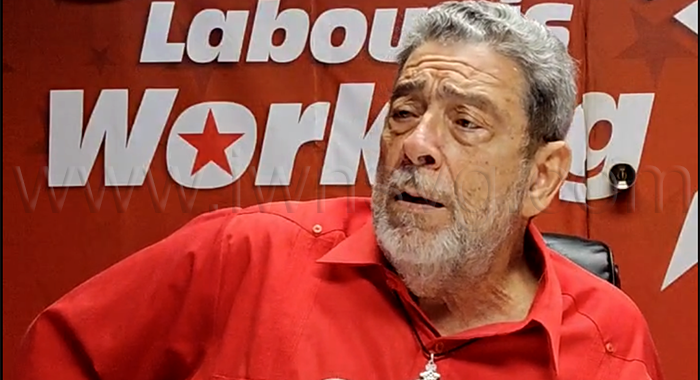
A controversial fast-track promotion of a former partisan political official to a senior leadership role in the Royal St. Vincent and the Grenadines Police Force is at the center of growing political tension, with opposition leader Ralph Gonsalves labeling the plan entirely unacceptable and warning it will deepen what he calls systemic partisan infiltration of the national constabulary.
National Security Minister St. Clair Leacock first made public Brenton Smith’s planned promotion as part of a broader reshuffle of the police force’s top command on Wednesday. Smith’s path to this anticipated senior appointment traces back to 2021, when he was one of hundreds of public sector workers terminated under Gonsalves’ Unity Labour Party (ULP) government, which enforced a COVID-19 vaccine mandate that removed unvaccinated public employees from their posts.
After his dismissal, Smith stepped into a top partisan role, serving as general secretary of the then-opposition New Democratic Party (NDP). Following the NDP’s landslide general election victory on November 27, the new administration fulfilled a campaign pledge to reinstate all workers dismissed under the previous government’s vaccine mandate, restoring their full employment benefits. Smith returned to his role in the police force as part of this policy.
What makes Smith’s planned promotion extraordinary is the size of the rank jump: instead of advancing sequentially through the traditional hierarchy of assistant superintendent and superintendent, he will move directly from his current rank of inspector to the senior position of assistant commissioner of police (ACP), skipping three intermediate ranks entirely. On Wednesday, Gonsalves addressed the plan during a caller segment on his popular weekly radio show *Morning Comrade*, broadcast on Star FM, after a listener cited Leacock’s announcement that Smith would also be tapped to lead critical human resources operations within the force.
Gonsalves stressed that his criticism centers on institutional principle, not a personal attack on Smith. He emphasized that the proposed leap would be an unprecedented break from longstanding police protocol and fundamentally unfair to veteran officers who remained in service and climbed the ranks gradually while Smith left to pursue full-time partisan political activity.
“I have no objection to him returning to his post — other workers dismissed under the mandate were reinstated, and that is the policy the new government put in place, that is their right,” Gonsalves said. “But there is no justification for moving him straight from inspector over multiple intermediate ranks directly to the ACP. You simply cannot skip assistant superintendent, superintendent, and all the intervening steps to land at a senior command post. I do not believe the public of this country will accept this unfair outcome lightly.”
The opposition leader warned that if the promotion moves forward, it will trigger significant unrest both among the general public and within the rank-and-file of the police force. “Vincentians have a deeply held belief in fairness in public service,” he noted. “When the public sees an unfair appointment, they will speak up. And serving officers who have spent decades working their way up the ranks will also object to this. This decision will carry major repercussions, far-reaching repercussions.”
Gonsalves called on the independent Police Service Commission (PSC), which holds formal authority to approve senior police appointments, to reject the plan, saying he would be gravely disappointed if the body endorsed the accelerated promotion. “I know the chairman and all members of the PSC personally, and I cannot imagine that, with proper legal and procedural advice, they would endorse such an irregular decision. This is fundamentally a question of merit and seniority. There are only four ACP posts in the force, and when vacancies open, appointments should go to officers who have worked their way up through the system, not to former political officials who just returned to the force.”
Gonsalves drew a clear distinction between Smith’s proposed promotion and the planned elevation of two other senior officers, Trevor “Buju” Bailey and Dwayne Bailey, who are set to be promoted to deputy commissioner of police. He stated he holds the Bailey brothers in high professional regard, noting that their promotions follow traditional hierarchical advancement: Dwayne Bailey was promoted to superintendent by the PSC during the ULP administration, and Trevor Bailey already holds the ACP post, so his elevation to deputy falls well within normal procedural bounds.
“The promotions for the Bailey brothers are completely reasonable and aligned with constitutional and regulatory frameworks, which outline the prime minister’s role in appointing commissioner and deputy commissioner posts,” Gonsalves explained. “Smith’s jump is on an entirely different footing — it combines an unprecedented accelerated promotion with recent full-time partisan political activity with the ruling party.”
Gonsalves also questioned the procedural decision to have the sitting national security minister announce individual senior promotions, rather than releasing the announcement through the PSC, the body legally responsible for police personnel decisions. “I held the national security portfolio and oversaw the police force for years under the ULP government, and I have never seen a sitting minister personally announce individual promotions of this sort. This makes clear that the entire police force is now being politicized from the top down, after the NDP took office in November,” he added.