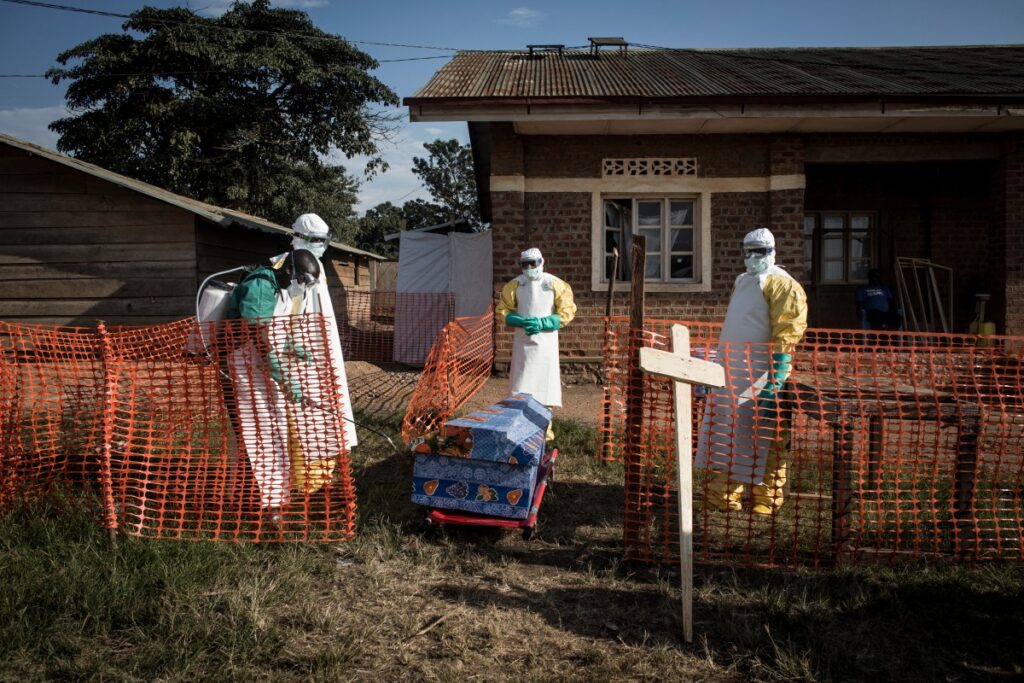
KINSHASA, DR Congo – A newly declared Ebola outbreak in the northeastern region of the Democratic Republic of the Congo has triggered urgent international public health alarm, driven by a particularly dangerous strain with no approved vaccine or targeted treatment and a death rate that can climb as high as 50 percent, the country’s health minister announced Saturday.
Speaking at a press briefing in the national capital Kinshasa, Health Minister Samuel-Roger Kamba confirmed that the outbreak is caused by the rare Bundibugyo strain, a variant first documented in 2007 that currently lacks any licensed immunization or specific antiviral therapy. Unlike the more common Zaire Ebola strain – identified in 1976, which has a higher 60 to 90 percent fatality rate but benefits from existing authorized vaccines – the Bundibugyo variant leaves health responders with far fewer tools to contain transmission and treat infected patients.
Updated official figures released Saturday put the death toll at 80, up from the 65 fatalities reported publicly just 24 hours earlier. Out of 246 total suspected cases recorded so far, authorities have already recorded one death outside DRC’s borders: a 59-year-old Congolese national who died in the Ugandan capital Kampala earlier this week, following admission for Ebola-like symptoms. Ugandan health ministry officials confirmed late Friday that post-mortem testing identified the Bundibugyo strain as the cause of death, and the victim’s remains were repatriated to DRC the same day.
The Africa Centres for Disease Control and Prevention confirmed the new outbreak Friday, noting it is centered in DRC’s Ituri province, a northeastern region that shares porous borders with both Uganda and South Sudan. Public health experts warn that frequent unregulated cross-border population movement in the affected area dramatically increases the risk of the outbreak spreading beyond DRC’s borders, amplifying the global public health threat.
According to Minister Kamba, the outbreak’s index case – or patient zero – was a nurse who first presented to a health facility in Bunia, the capital of Ituri province, on April 24 with classic Ebola symptoms: high fever, internal and external bleeding, and vomiting. This marks the 17th recorded Ebola outbreak to hit the DRC since the virus was first discovered, and the acting director of the U.S. Centers for Disease Control and Prevention, Jay Bhattacharya, characterized the event as a large-scale outbreak that requires immediate coordinated action.
Ebola is a deadly viral hemorrhagic fever believed to originate in fruit bat populations, spreading between humans through direct contact with infected bodily fluids or contaminated biological materials. Symptoms only develop after an incubation period that can last up to 21 days, and infected people only become contagious once symptoms appear. In severe cases, the virus causes widespread organ failure and uncontrolled bleeding, with historical mortality rates ranging from 25 percent to 90 percent depending on the strain and access to care.
Over the past 50 years, Ebola outbreaks across Africa have killed roughly 15,000 people, even as medical research has delivered new vaccines and treatments for the most common Zaire strain. DRC’s last outbreak, declared in August 2023 in the country’s central region, killed 34 people before it was declared fully contained in December 2023. The deadliest Ebola outbreak in DRC’s history, recorded between 2018 and 2020, claimed nearly 2,300 lives.
The World Health Organization has already sounded the alarm over the unfolding crisis, noting deep uncertainty around the scope of community transmission and the inherent severity of the disease. The agency is moving quickly to deploy critical supplies, planning to airlift roughly five tonnes of medical equipment including personal protective equipment and infection prevention gear from Kinshasa to the affected region. Even with this urgent response, logistical challenges remain steep: DRC is home to more than 100 million people, spans an area four times the size of France, and suffers from extremely underdeveloped transportation and communications infrastructure that complicates rapid large-scale public health action.