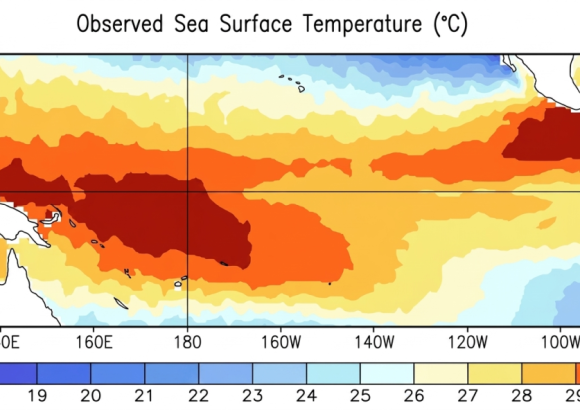
Two leading climate forecasting bodies have raised a high-confidence alert that a new El Niño event will develop in the Pacific Ocean by mid-2026, with researchers and United Nations agencies warning that the climate phenomenon could exacerbate existing food insecurity and push millions of already vulnerable people deeper into crisis across the Americas.
El Niño, defined as a sustained abnormal warming of Pacific Ocean surface waters that reshapes global weather patterns, has an 82 percent probability of emerging between May and July 2026, according to an official forecast released Thursday by the U.S. National Weather Service Climate Prediction Center (NWS-CPC). The agency added that there is an even higher 96 percent chance that El Niño will persist through the 2026–2027 winter in the Northern Hemisphere, lasting until at least February 2027.
Forecasters at NWS-CPC trace the expected development of the event to two key current oceanic and atmospheric conditions: record-warm temperatures in the equatorial Pacific’s subsurface layers, and unusual low-level westerly wind patterns across the western equatorial Pacific that have already spread to the central and east-central Pacific.
While the high probability of El Niño’s arrival is clear, forecasters have noted that its final intensity remains uncertain. The strongest recorded El Niño events all exhibited robust ocean-atmosphere coupling during the Northern Hemisphere summer, a key precursor that has yet to be confirmed for the 2026 event. Even if a strong event does develop, forecasters emphasize that intensity does not guarantee extreme impacts—it only raises the likelihood of disruptive weather outcomes.
The alert has already been circulated by national meteorological leaders across the Americas, including Gloria Ceballos, director of the Dominican National Institute of Meteorology (Indomet), who shared the forecast with the public via her official X social media account.
Beyond climate forecasting, three major United Nations food security agencies have warned that the impending El Niño poses substantial risks to vulnerable populations across the region, at a time when the climate crisis and global price hikes have already stretched livelihoods thin. Ahead of the forecast, the Food and Agriculture Organization (FAO), International Fund for Agricultural Development (IFAD), and World Food Programme (WFP) convened discussions on early preparedness, proactive intervention, and long-term resilience building to counter extreme weather shocks.
Current regional data underscores the depth of pre-existing vulnerability: across the Americas, more than 33 million people already face chronic hunger, 167 million experience moderate to severe food insecurity, and over 181 million cannot afford nutritionally adequate diets. The region also bears 22 percent of global economic losses from agriculture-related disasters, totaling more than $713 billion in cumulative damage.
In a joint warning, the three agencies stated that El Niño will likely worsen this precarious situation. The phenomenon is expected to worsen drought conditions across Central America’s Dry Corridor, an already poverty-stricken arid region that is extremely susceptible to climate shocks, while also disrupting rainfall and temperature patterns across the entire hemisphere. These disruptions could push tens of thousands more vulnerable families into food insecurity and chronic poverty, the agencies warned, stressing the urgent need for early action to mitigate harm.