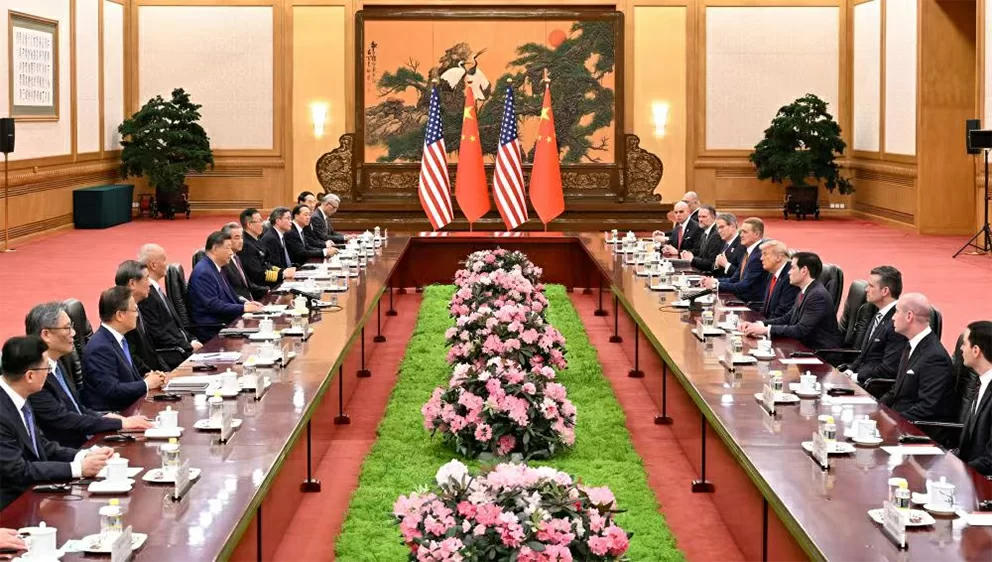
On Wednesday, former U.S. President Donald Trump launched an official state visit to China, opening a full day of high-stakes diplomatic talks with Chinese President Xi Jinping that touched on everything from bilateral cooperation to sensitive geopolitical issues.
The visit opened with a ceremonial welcome, including a formal military review held at Beijing’s Tiananmen Square, setting a solemn tone for the discussions between leaders of the world’s two largest economies. During opening remarks, both heads of state underscored their shared commitment to building a stable, constructive, and strategic bilateral relationship, even as they addressed long-standing points of disagreement.
President Xi opened his remarks by acknowledging the growing uncertainty and rapid transformation reshaping today’s global order, posing two fundamental questions that frame the future of U.S.-China ties: Can the two nations co-develop a new model of relations between major global powers? Can they set aside differences to collaborate on pressing transnational challenges and bring greater stability to the world? Xi expressed hope that working with Trump would turn 2026 into a historic milestone for advancing bilateral relations.
On the topic of economic cooperation and trade, negotiation teams from both sides reached positive, actionable outcomes. Xi emphasized that even amid existing differences and tensions, dialogue rooted in equality and mutual respect has delivered tangible results. He reaffirmed that U.S. companies have long played a key role in China’s reform and opening-up process, and that the Chinese market will only grow more accessible to American businesses moving forward. “China welcomes deepened mutually beneficial cooperation between the United States and China,” Xi stated, noting that the door of China’s market will keep opening wider to foreign, and particularly American, enterprises. He added that the framework of a “constructive, strategic, and stable relationship” agreed by both leaders is no empty slogan, but a concrete roadmap to guide bilateral ties in the coming years, with core goals of sustaining long-term peace, keeping differences manageable, and delivering fruitful collaboration.
For his part, Trump called the state visit a tremendous honor, offering warm praise for Xi Jinping and the Chinese people. He described the current U.S.-China relationship as the strongest it has ever been, and reiterated his commitment to resolving outstanding differences through dialogue while deepening cross-border cooperation. Trump was accompanied by a delegation of senior American business leaders, who publicly expressed their confidence in the long-term potential of the Chinese market during the visit.
Beyond economic and trade issues, the two leaders exchanged in-depth views on a range of pressing regional and global issues, including the ongoing conflict in Ukraine, tensions in the Middle East, and security on the Korean Peninsula. Both leaders also expressed mutual support for each other’s presidencies of this year’s APEC and G20 summits, signaling alignment on advancing multilateral cooperation this year.
One of the most sensitive topics on the meeting agenda was the Taiwan question. Xi emphasized that the issue of Taiwan remains the most core and consequential topic in U.S.-China relations, and requires careful, prudent handling to avoid escalation and open conflict. “Taiwan independence and peace across the Taiwan Strait are mutually exclusive,” Xi warned.
To wrap up the official day of talks, Xi hosted Trump for a symbolic visit to the Temple of Heaven, a historic imperial complex in central Beijing that dates back to the Ming and Qing dynasties, where emperors once held rituals to pray for national peace and bountiful harvests. The cultural outing was widely interpreted as a symbolic gesture representing the two nations’ shared desire for peace, mutual understanding, and collaborative progress.