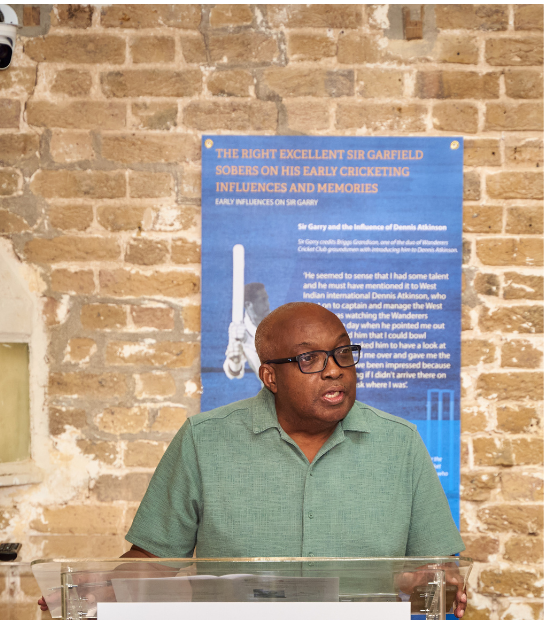
A leading historian from one of the Caribbean’s most prominent academic institutions has laid out a bold blueprint for Barbados’ long-term prosperity, calling for sweeping shifts in higher education training, urgent action to reverse democratic decline, and a renewed commitment to teaching national history across the country’s school system.
Dr. Henderson Carter, who leads both the History Department and the Faculty of Humanities and Education at the University of the West Indies Cave Hill Campus, delivered his vision during the annual Dean’s Lecture, hosted by the St Michael Centre for Faith and Action. Titled *Movers and Shakers: Activism for Democracy Building*, his address centered on the urgent need to build a more resilient, inclusive nation for current and future generations of Barbadians.
Carter’s first key proposal targets a fundamental gap in Caribbean higher education: a lack of training focused on entrepreneurship and self-employment. Instead of directing graduates solely toward traditional job hunting, he argues universities must reframe curricula to teach students how to turn their academic skills and degrees into sustainable self-employment and new business ventures. He points to diverse examples across disciplines to illustrate this potential: a biology or chemistry graduate could launch a biotech startup, an agricultural consulting service, or a sustainable food production enterprise, while a history graduate can monetize their expertise by developing well-researched scripts for feature films, streaming docuseries, and historical documentaries, which command growing global demand. Carter also notes that graduates need clearer pathways to access startup financing to turn these ideas into viable operations, a critical support system currently missing from many higher education outcomes strategies.
Beyond education reform, Carter identified three pressing systemic challenges Barbados must confront to secure its democratic future. The first is widespread voter apathy, which he describes as a critical threat to the country’s democratic foundations. From growing numbers of eligible voters choosing to stay home on election day to the emergence of paid vote-buying, Carter emphasizes these trends cannot be ignored and require intentional, collective action to reverse. The second challenge is weak institutional responsiveness across both public and private sector entities. Carter stressed that delayed, unresponsive service from institutions undermines public trust and weakens national stability at every level. “Institution-building starts with individual accountability,” he explained, noting that even frontline staff and senior leaders have a role to play in prioritizing timely responses to public, student and stakeholder needs. “If your institutions are unresponsive and weak, your nation will be weak as a result,” he said.
The third critical gap Carter highlighted is the erosion of historical education across Barbados’ primary and secondary school system. Walking audiences through centuries of the island’s history, from the mass resistance of enslaved people to the decades-long work of national heroes that shaped modern Barbados, Carter argued that widespread gaps in historical knowledge pose a direct danger to national identity. He emphasized that history must be restored as a core subject in schools, warning that it is unacceptable for children to complete the national education system without ever engaging deeply with their country’s past.
Pointing to the rusted shackles featured on the monument at Barbados’ Heroes Square, Carter noted this public memorial is a vital, tangible reminder of the island’s history of chattel slavery, a past that was long erased from public landscapes across the country. “For generations, you could travel across the entire island and find no public marker acknowledging that slavery ever existed here. That is an inherently dangerous omission,” he argued. “Children grow up never seeing tangible evidence of this history, and without that reminder, we risk repeating the injustices of the past. We have to remember the slave society that once shaped Barbados to ensure it can never happen again.”