Following the Free National Movement’s (FNM) humbling defeat in last Tuesday’s general election in the Bahamas, internal divisions have erupted over the future of party leader Michael Pintard, with a senior former party official calling for his immediate resignation in line with longstanding political tradition.
The election delivered a second consecutive consecutive term to the incumbent Progressive Liberal Party (PLP), while the FNM secured only eight out of 40 contested parliamentary seats – a result that nearly mirrored the party’s historic poor performance in the 2021 poll. While Pintard managed to hold onto his own Marco City constituency, he has so far declined to confirm whether he will step down, noting only that he will consult with his inner circle in the coming days to determine his next move.
Despite minor gains for the FNM, which flipped the Freetown and MICAL seats from the PLP, the party lost its hold on St Barnabas, leaving it badly outnumbered in the new parliament. The election also brought an unexpected shakeup: the upstart Coalition of Independents performed far stronger than predicted against FNM candidates, particularly across multiple constituencies in New Providence, signaling growing voter discontent with the established opposition party.
Opinions within the FNM’s senior ranks are deeply split on how to move forward. Some top officials have privately argued that Pintard should stay on in the interim to keep the party stable until a formal leadership convention can be called. Others, however, are pushing for an immediate exit, arguing that new leadership is required to rebuild the party’s base and reignite supporter enthusiasm.
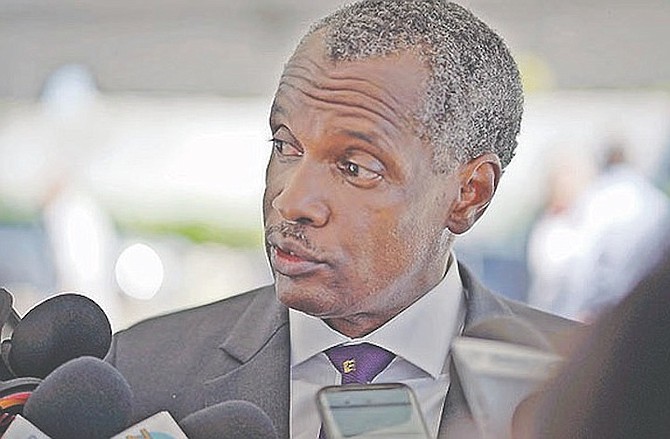
Desmond Bannister, the country’s former deputy prime minister and a long-time FNM figure, is the most prominent voice calling for Pintard’s departure. “The tradition in politics is that if you lose an election, you resign,” Bannister explained in comments this week. “That doesn’t mean that you don’t have a chance to come back at some stage.” He pointed to former FNM leader Dr Hubert Minnis, who stepped down after defeat and later launched a bid to retake the party leadership, as a well-known example of this precedent. Bannister added that stepping aside would not close the door on a potential future comeback for Pintard.
But FNM Secretary General Serfent Rolle pushed back against calls for an immediate resignation, arguing that it is far too early to pressure the leader out. He emphasized that the FNM has longstanding internal processes for addressing leadership questions, and party councils are already holding a series of meetings to assess the election result, review the party’s financial position and map out a path forward.
“We have to have a stable party, and that’s what I’m going to be fighting for,” Rolle said. “People want blood all the time because they like drama, and it’s all that. But nobody can die for that. It will happen. There will ultimately be a convention.”
As the party conducts its post-election internal review, key questions continue to swirl around why the FNM’s policy and campaign message failed to resonate with Bahamian voters. Carlyle Bethel, a former official with the FNM’s Torchbearers Youth Association, released a public statement calling for sweeping restructuring and generational renewal within the party, paired with an end to the infighting that has plagued internal operations. Bethel argued that the party’s long-time loyalists have been sidelined and treated as disposable for far too long, noting that a fundamental shift in party culture is non-negotiable.
Bannister echoed those criticisms, confirming that many long-time FNM supporters felt alienated by the current leadership team. “These are loyal FNM supporters who decided that they’d been alienated by the party,” he said. “Whether reasonable or not, they didn’t support the party in the election. These are people who campaigned for the FNM all their adult life. Many of them actually led the campaigns of PLP candidates who were successful.” Bannister stressed that the FNM must urgently develop a targeted strategy to rebuild trust and reconnect with supporters who have walked away from the party.
The former deputy prime minister also raised serious alarm over alleged widespread violations of electoral law during the campaign, including systemic vote buying and undue influence over voters. “I’m alarmed that almost every candidate I saw was breaking the law in terms of what benefits they give to voters,” he said, calling for the country to strengthen existing legislation banning voter inducements and improve enforcement of existing rules. Bannister specifically called on the FNM’s team of prominent lawyers to review whether legal challenges should be filed over irregularities in the Grand Cay and Moore’s Island constituencies, where the incumbent PLP government rolled out new benefits to voters just days before polling opened.
Bannister also gave credit to the PLP for running what he described as a masterful, well-resourced campaign, and urged the FNM to undertake a full review of how political parties structure their operations and prepare for national elections. He argued that leadership focused on policy development should not be tasked with managing election organization, adding that the FNM must become far more professional and efficient in its campaign operations to compete going forward.
He also noted that the relatively low voter turnout in the election suggests the PLP still holds only minority support among the overall electorate, with many voters choosing to stay home rather than back either the incumbent government or the FNM as a viable alternative.
With Pintard’s future uncertain, the FNM is widely expected to face a competitive leadership contest in the coming months. The eight FNM candidates who won their seats, in addition to Pintard, are J Leo Ferguson in MICAL, Lincoln Deal in Freetown, Kwasi Thompson in East Grand Bahama, Dr Andre Rollins in Long Island, Adrian White in St Anne’s, Frazette Gibson in Central Grand Bahama, and Michela Barnett-Ellis in Killarney. Bannister described the incoming group of FNM MPs as highly competent, noting that any of the newly elected lawmakers would be capable of serving as the party’s parliamentary leader.